

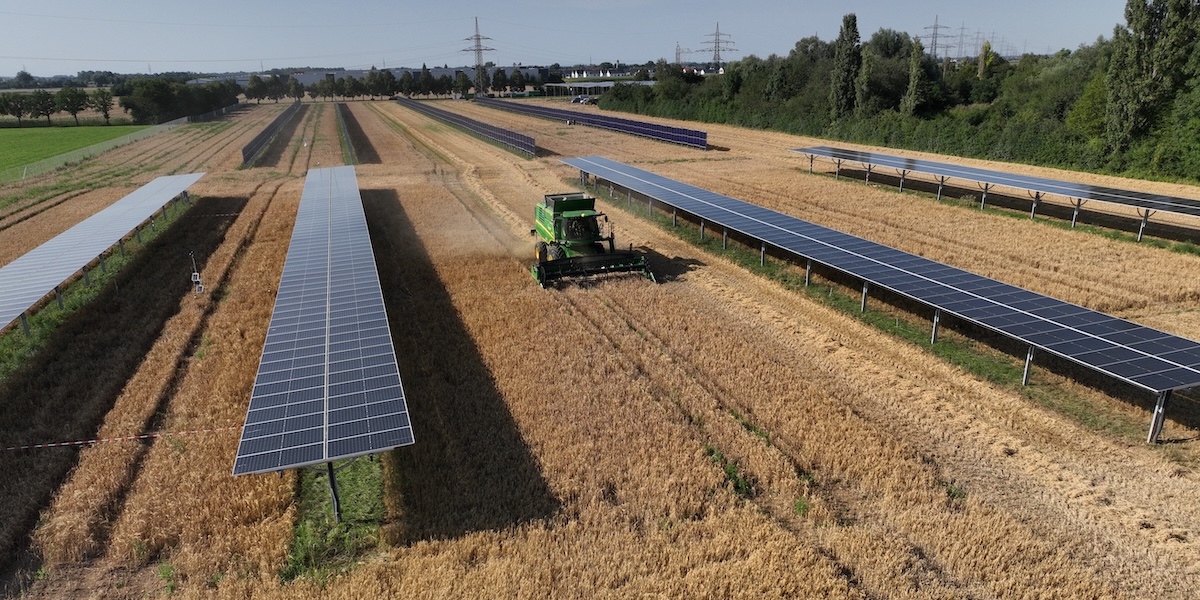
An industry analysis says agrivoltaic systems using trackers or vertical designs can outperform conventional solar energy in terms of both revenue and land use, questioning the conclusions of a recent German study.
According to a new analysis by Jochen Hauff, agricultural solar voltaics using tracking or vertical configurations can be financially viable and agriculturally beneficial when market revenues and land use efficiency are taken into account.
The argument is a response to a study by Germany’s Thünen-Institut that labeled agri-PV as economically questionable due to additional costs of up to 148% compared to conventional ground-mounted systems. Hauff said this figure only applies to elevated systems used in specialized applications such as orchards and not to cheaper configurations.
He also said the study focuses on levelized electricity costs, without taking into account market value: revenues from solar energy can be earned depending on when it is generated. This omission can distort project economics because investment decisions depend on both costs and expected revenues.
According to the Thünen study’s own data, vertical agricultural voltaic systems can have additional costs of as little as 4%, while tracker-based systems show costs approximately 12% to 13% higher than standard ground-mounted installations. Tracker systems follow the sun all day, while vertical systems produce more evenly in the morning and evening.
Hauff cited an analysis by the Institute for Energy Economics of the University of Cologne (EWI), which found that tracker systems achieved a 43% higher market value than fixed, south-facing installations in a modeled 2024 scenario in Brandenburg. The smoother generation profile can also improve grid utilization and reduce peak loads.
The analysis argues that vertical systems, while offering smaller market value gains than trackers, benefit from lower incremental costs, potentially making both configurations competitive with conventional solar when revenues are factored in.
Land use efficiency is another important factor. According to the Thünen-Institut study, a standard ground-mounted solar power plant can remove 1 hectare of agricultural land per generation unit. Vertical agri-PV reduces this to 0.4 hectares, while tracker-based systems reduce this to 0.2 hectares, allowing 60% to 80% of the land to remain in agricultural use.
Additional benefits cited include improved resilience to wind erosion, heavy rainfall and excessive solar radiation, as well as better soil moisture retention.
Hauff concluded that agrivoltaic energy should be seen as a tool to strengthen both economic and physical resilience in rural areas, and not as an expensive niche technology.
The views and opinions expressed in this article are those of the author and do not necessarily reflect those of the author pv magazine.
This content is copyrighted and may not be reused. If you would like to collaborate with us and reuse some of our content, please contact: editors@pv-magazine.com.
