

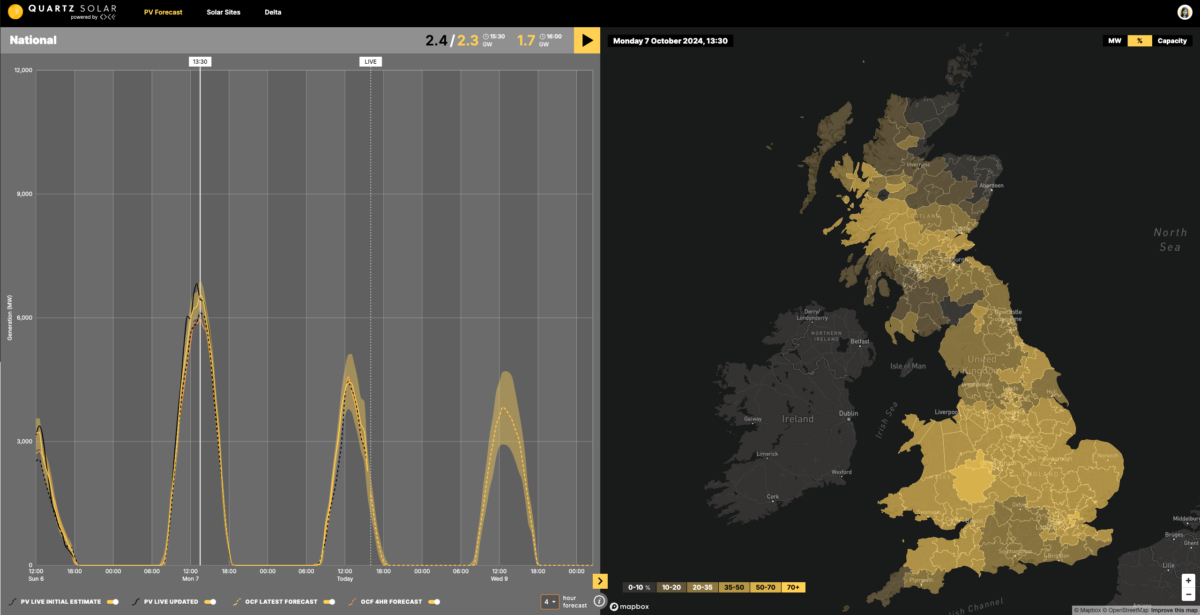
Open Climate Fix says its Quartz Solar tool will save the UK grid operator £30 million ($39 million) a year through more accurate forecasts, reducing the spare capacity needed to balance the electricity system. The non-profit company has used machine learning techniques with satellite, weather and historical generation data to reduce forecast errors by half.
A newly deployed AI-powered solar energy tool is expected to save the UK electricity grid millions of pounds in balancing costs by making more accurate predictions about solar power generation.
Quartz Solar from Open Climate Fix is now being used in the control room of the National Energy System Operator (NESO) to forecast PV generation and make decisions about how much spare capacity to purchase to ensure balanced supply and demand.
Since launch, Quartz Solar has halved forecast errors, according to Open Climate Fix, saving at least £30 million in imbalance costs per year, with the potential to rise to GBP150 million ($197.0 million) per year by 2035 if government solar capacity targets are met.
Developed in collaboration with NESO’s energy forecasting team, Quartz Solar combines machine learning, live satellite imagery and weather data to generate forecasts that are refined on a minute-by-minute basis. After extensive testing, the AI-powered tool is now fully integrated into NESO’s operations.
The forecasting tool uses machine learning techniques in combination with satellite images, weather data and historical PV data to predict solar generation within the same day and up to 36 hours in advance.
This is what a spokesperson for Open Climate Fix says pv magazine the non-profit company uses satellite data in twelve different spectral channels – that is, different wavelengths – that also provide a live view of clouds. This data includes infrared, visible terrain and water vapor.
Weather data comes from ECMWF and the UK Met Office and includes irradiation, temperature, wind speed and direction at multiple individual altitudes, air pressure, snow depth and cloud cover at multiple altitudes, and visibility.
Open Climate Fix uses PV Live as the main data source for PV generation. A spokesperson said the generation data is modeled at more than 1,000 locations and includes transmission and distribution data. “We believe this is the most accurate data source Britain currently has for solar energy generation data,” they said.
Quartz Solar provides NESO with a national forecast and a regional breakdown based on UK electricity supply points, covering approximately 300 locations.
According to Open Climate Fix, there are three main reasons why Quartz Solar has improved on previous forecasting methods used by NESO: the speed of updates, the variety of data sources, and a model that produces probabilistic results.
Traditional weather forecasting methods used by NESO are relatively slow, updating approximately every six hours. Open Solar’s machine learning-powered model is updated at 15-minute intervals, giving NESO’s control room a clearer view of changing patterns within the forecast.
Feeding the machine learning model with a wide variety of data sources to train its output has resulted in a higher level of accuracy, according to the spokesperson, and greater use of solar energy should lead to even more accurate predictions in the future. “The more data sources, the higher the accuracy. As UK solar capacity increases, the data sources will increase, further improving accuracy over time.”
The probabilistic outcome of the Open Climate Fix model PVNet produces a “most likely” scenario, as well as 90e and 10e percentile predictions, giving NESO control room engineers a broad view of the possibilities to inform decision-making.
There are potential applications for Open Climate Fix’s technology beyond the NESO control room, and a spokesperson confirmed that while the organization is committed to its nonprofit mission, it is exploring commercialization opportunities to fund further research. Open Climate Fix also wants to enter other markets in the future, such as the Netherlands.
Founded in 2019 by Jack Kelly, formerly of Google DeepMind, and Dan Travers, formerly of Origin Energy and SunGard, Open Climate Fix is a nonprofit organization dedicated to energy systems research. The British organization is working on a range of AI-powered energy system projects and the code is completely open source.
This content is copyrighted and may not be reused. If you would like to collaborate with us and reuse some of our content, please contact: editors@pv-magazine.com.
