Researchers in Sweden have developed an air-based photovoltaic-thermal system that can preheat ventilation air and domestic hot water, reducing district heating demand by as much as 16% for ventilation and 7% for hot water, while also reducing peak heating loads in cold Scandinavian climates.
A research team led by scientists from Sweden’s KTH Royal Institute of Technology has investigated the use of air-based photovoltaic thermal (Air-PVT) technology in Scandinavian climates.
“In a first phase, we are investigating Air-PVT, which is an unconventional solar technology to begin with. We wanted to show how upgrading from standard PV to Air-PVT in renovations can help reduce energy costs, improve the energy rating of buildings and increase property values, while adhering to any solar mandates in the future,” said corresponding author Giorgos Aspetakis. pv magazine. “At a scientific level, this research goes beyond theoretical modeling in the laboratory. It is based on real-world data from an operational Air-PVT prototype and a multi-family building in Stockholm, Sweden.”
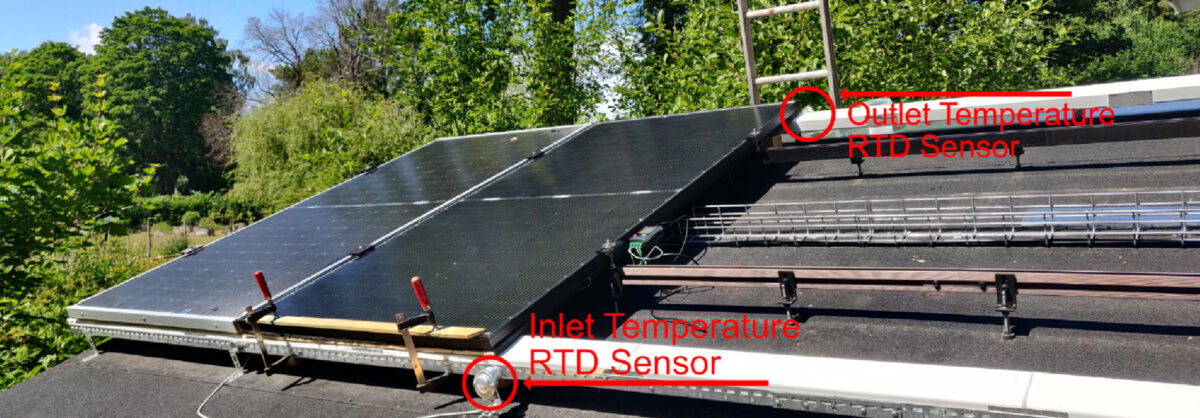
The Air-PVT prototype was tested in an apartment building in Stockholm, where it was used for both heat recovery ventilation (HRV) and domestic hot water (DHW).
Image: KTH Royal Institute of Technology, Applied Thermal Engineering, CC BY 4.0
The prototype was fabricated by attaching a backplate to a solar PV panel and drawing ambient air through a 14mm duct using negative pressure. The experimental system included air ducts, an air blower and measuring instruments. Continuous measurements were taken for 42 days during the summer and the simulation results for the same period were compared with the experimental data. Based on their validation results, the team was able to determine “that the models adequately validated the collector’s operation in practice.”
After validating the system, the group simulated its operation in a building with 56 apartments. Collaborating property owners provided schematics and equipment data sheets, along with sensor measurements, including temperature, pressure and volume flows, which were monitored over several years. The analysis focused on two main activities: preheating the cold water supply for tap water production in the summer and preheating fresh incoming ventilation air for the rest of the year. Two additional locations were selected to illustrate the effects of climatic conditions, namely Lund in southern Sweden and Umeå in the north.
“It was surprising to discover that heating domestic hot water using warm air, which sounds counter-intuitive, is actually feasible from a district heating peak reduction perspective,” said Aspetakis. “Another unexpected fact was that on some sunny winter days the Air-PVT was able to increase the incoming fresh ventilation air from 0 to 20 C.”
In addition, the system can reduce the annual demand for district heating for ventilation by 16% and for domestic hot water by 7%. The system also significantly reduces peak district heating demand for hot water, with an average reduction of 11% throughout the season and more than 50% on some days. Ventilation savings were similar in all climates, but frost reduction was less effective in northern Sweden. The slope of the panels had little effect, and vertical installation provided only minor additional heating benefits.
“The relative ventilation energy savings due to air PVT remained stable across different levels of heat exchanger efficiency,” the team concluded. “Units with an efficiency of less than 85% benefited the most in absolute terms. On the contrary, frost formation in the HRV system was reduced, especially in high-efficiency units, with a difference of up to 200 hours.”
Having worked primarily with heating systems in cold climates, Aspetakis says, his team now plans to “expand the scope to warmer regions and evaluate the potential of air PVT for solar cooling. We also plan to take a deep dive into the economics of the technology, to demonstrate viable business cases.”
The system was described in “Investigating airborne PVT for buildings in cold climates: experimentally validated energy system modeling”, published in Applied thermal technology. Researchers from Sweden’s KTH Royal Institute of Technology, installation and technical service provider Bravida Holding and construction solutions provider Uponor contributed to the study.
This content is copyrighted and may not be reused. If you would like to collaborate with us and reuse some of our content, please contact: editors@pv-magazine.com.
Popular content