

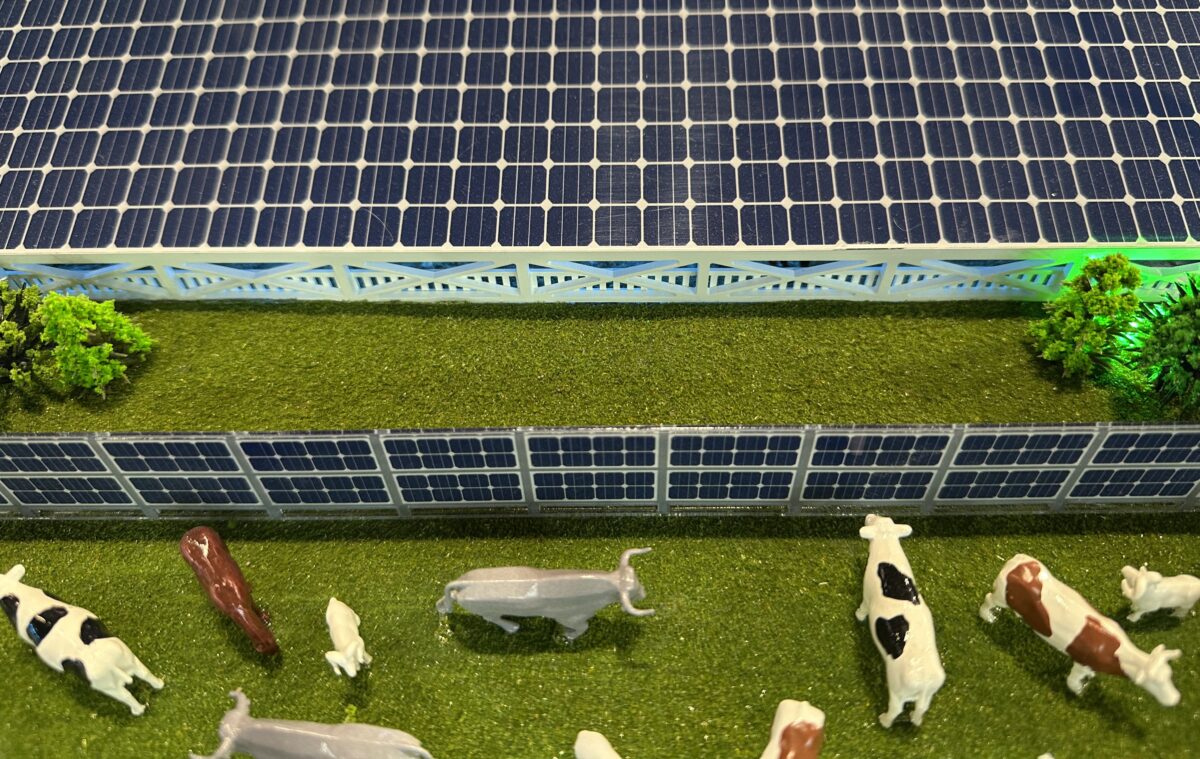
An international research team assessed agrivoltaic systems, highlighting challenges in design, crop performance and PV efficiency, while mapping their global potential. They call for innovative layouts, targeted crop selection and improved modeling to maximize energy yield and land use efficiency.
An international research team has created a comprehensive overview of the current state of affairs in the field of agrivoltaic cultivation systems.
“Our work highlights the challenges and barriers from four critical perspectives that are essential to the advancement of the field: system design, performance, implementation, and research,” corresponding author Silvia Ma Lu shared. pv magazine. “In addition to outlining these challenges, we recommend specific directions for research to address the current limitations of agricultural voltaic systems.”
Co-author Sebastian Zainali added: “We have mapped and classified the potential for agrivoltaic systems on agricultural land worldwide, estimating annual production of approximately 66 PWh to 385 PWh, if deployed in the most suitable areas.” He noted that this potential depends on the type of PV technology used and the installation density, and does not take into account the availability of the electricity grid.
Come to the on March 5 Double harvest, double problems: addressing EPC barriers in agrivoltaic system design pv magazine session in English at KEY – The Energy Transition Expo in Rimini.
Experts will share insights on current agricultural voltaic technologies, key design choices and key barriers to standardized, scalable dual-use projects in Europe and Italy, including region-specific EPC issues.
In the study “Scientific limits of agrivoltaic cropping systems”, published in nature reviews clean technologythe researchers explained that, from a system design perspective, integrating support structures and PV modules into traditional agricultural practices poses several challenges. These include potential losses in crop yields, operational issues, risks of damage to PV modules and agricultural machinery, and the inevitable loss of land required for support structures. Addressing these issues will require innovative layouts, PV modules and components tailored for agrivoltaic systems, as well as the identification of crop types and varieties that thrive under different shade conditions and climates.
“Such efforts are aimed at increasing the installed peak power per hectare, bridging the gap between agrivoltaic systems and conventional ground-mounted PV systems,” said Ma Lu. “Ultimately, this approach seeks to minimize the adverse effects of shade on crops while maximizing land use efficiency.”
From a crop performance perspective, the team highlighted that PV modules influence light, microclimate and soil conditions, which in turn influence crop-specific physiological responses and yield outcomes. These effects can increase or decrease productivity depending on factors such as shade levels, crop varieties and local climate conditions.
“Some published meta-analyses have attempted to establish simple relationships between degree of shade and crop yield in different crop categories, but they have several limitations,” Zainali noted. “They often do not take into account key factors such as water availability and are based on limited data. Most agrivoltaic studies have been conducted in regions where water stress does not significantly impact crops. Relatively little research has been done in semi-arid or drought-prone areas, where agrivoltaic systems may outperform open field cultivation.”
From a PV performance perspective, the researchers found that agrivoltaic systems have higher specific investment costs than conventional ground-mounted PV systems, with cost increases typically ranging from 20% to 90%. This is mainly due to the more complex and reinforced mounting structures required to accommodate agricultural activities.
“The complexity of these structures also increases the environmental impact of agricultural voltaic systems by approximately 20% compared to conventional ground-mounted PV systems,” said Zainali. “Additionally, under certain conditions, agrivoltaic systems may produce less specific energy than conventional PV systems due to the higher pollution rates associated with agricultural activities.”
The team also highlighted the benefits of co-locating PV systems and crops, noting that crop selection based on albedo can influence irradiance reflectance and PV energy performance. “The microclimate created by PV modules and crops can improve PV efficiency by lowering module operating temperatures through crop transpiration,” explains Ma Lu. “Lower panel densities and specific agrivoltaic configurations, such as vertical installations, can reduce the temperature of solar cells by up to 10°C, further increasing efficiency.”
The researchers mapped the global agrivoltaic potential and identified Africa, the Asia-Pacific region and Central and South America as countries offering the greatest potential for these systems.
“We reviewed current guidelines, standards, regulations and policies for agrivoltaic energy worldwide,” Ma Lu said. “Our research shows that accurately predicting system performance before installation is critical, especially for countries with crop yield targets such as Italy, France, Germany and Japan. This has increased demand for accurate modeling and simulation tools that can link system design, components, shading, soil irradiation, microclimate variations, crop yield and energy production to optimize system design.”
“Advances in modeling, simulation and optimization need to be complemented by field work,” Zainali added. “In our paper, we identified at least five limitations in current field studies, including small-scale facilities with non-standard PV designs, a lack of comprehensive databases, insufficiently standardized protocols or performance indicators, and short experimental durations.”
Finally, the researchers emphasized that analyzing the techno-economic, environmental and social aspects of agrivoltaic energy, as well as the impacts on the landscape and suitable deployment areas, is crucial for guiding policy development.
The research team included academics from Sweden’s Mälardalen University, the US National Laboratory of the Rookies (NREL), Italy’s Catholic University of the Sacred Heart, Saudi Arabia’s King Fahd University of Petroleum and Minerals, Germany’s Fraunhofer Institute for Solar Energy Systems ISE, China University of Science and Technology, the EU’s Joint Research Center and Italy’s National Agency for New Technologies (ENEA).
This content is copyrighted and may not be reused. If you would like to collaborate with us and reuse some of our content, please contact: editors@pv-magazine.com.
Popular content
