

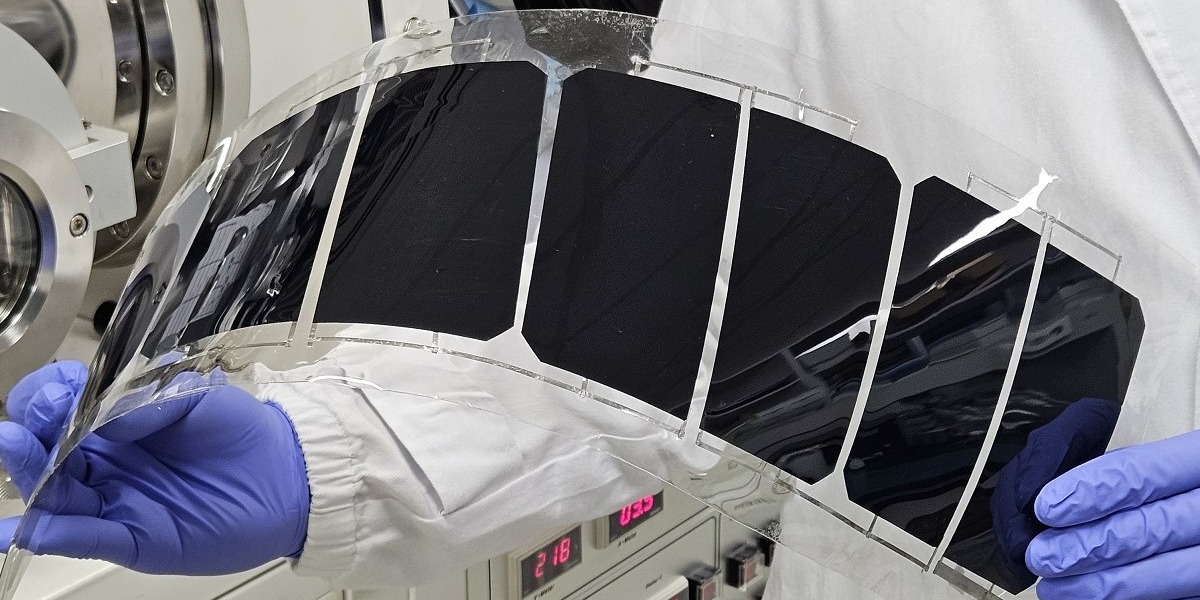
South Korean researchers developed a process that enables the use of aluminum-doped zinc oxide film in radiation-resistant quartz glass. A demonstration in III-V solar photovoltaic space modules showed that the shielding effect of bare quartz glass was significantly improved.
A South Korean research team led by the Korea Electronic Technology Institute (KETI) reported that quartz glass with a thermally annealed aluminum-doped zinc oxide film can provide electron beam protection for III-V space photovoltaic modules.
“Our work shows that aluminum-doped zinc oxide (AZO)-coated quartz glass can serve as an effective radiation-shielding cover glass for space photovoltaic modules. By tailoring the properties of the AZO film through post-treatments, we significantly improved both crystallinity and electron beam protection, enabling improved durability of space PV modules,” Yonghwan Lee, corresponding author of the study, told us. pv magazine.
The researchers chose a transparent conductive oxide (TCO) coating for the cover glass as an alternative to conventional cerium-doped space cover glass. They then chose AZO as a representative TCO coating. “In addition to shielding, the TCO coating reduces the accumulation of space charges that generate local electric fields, reducing the likelihood of electrostatic discharges (ESDs) through efficient charge dissipation,” the researchers said.
The study tested two post-treatment methods of AZO films: ultraviolet (UV) treatment and thermal annealing. The team compared the performance of four substrate samples: bare quartz, the as-grown AZO, the UV-treated AZO and annealed AZO-coated quartz.
An extensive series of tests revealed that thermal annealing between these two proved to be more effective at removing “residual organic compounds and solvents” and better at “inducing crystallization of the initially amorphous AZO thin film.
Furthermore, it was observed that thermal annealing improved its effective shielding against electron radiation. “Under electron irradiation at 1.2 MeV with a fluence of 1 × 10¹⁵ to 3 × 10¹⁵ e−cm2, the thermally annealed AZO-coated glass showed superior radiation shielding performance compared to bare quartz glass,” the researchers noted.
The AZO-coated glass was then tested in modules with a large surface area of 30 cm2 based on the 4G32C III-V photovoltaic cell technology. After electron beam irradiation, tests showed that energy conversion efficiency dropped by only 2.37%, while the module encapsulated with bare quartz glass showed a 4.18% reduction, the paper said.
The researchers concluded that the findings demonstrate that AZO thin films, if prepared with appropriate post-treatment, “can serve as reliable radiation shielding layers, offering significant potential improvement in the long-term durability and operational stability of photovoltaic space modules.”
Commenting on the manufacturability of the technology, Lee said: “The AZO films in this study were applied using a spray coating method, which is inherently compatible with large-area processing. We have already demonstrated uniform coatings on substrates larger than 30 cm x 30 cm, which is sufficient for module-level prototypes and can be extended to mass production,” said Lee.
The research group, which has ongoing research into cover glass materials and space modules, including radiation resistant coatings and lightweight encapsulation is now working on the next generation of space PV modules. The goal is to lighten the module technology to reduce launch costs, and reduce volume by being flexible and deployable, Lee said.
The details of the study appear in “Radiation-resistant glass with tailor-made Al-doped zinc oxide (AZO) coatings for sustainable photovoltaic space modules”, published by RSC progress. Researchers from the Korea Advanced Nanofab Center (KANC) also contributed to the work.
This content is copyrighted and may not be reused. If you would like to collaborate with us and reuse some of our content, please contact: editors@pv-magazine.com.
