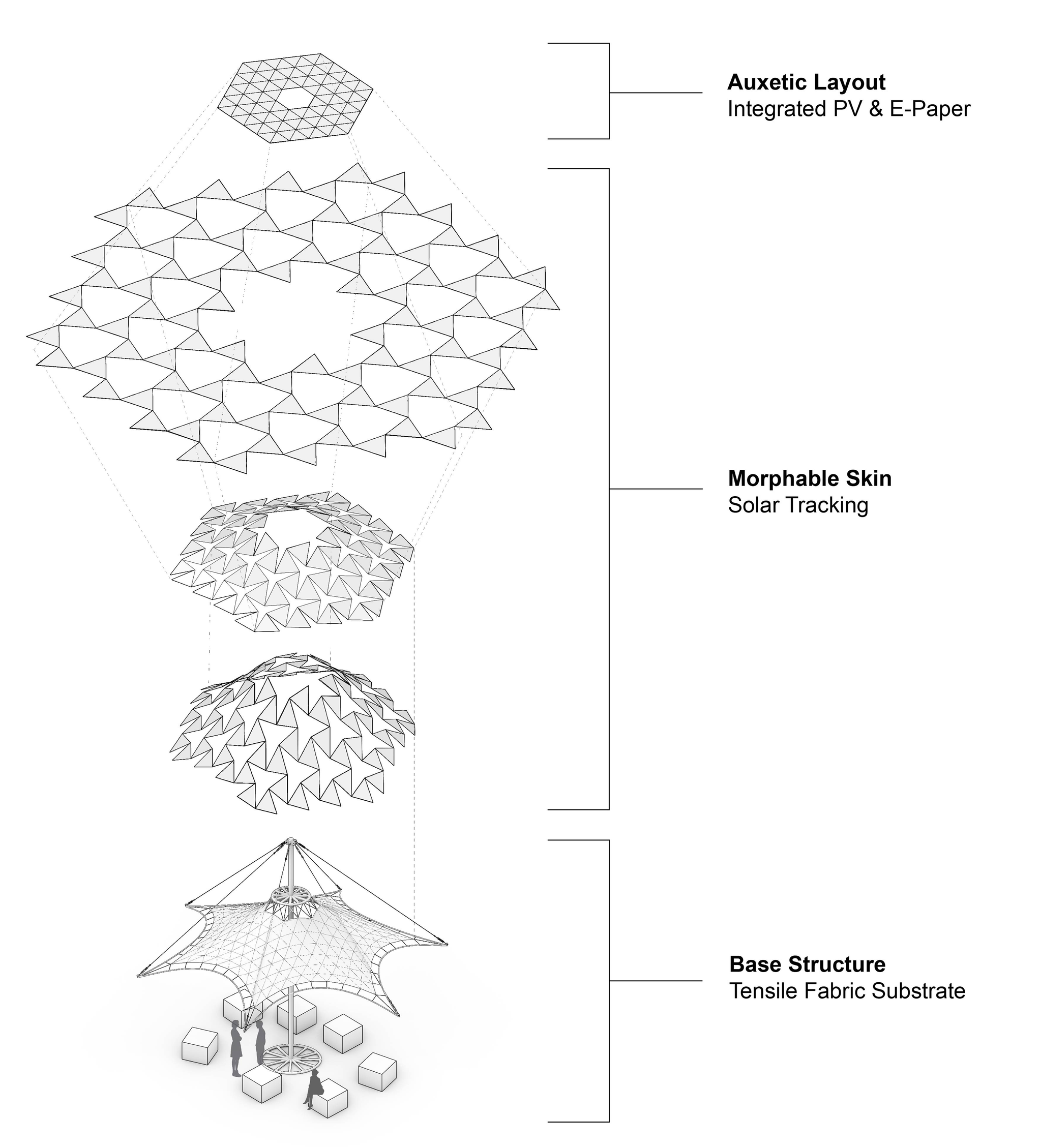
Researchers from Cornell University are working on creating a portable canopy with double axis of approximately 14 m2 that will change and follow the sun to optimize the absorption of solar energy.
For Helioskin, part of the vision of their brand is to make ‘solar energy attractive, so that people actually find it usable and interesting’.
The “Morphing Skin” would follow sunlight and have the flexibility and surface to wrap over large surfaces, such as buildings and stadiums.
The researchers said they are working on two problems:
- Sun-As follows with a single axis with flat silicon systems can generate no less than 10% to 40% more energy, depending on the geographical location, but more location management and more maintenance are required than conventional systems.
- Poor design quality and aesthetics hinder the large -scale public adoption of solar panels in the living sector.
Helioskin started in a partnership between Jenny Sabin, an architectural designer at Cornell University, and Mariana Bertoni, an energy engineer at Arizona State University that specializes in photovoltaic. They started to combine computational design, digital manufacture and 3D printing to make photovoltaic panel mass blows that would not only stimulate the absorption of the light, but would also draw the eye.
The key, they found, was to look at the mechanics of heliotropism, so they brought in Adrienne Roeder, a professor in plant biology at Cornell University. Heliotropism is a capacity that moves in many plants, such as sunflowers, towards the sun.
Nowadays the research team includes various sciences, including plant biologists, engineers, physicists, mathematicians and architects. The research is financed by A subsidy of $ 650,000 from the National Science Foundation Project. The subsidy covers the first phase of the project and the team has requested financing for the next phase-one-year-old pilot-for $ 5 million.
“Beauty and Sustainable design are an essential part of nature, “the researchers said about their hypothesis,” and it has been shown that solar tracking produces a photosynthetic benefit in the factory that suggests that it will be equally beneficial for photovoltaic systems. “
“We have discovered that the best way to follow the sun is on the world scale of the surface,” Sabin said. “Instead of energy-hungry components that follow mechanically and possibly break down, we will follow the entire surface and also work at a very slow pace.”
Co-Principal Investigator Itai Cohen, a physics professor at Cornell University, said that in many cases people avoid solar panels because of the costs and aesthetics. “Many solar panels are just ugly,” he said.
Roeder said that their goal is for Helioskin to Morph and Tracket from scale “all the way to building a scale,” she said. “If you hit these ugly solar cells on your house, people don’t want that.”
(See also: Beauty in design: Five PV projects on solar energy that we noticed in 2021))
Although their ultimate goal is to wrap buildings in them flexible solar “Morphing Skin”, in the pilot project the researchers are planning to create a portable, double axle canopy of around 150 square feet that will change and follow the sun to optimize the absorption of solar energy. The Host Low-Power draw system, adjustable electronic paper displays made from roll-to-roll printing to enable consumer brand and lighting adjustment options.

Helioskin works together with E -Inkt, an electronic paper display company, with which they can produce photovoltaic sheets in large quantities and at relatively low costs, Similar to perovskiet cells.
To do this, Helioskin uses roll-to-roll prints of photovoltaic and e-ink materials integrated in the same leaf. Those sheets could then be wrapped to give “second skins” to structures, Cohen said, “and because E ink has the capacity to manufacture kilometers of this stuff every day,” he added, “you could imagine that they really pack large objects like a skyscraper.”
(See also: Active surfaces recruit $ 5.6 million to develop ‘Solar 2.0’))
The second phase of the project is to refine the detection, wiring, setup, geometry and substrate of the Helioskin prototype. Helioskin is cooperating for this phase SunflexA company that uses Laser-Lasted return module technology for photovoltaic production.
Helioskin has not announced any figures with regard to the cost or system capacity. Cornell University said, however, that the Helioskin team conducted extensive marketing analysis and interviews that demonstrated the gross costs of Helioskin, the costs per W and system capacity were competitive with existing PV products.
Sabin said that the construction sector contributes to 40% of CO2 emissions of the world. “That’s a huge, huge problem,” she said. “If we can just start shifting that margin, the needle can run through the performance, function, bio-inspired design strategies and more importantly, good design and aesthetics, we have something that will really be transforming and impactful.”
“Imagine a skyscraper wrapped with these incredible geometries and form those new questions about these important issues,” she said. “Making sustainability interesting, making it sexy to invite people to get involved, get excited and bring people together fundamentally,” she said, adding, “bring solar to life.”
This content is protected by copyright and may not be reused. If you want to work with us and reuse part of our content, please contact: editors@pv-magazine.com.
Popular content