

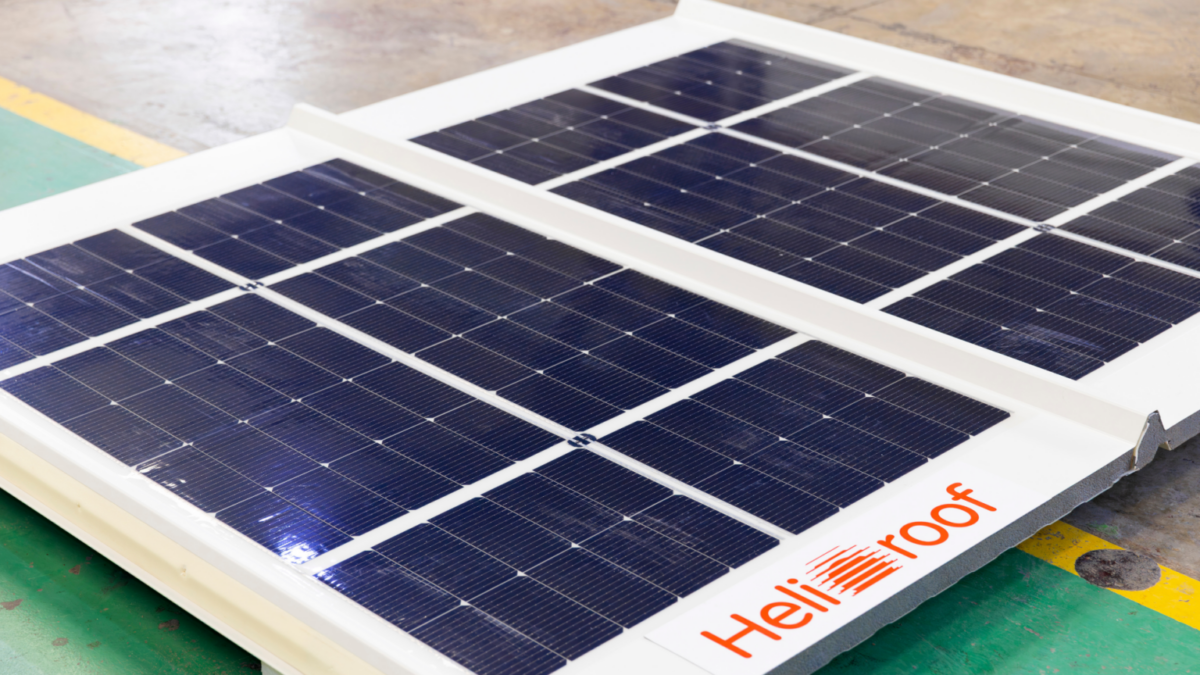
ArcelorMittal has started production of its Helioroof building-integrated PV modules in France. The steelmaker says the system aims to simplify energy retrofits for commercial and industrial roofs.
After five years of research and an investment of €15 million ($17.3 million), steelmaker ArcelorMittal has inaugurated a production line for its Helioroof building-integrated photovoltaic (BIPV) system in Contrisson, France’s Grand Est region.
Helioroof combines steel roofing, thermal insulation and photovoltaic generation in a single, ready-to-use product for roofs with slopes of 7% or more. “Rooftop solar energy must become the norm. With Heliroof we can combine two worlds: roofing and solar energy,” said Renaud Vignal, director of Helioroof at ArcelorMittal Building Solutions, during the October 9 event.
The product uses two steel plates with an insulation layer in between, while the solar cells are integrated in the top plate. Custom-made panels can be up to 12 meters long, with an energy capacity of 310 Wp to 2.1 kW per module.
Production begins with rolls of low-carbon X-Carb steel, which are rolled and cut to order. Processing takes place in a ‘gray room’ within the factory, to protect the solar cells. The TOPCon M10 cells, with 16 rails and an efficiency of 25.4%, are supplied by unspecified Asian partners and are welded, strung and laminated directly onto the Eklipstherm sandwich panels.
The process is protected by 15 patents, according to Vignal. The line is now being scaled up, with a potential capacity of 200,000 square meters of Helioroof per year – equivalent to approximately 80 MW – depending on market demand.
ArcelorMittal focuses on new and renovated roofs of residential, commercial and industrial buildings, especially roofs undergoing asbestos removal. Without glass or mounting frames, Helioroof would be 50% lighter than conventional systems. The solar layer adds only 2.5 kg/m², compared to 12 kg/m² for standard PV modules. Depending on the insulation thickness, the entire system weighs between 13.5 and 17.5 kg/m².
“This significantly reduces the structural load on the building,” says Vignal.
The product also aims to reduce installation time. It reportedly requires only one intervention instead of two, reducing installation time by 40% compared to conventional systems.
All electrical connections are located within the building, minimizing the risk of leakage or electrical faults. The system features two MC4 connectors in an integrated cable tray that is accessible from the inside. No external electrical layout is required. A section of the Contrisson site is dedicated to training installers.
Commercial production has begun. The first projects using Helioroof total 1,500 square meters, including a city brewery in Liège, Belgium; an energy-efficient single-family home in France’s Marne region; and two industrial halls in Haut-Rhin and Maas.
By using low-carbon steel and eliminating glass and frames, ArcelorMittal claims Helioroof’s carbon footprint is 25% lower than conventional systems that combine sandwich panels and rooftop PV. A full life cycle assessment is underway to quantify emissions.
This content is copyrighted and may not be reused. If you would like to collaborate with us and reuse some of our content, please contact: editors@pv-magazine.com.
