

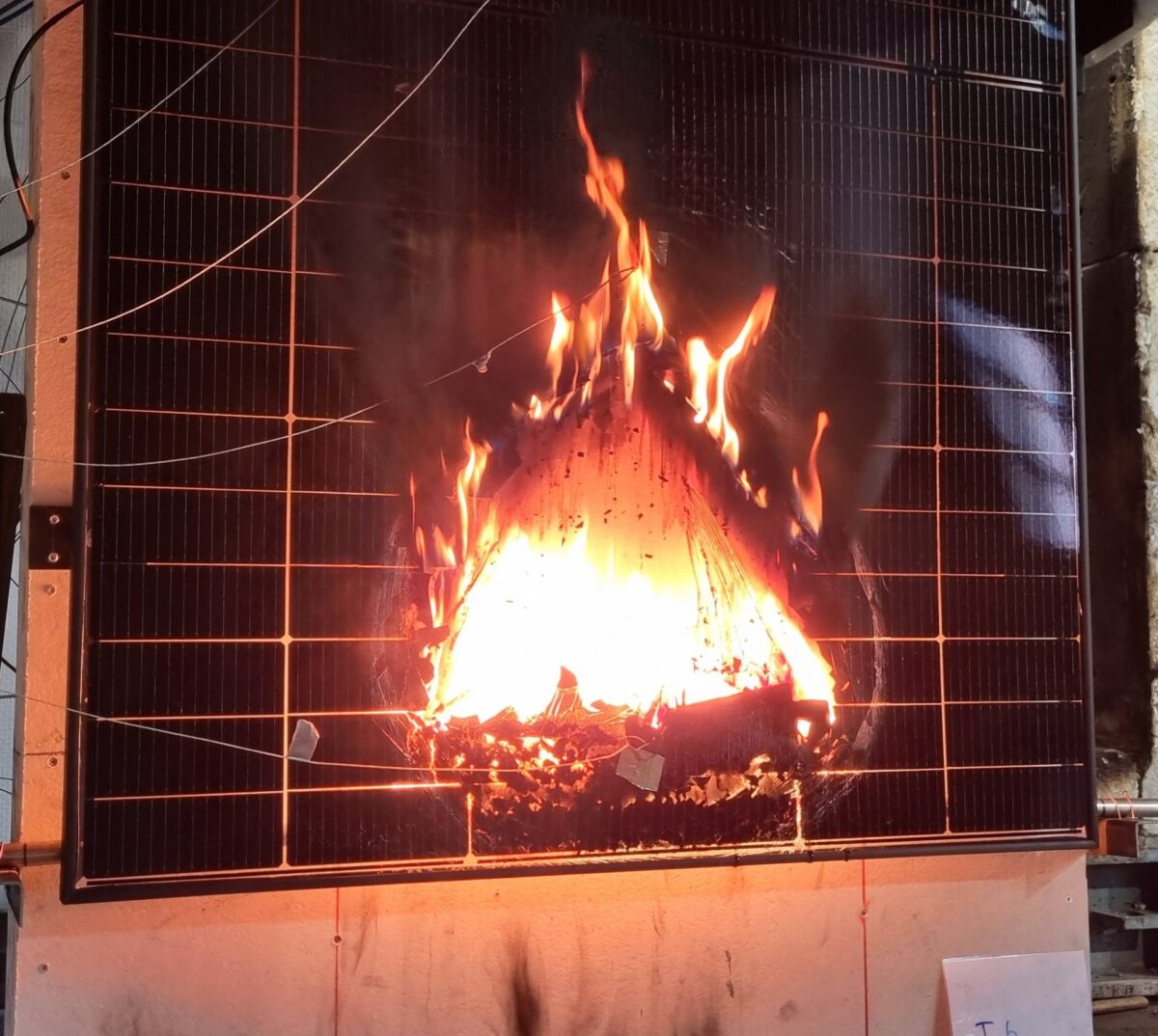
An international research team has analyzed which factors contribute to fire accidents in PV facades and discovered that the distance between the wall and the photovoltaic modules plays a crucial role. The scientists also said property developers should carefully consider what combustible materials are embedded in the cavity wall.
A Danish-Norwegian research group has investigated how fire can spread in building-integrated photovoltaic (BIPV) facades and found that the gap distance between the panels and the wall, as well as the presence of flammable materials in the wall cavity, are crucial are factors.
The research group included academics from Norway’s RISE Fire Research AS and Fire Research and Innovation Center (FRIC), as well as the Danish Institute for Fire and Security Technology (DBI).
“PV modules contain polymers that can ignite,” said RISE researcher Reidar Stølen pv magazine. “How quickly this happens and how much of the combustible materials contribute to the fire depends on how big the ignition source is, the distance between the building and the module and whether the module has glass on both sides or only at the front. .”
“Both facades with living plants and PV modules have many environmental benefits and can look very beautiful,” added study co-author Janne Siren Fjærestad. “We believe and hope that many more of these types of facades can be built in the coming years without endangering the fire safety of the buildings.”
In their reportin particular, the scientists sought to assess which factors increase the risk of ignition, how vertical fire spreads along the facade and whether exposure to heat from the building and adjacent buildings contributes to the ignition. To answer these questions, the scientists contacted suppliers of both photovoltaic modules and green facade systems, as well as building owners and researchers working with such systems.
They then conducted 35 experiments, 25 of which included photovoltaic modules and 10 green plant systems.
Their analysis found that three main factors contribute to the spread of fires in PV facades: the distance between the wall and the photovoltaic modules; the presence of PV panels built with glass on one or both sides; and the presence of other flammable materials in the cavity wall.
“Experiments with modules with single-sided glass and the smallest cavity (6 cm) produced the most intense fires,” the group explained. “As the distance increased, the modules tolerated more heat from the initial fire and released less heat when they ignited. The same effect was found when switching from modules with single-sided glass to modules with double-sided glass. It turned out that increasing the cavity distance by 4-5 cm has the same effect as switching from single-sided glass modules to two-sided glass modules.”
The researchers also emphasized that it is currently difficult to conduct tests for classification according to the standard EN 13501-1, which defines a standardized procedure for the classification of reaction to fire for all construction products. “Photovoltaic modules can also be challenging to test properly to obtain a relevant rating because the test methods are not adapted to the unique properties of a photovoltaic installation,” they noted.
RISE recently conducted a series of experiments showing that the distance between solar panels and roof surfaces could be a crucial factor in fires in PV systems.. It was also investigated how fire can spread in PV systems on flat roofs.
This content is copyrighted and may not be reused. If you would like to collaborate with us and reuse some of our content, please contact: editors@pv-magazine.com.
