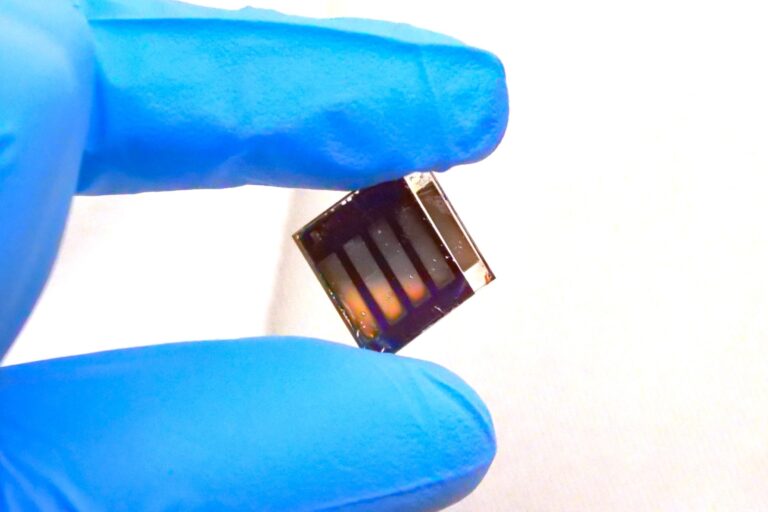
Researchers from the University of Queensland have developed a scalable, lead-free manufacturing process for perovskite solar cells that achieves record indoor light efficiency while avoiding toxic materials and enabling flexible applications for consumer electronics.
Researchers from the University of Queensland have developed a safe and scalable vapor-based manufacturing process for manufacturing high-quality lead-free perovskite material with fewer performance-limiting defects.
Indoor perovskite solar cells operate under low-intensity artificial lighting, such as light-emitting diodes (LEDs) and fluorescent lamps, but most rely on lead-based hazardous materials.
The new manufacturing method eliminates the need for toxins pipe and other hazardous solvents.
UQ Chemical Engineer and co-research leader Miaoqiang Lyu said the technology his team developed eliminates these materials while still delivering high efficiency.
“By completely removing these solvents, the process is much more suitable for scalable production,” Lyu said.
Efficiency
Lyu said halide perovskites are an emerging technology that could replace silicon, offering much higher efficiency and commercial potential.
“Indoor solar cells are not new in themselves, but the energy conversion efficiency of commercial silicon-based technology is only about 10%,” he said.
Using the new method, the panels achieved an efficiency of 16.36% – the highest reported for this type of indoor lead-free perovskite solar cell, made using an industry-compatible evaporation method.
Commercial use
Panels manufactured using the UQ process are thin, scalable and can be made on flexible plastic and in a variety of shapes, making them easy to integrate into a range of products.
They provide an alternative to coin cell and button batteries for low-power electronics such as environmental sensors, wearables, medical and health monitoring devices, and small consumer electronics.
Battery-powered electronic shelf labels being trialled by supermarkets are also a possible early application of the technology.
“People will likely see perovskite interior panels and integrated consumer electronics on the market in the coming years,” Lyu said.
Further testing
“I think the key here is encapsulation, to protect the material from oxygen and moisture,” Lyu said.
The research was published in ACS Energy Letters.
This content is copyrighted and may not be reused. If you would like to collaborate with us and reuse some of our content, please contact: editors@pv-magazine.com.
Popular content