

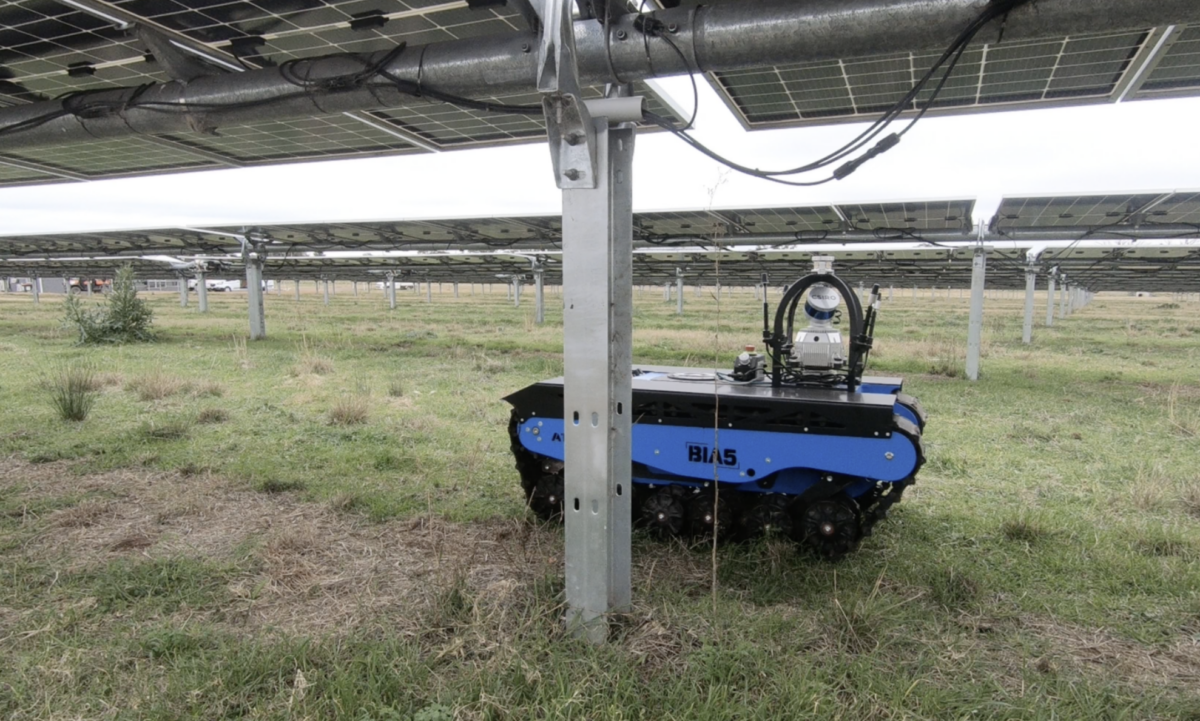
Australia’s National Science Agency says AI-powered robots could reshape solar maintenance in large-scale PV projects after successfully testing the cutting-edge technology.
The Commonwealth Scientific and Industrial Research Organization (CSIRO) has repurposed robots originally designed for mining to carry out maintenance inspections on large-scale solar farms in Australia.
The CSIRO said the autonomous robots, which use cameras and sensors to create a digital map of a solar farm and artificial intelligence software to identify maintenance issues, have been successfully tested on utility-scale projects in Queensland and New South Wales.
Researchers at the science agency said the AI-powered robots are equipped with a range of sensors, including cameras for visual inspections, an infrared camera to detect hotspots and electrical faults, and Light Detection and Ranging (LiDAR) technology for accurate 3D perception and mapping.
They are programmed to autonomously navigate solar farms in all terrains and conditions, building accurate maps to digitize site conditions, avoid hazards and develop a holistic understanding of the scene.
CSIRO Senior Robotics Engineer Ross Dungavell said the AI-powered robots can automatically detect faults in the project’s PV panels, including dust build-up, insect nests or bird droppings, physical damage, loose nuts or bolts, hotspots in panels or electrical connectors and wiring in need of repair.
“The robot records and stores every piece of data it captures, its sensors can detect any fault in a panel,” he said.
Dungavell said the integration of robotics and AI technology in solar farm space for predictive maintenance will reduce maintenance costs, improve efficiency and safety, help maintain panel performance, improve the stability of energy production and extend asset life.
The technology also reduces the need for people to conduct inspections on foot, shifting the focus from repetitive manual tasks to creating skilled jobs focused on technical work in solar farm maintenance, robotics support and data analytics.
“It’s good to meet a need in areas of the country where the work is not feasible or reliably available,” Dungavell said. “Often you can’t let someone go outside for an extended period of time in such harsh conditions.”
CSIRO Senior Principal Research Scientist Peyman Moghadam said the introduction of robotics into solar energy is a game-changer for Australia’s large-scale solar sector.
“We don’t just collect images or 3D data,” he said. “We are laying the foundation for intelligent solar operations, combining data from robots, fixed sensors and field systems, supporting better proactive maintenance decisions and more resilient performance over time.”
The CSIRO said it is continuing to test the robotic and AI systems at pilot sites and plans to work with industry to make the technology more widely available.
This content is copyrighted and may not be reused. If you would like to collaborate with us and reuse some of our content, please contact: editors@pv-magazine.com.
