

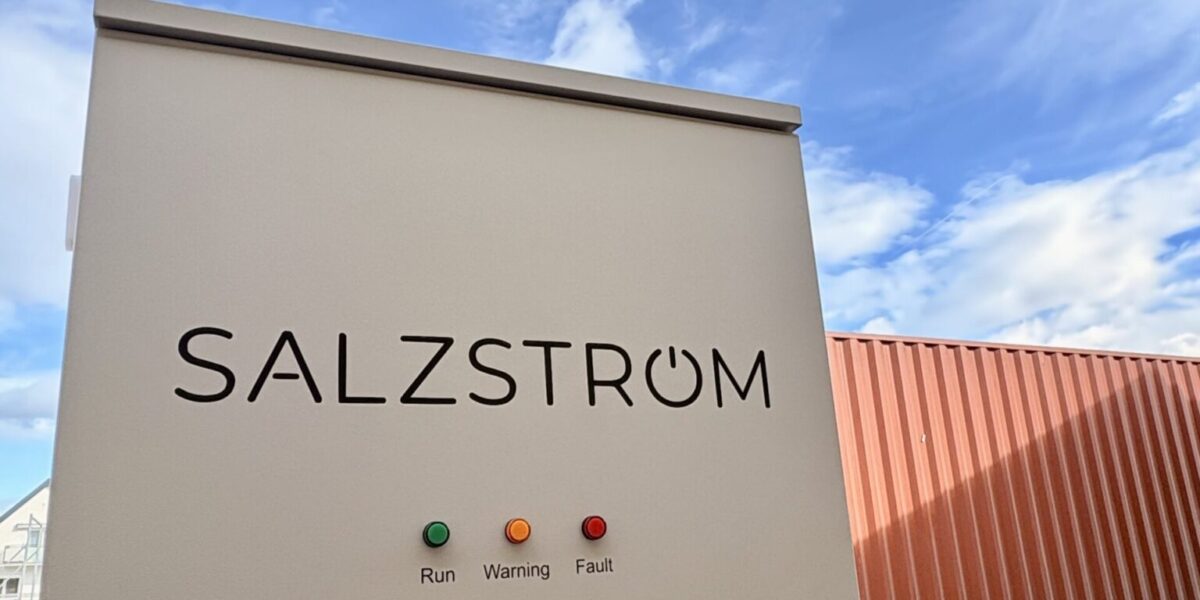
The Viennese company’s new battery storage system SALT 110 has a usable capacity of up to 110 kWh. The storage system is reportedly capable of 6,000 charge cycles at a 95% depth of discharge.
By ESS news
Salzstrom has unveiled a sodium-ion energy storage system for use in commercial applications.
Salzstrom had previously launched a residential photovoltaic storage system based on its sodium ion technology. The market reaction to that system significantly exceeded Salzstrom’s expectations. Even before the market launch of its new battery storage system, the company reported strong interest from commercial and industrial customers.
The SALT 110 storage system has a capacity of 100 kVA and a usable storage capacity of up to 110 kWh.
According to Salzstrom, the cell chemistry used is based on sodium iron phosphate (NFPP). The battery efficiency is listed as 95%. The storage system is suitable for use at temperatures between -25 C and 55 C. The dimensions are 1,000 mm x 1,460 mm x 2,450 mm and the weight is 2,400 kg.
Salzstrom specifies the product’s output voltage as 400 V at 50 hertz. The device has certifications to EN IEC 62619, VDE 4105 and EN 50549, among others. The storage system is reportedly capable of 6,000 charging cycles at a 95% depth of discharge.
Salzstrom said it developed the SALT 110 compact commercial energy storage system for applications in small spaces, such as data centers or industrial buildings with limited space.
Viewings of the storage system are now possible by appointment at Salzstrom. The first customer installations in Germany and Austria will start in early March.
“Customer interest is overwhelming. Many companies are specifically looking for alternatives to lithium – for sustainability reasons or for safety reasons. With the ‘SALT 110’ we offer the first market-ready cabinet solution for the commercial segment in Europe,” explains Jürgen Ellensohn, co-founder and CSO/CMO responsible for sales and marketing.
This content is copyrighted and may not be reused. If you would like to collaborate with us and reuse some of our content, please contact: editors@pv-magazine.com.
