
Close Menu
  • News
  • Industry
  • Solar Panels
  • Commercial
  • Residential
  • Finance
  • Technology
  • Carbon Credit
  • More
    • Policy
    • Energy Storage
    • Utility
    • Cummunity
What's Hot

Dutch solar owners asked to switch off during peak periods to ease the distribution crisis

June 7, 2026

The hydrogen flow: Toyota demonstrates its racing prototype on liquid hydrogen

June 7, 2026

Era of electrification exposing Australia’s weakest link

June 6, 2026
Facebook X (Twitter) Instagram
Solar Energy News
Sunday, June 7
  • News
  • Industry
  • Solar Panels
  • Commercial
  • Residential
  • Finance
  • Technology
  • Carbon Credit
  • More
    • Policy
    • Energy Storage
    • Utility
    • Cummunity
Solar Energy News
Home - Solar Industry - Beware of cleaning photovoltaic panels with detergent
Solar Industry

Beware of cleaning photovoltaic panels with detergent

solarenergyBy solarenergyMarch 31, 2026No Comments3 Mins Read
Facebook Twitter Pinterest LinkedIn Tumblr Email
Share
Facebook Twitter LinkedIn Pinterest Email

Researchers in Finland found that dish soap reduces the permeability and performance of solar panels, leaving residue even after rinsing. They recommend avoiding its use for cleaning solar panels.

March 30, 2026
Emiliano Bellini

Researchers from the University of Turku in Finland investigated whether household cleaners can be used to clean solar panels, finding that most – including glass cleaner and isopropanol – are suitable and do not affect the light transmission of module glass.

Dish soap was the exception, as it was found to alter the optical properties of anti-reflective (AR) coated solar panel glass.

The scientists noted that while dishwashing detergent is unlikely to cause lasting damage, the permeability of glass cleaned with it did not return to pre-cleaning levels, even after rinsing.

“Although glass washed with detergent looks clean, its light transmittance is noticeably reduced. A visually clean result does not necessarily guarantee top performance,” said researcher Julianna Varjopuro. pv magazine.

“It is possible that the detergent simply leaves stains on the glass instead of damaging the AR coating. In any case, it is recommended to avoid its use when cleaning solar panels,” said Professor Kati Miettunen.

The experiments were performed with glass fragments from an unused silicon solar panel. Large pieces of glass were immersed for 20 hours in various cleaning solutions, including ethanol, acetone, isopropanol, solar panel cleaner, glass cleaner and dish soap.

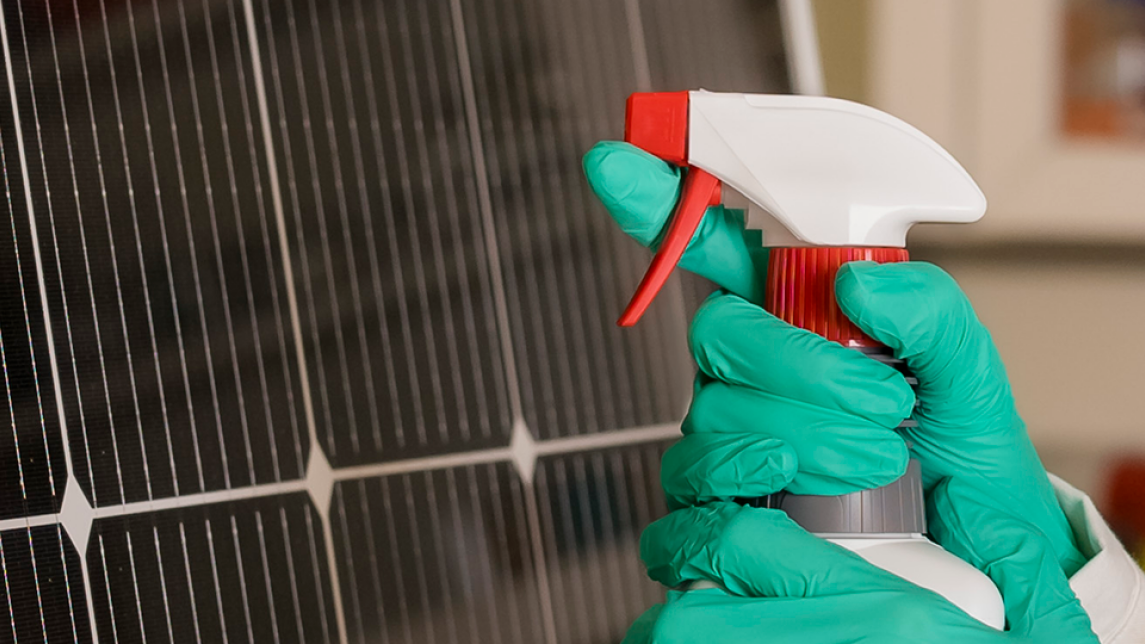
Julianna Varjopuro sprays the solar panel with a standard glass and mirror cleaner (the Mellerud brand was used in the study), which turned out to be almost as effective for the type of solar panel examined as a commercial product specifically designed for cleaning solar panels.

Image: University of Turku, Mikael Nyberg

A similar test was conducted after growing algae on the glass for three days using a mixture of nutrients, sugar and moss. The transmittance of cleaned glass was measured using a UV–vis spectrophotometer over 190–1100 nm.

See also  Researchers build 24.4% efficient perovskite solar cells using a room temperature process

Cleaning tests on unsoiled solar panel glass showed that all chemicals improved transmission except dish soap, which reduced the peak by about 1%. Solar panel detergent products, meanwhile, were found to perform only slightly better than generic cleaners. For contaminated samples, cleaning restored transmission and removed algae-induced differences, except when detergent was used, reducing the peak by almost 4%.

Atomic force microscopic (AFM) analysis confirmed that the anti-reflective coating remained intact after cleaning, with scratches
attributed to previous actions.

“Cleaning has a fairly even effect on the surface and the PV power decreases approximately in proportion to the decrease in optical transmission,” says Miettunen. “On average, the transmission of the contaminated glass sample cleaned with detergent was approximately 3% lower compared to that of glass cleaned with the most suitable cleaning agents. The impact on PV yield is therefore
expect it to be similar.”

“Currently, our group has started investigating pollution caused by snow,” Miettunen added. “In Scandinavian conditions, especially in late spring, solar radiation can already be significant, while electricity demand still remains high. Therefore, we are interested in investigating energy losses due to snow accumulation on PV panels.”

Recently, other researchers from the German research institute Fraunhofer CSP discovered that some commonly used PV cleaning agents can damage anti-reflective glass coatings, significantly reducing the efficiency of solar panels. Their tests showed that while some cleaning products are safe, others cause visible and permanent degradation of the coating. This highlights the need for careful selection of cleaning products to avoid long-term performance loss.

See also  Improving the performance of perovskite solar cells with phenethylammonium chloride

This content is copyrighted and may not be reused. If you would like to collaborate with us and reuse some of our content, please contact: editors@pv-magazine.com.

Popular content
Source link

Beware cleaning detergent panels photovoltaic
Share. Facebook Twitter Pinterest LinkedIn Tumblr Email
solarenergy
  • Website

Related Posts

ComEd starts a new energy pilot with a solar rebate on the roof of a brewery

June 5, 2026

Video: Understanding Safe Harbor Programs | Power forward!

June 3, 2026

Illinois board approves massive Pride of the Prairie site | Projects Weekly

June 1, 2026
Leave A Reply Cancel Reply

Don't Miss
Solar Panels

Right to Charge Laws in California and Beyond

By solarenergyMay 18, 20240

google-site-verification=RjiD5tYSJxBaTfkGiBp104RAYTo25K8mW9G114I7sbI google-site-verification=RjiD5tYSJxBaTfkGiBp104RAYTo25K8mW9G114I7sbI Right to Charge Laws in California and Beyond Top of the pageat the…

The Illinois School District will be a major subscriber to a community solar project on school grounds

May 2, 2024

the role of solar energy for the tropics – SPE

December 12, 2025

KCE launches £ 400,000 Community Share offer for Kent Solar Portfolio

August 25, 2025
Stay In Touch
  • Facebook
  • Twitter
  • Pinterest
  • Instagram
  • YouTube
  • Vimeo
Our Picks

Dutch solar owners asked to switch off during peak periods to ease the distribution crisis

June 7, 2026

The hydrogen flow: Toyota demonstrates its racing prototype on liquid hydrogen

June 7, 2026

Era of electrification exposing Australia’s weakest link

June 6, 2026

‘Come out from behind your screen, our industry is ultimately about people’

June 6, 2026
Our Picks

Dutch solar owners asked to switch off during peak periods to ease the distribution crisis

June 7, 2026

The hydrogen flow: Toyota demonstrates its racing prototype on liquid hydrogen

June 7, 2026

Era of electrification exposing Australia’s weakest link

June 6, 2026
About
About

Stay updated with the latest in solar energy. Discover innovations, trends, policies, and market insights driving the future of sustainable power worldwide.

Subscribe to Updates

Get the latest creative news and updates about Solar industry directly in your inbox!

Facebook X (Twitter) Instagram Pinterest
  • Contact
  • Privacy Policy
  • Terms & Conditions
© 2026 Tsolarenergynews.co - All rights reserved.

Type above and press Enter to search. Press Esc to cancel.