A record year and incredibly strong prospects for the energy storage sector.
By ESS news
The energy storage industry has reached the 100 GW era, with BloombergNEF’s Energy Storage Market Outlook for the first half of 2026 confirming that 112 GW will be installed by 2025.
After tracking record installation numbers since 2014, the increase from 2024 was a full 48% increase, for the 112 GW figure and the 307 GWh of batteries added globally, according to BloombergNEF analysts. Global energy storage capacity has cumulatively reached 2.9 TW, a figure excluding pumped hydro. Another huge increase is expected in 2026, with a jump of 41% compared to 2025 to 158 GW / 459 GWh in total.
As the outlook for the next decade includes different forecasts, the 1H 2026 Outlook predicts that by the end of 2036, cumulative capacity will have reached 2,867 GW / 10,514 GW, approximately 10 times the 2025 level. By 2036, 306 GW will be installed annually.
China continues to lead the way in installations, as it has for years, accounting for 54% of new additions in 2025, followed by the US with 16%. Utility-scale projects accounted for 85% of capacity additions in 2025, and were mainly used for energy shifting.
Isshu Kikuma, Senior Associate Energy Storage at the company, noted: “It took just four years for energy storage to increase annual additions from 10 GW to over 100 GW, while solar and wind took approximately eight and 15 years, respectively. This record underlines the growing market momentum and increased industry maturity.”
Chemistry
An interesting aspect of the outlook is the share of energy storage. Lithium-ion batteries are dominated by the lithium iron phosphate (LFP) construction of cells, with LFP accounting for 90% of annual additions.
BloombergNEF expects this to change, with annual additions of long-duration energy storage (lasting six hours or more) quadrupling to 2 GW.
In the field of sodium-ion batteries, analysts expect it to gain market share, but they refrain from making a firm prediction of power or capacity for the future. The Outlook noted supply agreements for sodium ions, including CATL’s deal with HyperStong for 60 GWh sodium batteriesAnd Peak Energy has signed a deal with Jupiter Power for a supply of 4.75 GWh.
Solar energy versus storage
Annual energy storage additions are approaching solar capacity, with the once enormous gap now closing. As many projects embrace adding stand-alone storage or additional storage, the solar-to-solar ratio in 2025 fell from 56:1 in 2016 to 6:1 in 2025, and could fall to the predicted 4:1 in 2026.
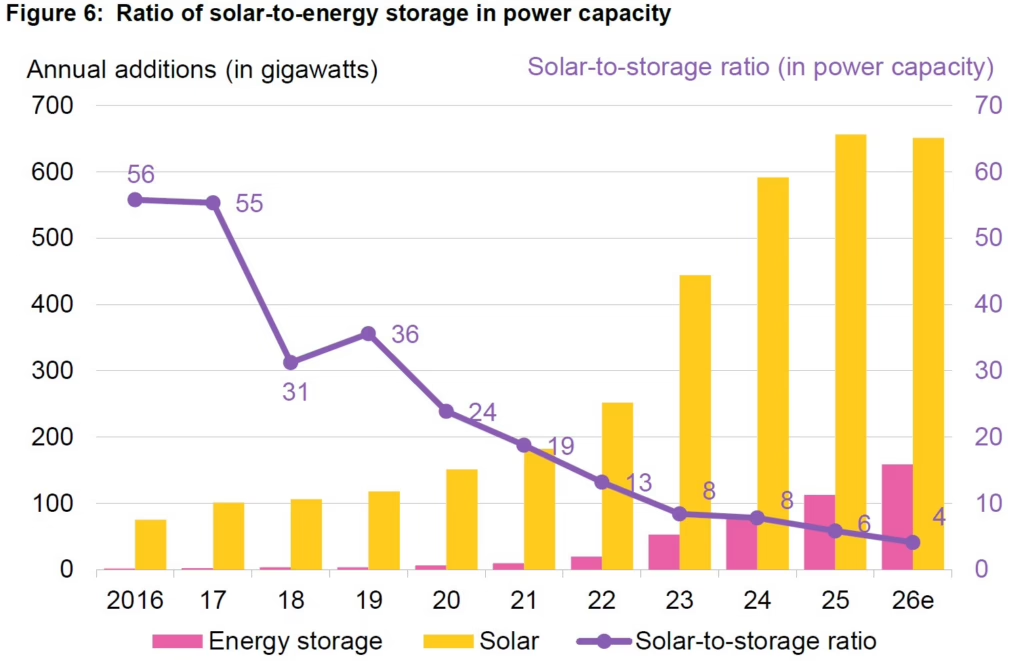
Image: BloombergNEF
Regarding the negative impact on energy storage due to the war in Iran, the Outlook suggests that the impact has been limited:
“The direct impact of the war in Iran on energy storage markets has been limited so far, mainly due to China’s dominance in battery supply chains. Nevertheless, rising fossil fuel prices could have several consequences,” Kikuma noted, pointing to improved revenues and likely additional installations, but headwinds from higher transportation and production costs. The consequences will be more regional than evenly distributed.
This content is copyrighted and may not be reused. If you would like to collaborate with us and reuse some of our content, please contact: editors@pv-magazine.com.
Popular content