

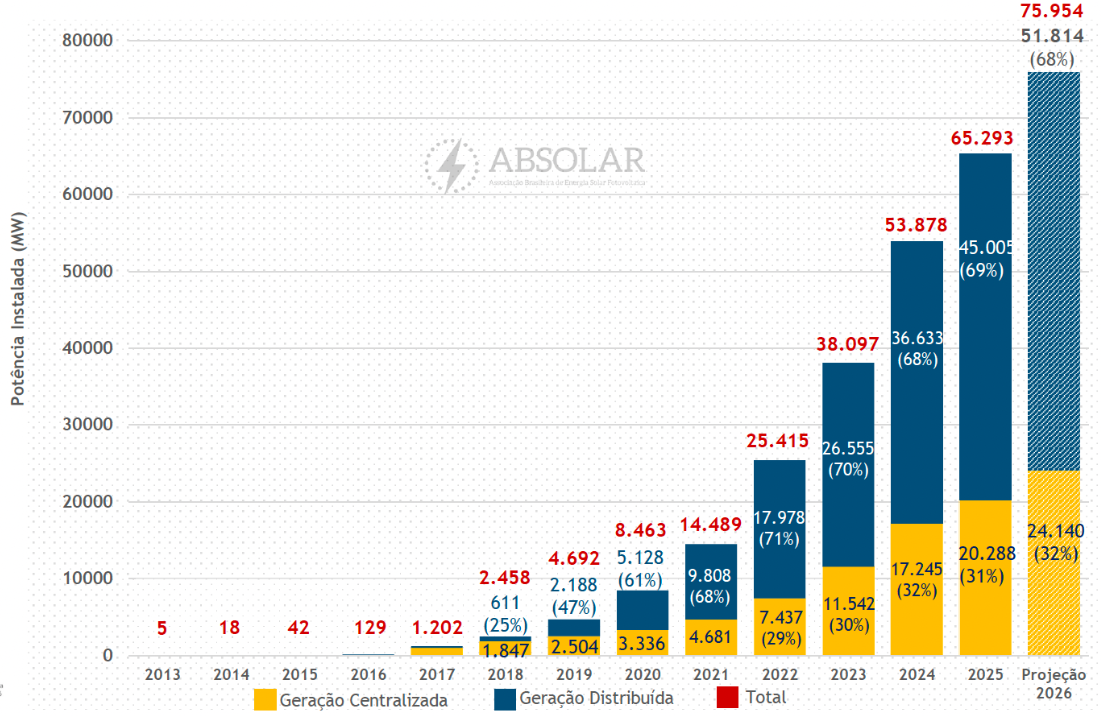
Brazilian photovoltaic association ABSolar says solar capacity expansion could fall by 24% from 15 GW in 2024 to 10.6 GW in 2026, with regulatory barriers, high capital costs and limited access to self-generation slowing investment and reducing employment.
Brazil’s PV market could shrink for the second year in a row, with 10.6 GW expected to be added in 2026, down 24% from the 15 GW added in 2024. Brazilian photovoltaic association ABSolar warned that regulatory barriers related to curtailment, high capital costs and limited access for self-generation systems could discourage new investments and reduce employment in the sector.
Large-scale solar projects face financial losses due to curtailment without compensation. Small and medium PV systems face grid connection barriers, often justified by perceived limitations or power flow reversal concerns, discouraging consumers from generating clean electricity on their own.
ABSolar said Brazil’s high cost of capital, with interest rates near 15% per annum, volatile US dollar exchange rates and increased import duties on photovoltaic equipment are hindering new investments.
The association expects new investments in solar energy to reach BRL31.8 billion ($5.8 billion) in 2026, up from around BRL40 billion in 2025. Job creation is expected to fall from 396,500 in 2025 to 319,900 next year. Sector turnover is expected to decline from more than BRL 13 billion in 2025 to approximately BRL 10.5 billion in 2026.
By the end of 2026, Brazil’s cumulative installed PV capacity is expected to exceed 75.9 GW, of which 51.8 GW will come from residential and commercial systems and 24.1 GW from large-scale plants connected to the National Interconnected System (SIN).
ABSolar plans to present proposals to presidential candidates in 2026 calling for compensation for curtailment losses, easier connections for small and medium-sized self-generation systems and clearer rules for electricity storage to ease market bottlenecks.
The association will also continue to work with Brazilian authorities and the electricity sector to expand transmission and distribution infrastructure, improve system operations, regulate storage capacity reserve auctions (LRCAP), value distributed generation, modernize tariffs and implement reforms in the electricity sector under Law No. 15,269/2025.
Despite the market slowdown, solar remains Brazil’s leading source of new generation capacity, accounting for 68% of additions through November 2025, including both distributed and centralized generation.
This content is copyrighted and may not be reused. If you would like to collaborate with us and reuse some of our content, please contact: editors@pv-magazine.com.
