

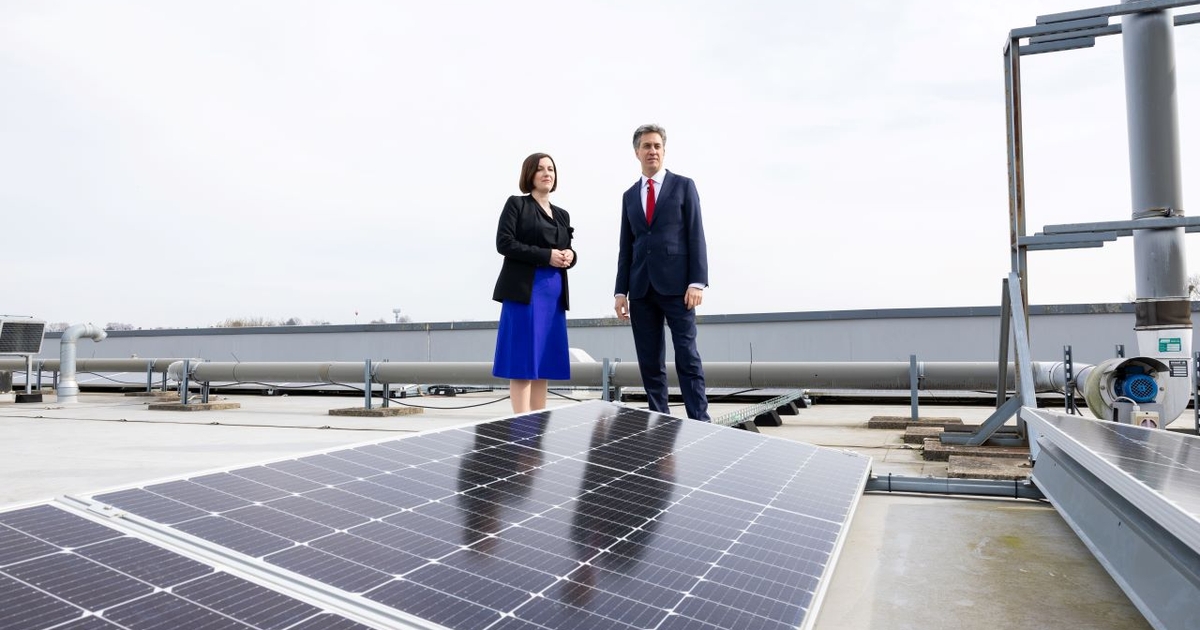
When he was appointed Energy Minister, Ed Miliband promised that he would operate not on myths and false information, but on evidence.
This was a pretty obvious one to reflect on a previous political term That allowed the penetration of largely untrue reports about the negative impact of solar energy development in parliament, which filtered through to the mainstream media and hit the industry where it hurt: public perception.
Community buy-in for developers is an important factor in solar deployment, especially for utility-scale projects.
Just over a year into the current government’s term, there has been a shift in the message from the opposition parties. While this message comes from an arguably negligible portion of elected officials, it is loud and has a worryingly high level of support.
Late last week, media reports confirmed that a Reform UK-led county council has voted to oppose the construction of solar power stations and battery energy storage projects on farmland in Derbyshire.
The British reform councilor for the area, Andy Graves, called the planned solar energy development in the area “Chinese-made eco-deserts”.
It was then a Conservative councilor who introduced a motion to expand opposition to solar energy from being against five specific projects, as in Graves’ original motion, to a unilateral opposition to all solar energy planned for agricultural land.
The Derbyshire area is uniquely suited to large amounts of solar PV development as there are two major grid connection points within the constituency.
Solar Media Market Research databases show that 335 MW of solar energy development has been granted in Derbyshire, awaiting construction or under construction, and 187 MW is operational. Projects awaiting a decision total 205 MW, with a further 100 MW on appeal.
Planning decisions are typically made by district and municipal councils, or, if large enough to be a nationally significant infrastructure project (NSIP), by the Minister of Energy himself.
This suggests that Graves’ move to oppose solar energy is more symbolic than anything else.
Some locals see solar energy development as industrialization of the local countryside and a risk to food security if solar farms replace traditional agriculture. There is plenty of information available to allay these fears and developers spend a significant amount of public consultation trying to explain that solar energy can co-exist with agriculture.
The National Farmers Union (NFU) supports solar energy, calling it a good diversification option for farmers, especially if it is installed on lower quality land that would otherwise have no use.
“All the evidence shows that well-managed solar farms can be a sanctuary of biodiversity. Solar Energy UK has found this to be true time and time again, compiling hundreds of ecological monitoring reports from independent ecological consultants. The RSPB and the University of Cambridge have discovered the same thing and I have seen it first hand,” said Chris Hewett, chief executive of the industry body for solar energy Solar Energy UK.
However, the cynical messages from opposition political parties are doing their best to ensure that these facts don’t stand in the way of local anti-solar energy.
Hewett put it well in a recent keynote speech: “There is a growing movement of political parties around the world, including this country, that want to cause social and economic chaos to impose authoritarian rule.”
According to Hewett, the solar and energy storage sector is being dragged into a toxic political debate, “whether we like it or not”.
There is no longer a political consensus that renewables and decarbonization are necessary. At the Conservative Party conference in early October, Conservative leader Kemi Badenoch pledged that the party will repeal the Climate Change Act.
The attack on clean energy is not happening in isolation; it follows the US election of Donald Trump on the mantra ‘drill, baby, drill’ and is very similar to a debate in Italy where last year the Minister of Agriculture, Francesco Lollobrigida, announced a plan to “end the wild installation of ground-mounted solar photovoltaics” on land classified as agricultural.
According to Britain’s shadow energy secretary Claire Coutinho, who was previously secretary of state for energy security and net zero, and, while in that role, significantly delayed decisions on Nationally Important Solar Infrastructure Projects (NSIPs). in the midst of Conservative struggle“the problem with the Climate Act is that it tells us that we must continue to decarbonize while costs continue to rise.”
While anti-clean energy rhetoric argues that network build-out and government subsidization of electricity costs through mechanisms such as the Contracts for Difference (CfD) program (notably introduced under the Conservative-Liberal-Democratic coalition government in 2014) are responsible for high energy bills for consumers and businesses – with industrial electricity costs in Britain the highest in the world – the wholesale price of electricity is determined by the gas price.
Perhaps the gap in the clean energy argument is that, despite record levels of renewable energy generation online, the lower costs of power generated by solar and wind energy are not yet reaching consumers at the same pace.
This leaves room for the opposition’s (false) argument that there are cheaper energy sources available, which are dismissed for the sake of decarbonisation – what those energy sources are remains vague.
Moving away from renewable energy sources, including solar energy, would mean continued dependence on gas, which will have to be imported, and means that Britain will be dependent on (high) wholesale prices set on a global scale.
Speaking at the Energy UK annual conference yesterday (October 14), current Energy Secretary Ed Miliband said: “If you listen to some people, you would think there was a free pass to simply continue using unlimited gas from existing stations for decades to come, but that is simply not the case.”
Miliband pointed out that halting the development of renewable energy sources to “rely on an entirely new fleet of gas-fired power stations” would still entail construction costs.
“The reality is that there is no alternative to investing in both generation and the network to keep the energy system running,” Miliband said. As such, the debate is not ‘whether to build, but what to build’.
Choosing what to build: in favor of clean energy
Whether or not there is a 2030 deadline, there will be an energy transition in Britain. Only sustainable energy can deliver permanently lower energy prices.
In his seventh carbon budget advicethe Climate Change Commission was clear: “As the electricity system decarbonizes and wind and solar power continue to displace gas, the underlying costs of electricity supply are expected to decline over time.”
An analysis released in early October by the Energy and Climate Intelligence Unit (ECIU) found that wind energy reduced the wholesale price of electricity by as much as a quarter (25%) in 2024, by offering lower day-ahead wholesale prices, which could be roughly equivalent to the support wind farms receive from bills.
For commercial and industrial electricity users, installing solar energy or purchasing solar energy through power purchase agreements (PPAs) offers the cheapest operations.
All this is common knowledge in the renewable energy sector, but despite being in the minority, those opposed to solar energy and the wider clean energy transition are currently the most vocal. The media tends towards its typical right-wing agenda and amplifies voices that promise to maintain a status quo.
Also speaking at the Energy UK conference, where political naysaying and its impact dominated talk, Liberal Democrat Party leader Ed Davey said: “The right-wing argument, ‘tear up the climate change commitments and the bills will collapse’, is simple, seductive and terribly, terribly wrong.”
Although it is “so wrong that it is tempting to simply dismiss it and refuse to engage with it,” this would be a “big mistake.”
A concerted effort to dispel narratives that, at best, ignore the actual benefit of renewable energy is crucial if the industry’s efforts are to bear fruit beyond the next election.
That said, more than half of the current government period still remains. Following the approval of 17 clean energy NSIPs, 10 of which are solar PV, in the first 18 months, continued support for the clean energy industry provides an opportunity for the economy to play out and prove the benefits of the energy transition.
