Researchers in Canada have compared strawberry growth with uniform lighting of semi-transparent thin-film Cadmium Telluride panels and non-uniform lighting of semi-transparent crystalline silicon modules. Their analysis considered metrics such as fresh weight, height, leaf count, chlorophyl content, soil temperature and humidity.
Researchers from the Western University of Canada have compared the growth of strawberries under Agrivoltaic panels with uniform lighting and with non-uniform lighting. For uniform lighting they used semi-transparent thin film Cadmium Telluride (CD-TE), and for the non-uniform lighting they used semitransparant crystalline silicon (C-Si), with rows of solar cells and transparent sun class glass.
“The selection of CD-TE and C-Si PV modules was based on their contrasting characteristics of the light transmission,” the group explained. “CD-TE modules offer a uniform light distribution, which makes controlled analysis of light intensity effects on strawberry growth possible. In contrast to C-SI modules, non-uniform lighting patterns create as a result of alternating rows of opaque solar cells and transparent glass.
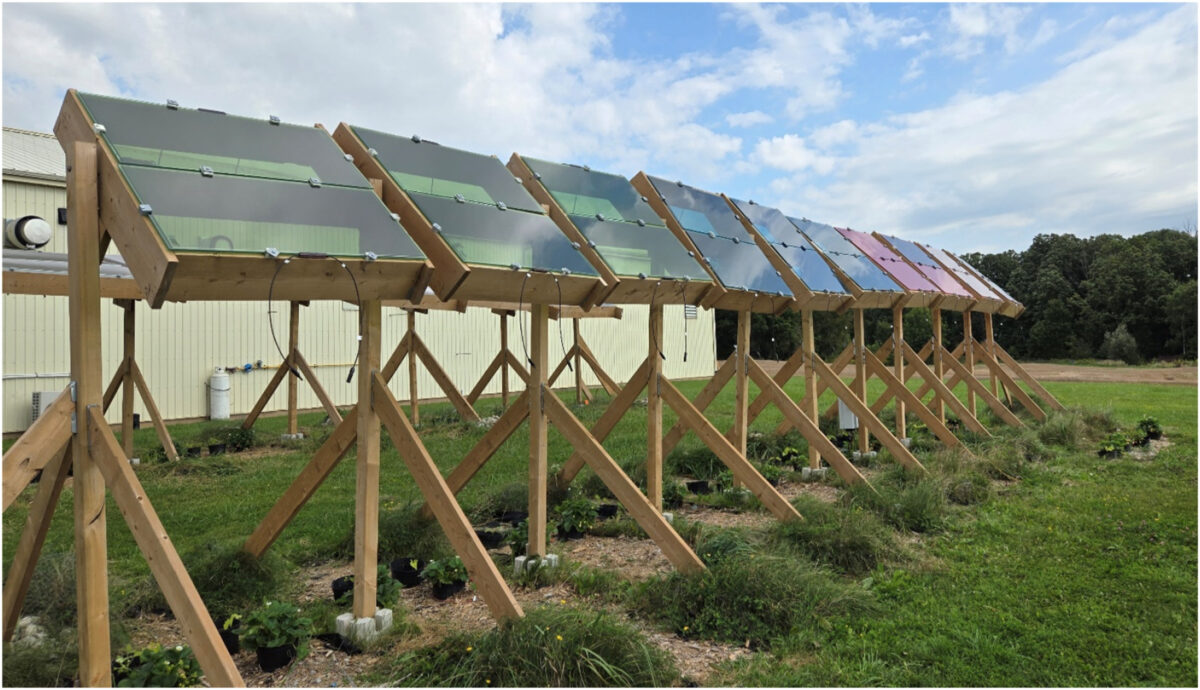
The study included two CDTE thin film modules with 40% (one variance-red colored) and 70% transparency (three variants-red, blue and green colored) and two C-Si-based PV modules with 44% and 69% transparentiën levels. They had a maximum power of 48 W, 24 W, 275 W and 150 W. Two strawberry plants were grown under each C-Si and thin film module, while three plants were grown without modules to function as control samples.
The analysis considered metrics such as fresh weight, height, leaf count, chlorophyl content, soil temperature and humidity. The C-SI modules had a leading height of approximately 0.7 m and a rear edge of 1.4 m, while the CD-TE modules were used for raised racks with a leading height of 2.0 m and a rear edge of 2.8 m.
Image: Western University, Renewable Energy, CC by 4.0
For each results, the 40% red thin-film PV module 87% of the average fresh weight compared to the control, while the C-SI reached 44% transparent module 104%. The 70% transparent green, blue and red CD-TE PV module resulted in 56%, 65% and 34% of the control of the control and the 69% transparent C-Si PV module reached an average fresh weight of 118%.
The analysis showed “strong” correlations between important plant growth parameters, with an increased flower production having a positive influence on fresh weight and overall biomass. “Longer plants showed improved flower counts and biomass, with an emphasis on the meaning of vertical growth in plant power,” the academics explained. “Moreover, the interdependence on leaf production with flour development emphasizes the crucial role of leaves in supporting reproductive growth by improved photosynthesis and nutrients.”
Moreover, the group simulated the inclusion of PV generation in all Canadian Strawberry Farmland. If such a thing happened with C-SI modules, the generation capacity that was added to the Canadian schedule would be between 1,518 GWH and 2,783 GWH. If electricity savings were applied to lower the costs of strawberries, prices can fall from CAD 6.51 ($ 4.52)/kg to CAD 4.82/kg.
“The implementation of Agrivoltaics can lead to electrical energy values between CAD 105 million and CAD 340 million. Only strawberry agriculture generates around 152.92 million turnover. Up to CAD 27 million in income,” the scientists concluded.
Their findings were presented in “Effects of the type of partial transparency on strawberry agrivoltaisches: Uniform lighting thin film Cadmium-teluride and non-uniform crystalline Silicon solar photovoltaic modules“Published in Renewable energy.
This content is protected by copyright and may not be reused. If you want to work with us and reuse part of our content, please contact: editors@pv-magazine.com.
Popular content