

About 60% of California energy customers have integrated battery energy storage into their rooftop solar installations. However, a “continued downturn” is expected for the market.
California transitioned its rooftop solar policy on April 15, 2023, eliminating net energy metering (NEM) and moving to a net billing rate structure (NBT). This change reduced the rate paid to customers for exporting their excess solar production to the grid by approximately 80%. A year later, Lawerence Berkeley National Laboratory (LNBL) has a report evaluating changes in the state’s rooftop solar market.
LNBL found that rooftop solar installations in California were about the same between 2023 and 2022. However, 80% of installed systems were NEM 2.0 installations that rushed into the interconnection queues ahead of the April 15, 2023 deadline to secure the more lucrative tariff structure. To date, approximately 50,000 systems have been connected under the new NBT structure, in addition to the 200,000 NEM systems connected during the same period.
Data from EnergySage, operator of the largest residential solar energy quote in the United States “suggest a more sustained downturn,” the report said.
The number of RFQs increased during the period from December 2022 to April 2023 between the announcement and implementation of NBT. Since then, monthly RFQs have averaged around 60% of historical levels (2019-2021).
A 40% decline in historical RFQs is a “leading indicator” of market activity and “is perhaps the clearest signal yet of a substantial and sustained market contraction,” LNBL said.
A significant contraction in the rooftop solar market is not an ideal outcome for California, a state with ambitious clean energy goals and an electricity affordability crisis. Trade association leaders have warned that California is It is unlikely to meet its clean energy targets without robust contributions from the rooftop solar industry.
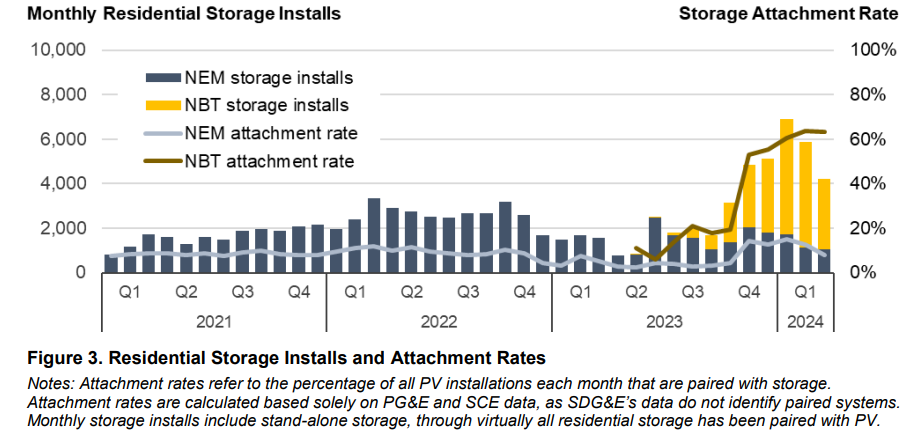
However, the transition to NBT has produced some results in California that may be desirable. The profile of an installed system has changed significantly. Before NBT, customers had battery energy storage connected to their rooftop array in approximately 10% of installations. Now post-NBT installations contain batteries 60% of the time.
This is important for California’s grid operators, who are trying to close the discrepancy between the supply of solar-generated electricity and demand on the grid. This mismatch, often represented by the “duck bend,” has deepened in California, creating pricing and grid maintenance issues and creating a need for inefficient “peaker” natural gas plants to meet times of high demand and low generation.
The high attachment rate of the battery also offers customers some advantages. Although the overall sticker price will increase with a battery-connected system, the return on investment is improved over a solar-only installation.
Installers report an average payback period of eight years for solar energy systems with a battery, while stand-alone solar energy systems have a longer average payback period of approximately 10 years. Battery storage allows customers to store and use their solar production when electricity prices are highest, rather than selling it to the grid for pennies on the dollar on sunny afternoons. Solar battery owners also have the option to ccompensated for exporting power during peak demand events or emergency situationspotentially creating a new revenue stream.
Customers with batteries also benefit from backup power during power outages, which remains the main reason for battery adoption nationwide, according to an installer survey by SolarReviews.
“Since November 2023, residential storage has averaged approximately 5,000 systems installed per month, more than double the monthly rate in the previous three years,” LNBL’s report said.
The Berkeley Labs report noted a change in financing options for residential solar customers. During NEM’s last twelve months, third-party ownership rates, including leasing and power purchase systems, averaged 26% for standalone solar and 11% for solar and storage systems. This increased to 39% for standalone solar and 52% for solar plus storage under the NBT system. Some of this change can be attributed to the emergence of higher interest rates loan terms for customers who are more difficult to digest.
Finally, the Berkeley Labs report found an increase in consolidation in California’s rooftop solar market. The market share of the state’s five largest installers increased from 40% during NEM’s final year to 51% during NBT’s first year.
A year later, it is clear that the move to NBT has dramatically changed California’s rooftop solar industry. However, the backlog of NEM orders due in 2023 has made it unclear what the overall impact of this policy change will be. This sets the stage for 2024 as a crucial testing ground for the health of this industry.
“These and other trends will undoubtedly come into sharper focus in the coming year, once the NEM backlog is fully cleared and a ‘new normal’ under NBT emerges,” concludes Galen Barbose, staff scientist at LNBL.
This content is copyrighted and may not be reused. If you would like to collaborate with us and reuse some of our content, please contact: editors@pv-magazine.com.
