Scientists in Finland have created a special platform to assess the performance of PV modules that work under Arctic conditions. In particular, it offers data for efficient system design and validation of performance modeling, where Azimut and tilt corner is important parameters.
Researchers from the Finlands University of Oulu have carried out a two -year empirical evaluation of solar panels in various azimuts and tilt corners under Arctic conditions.
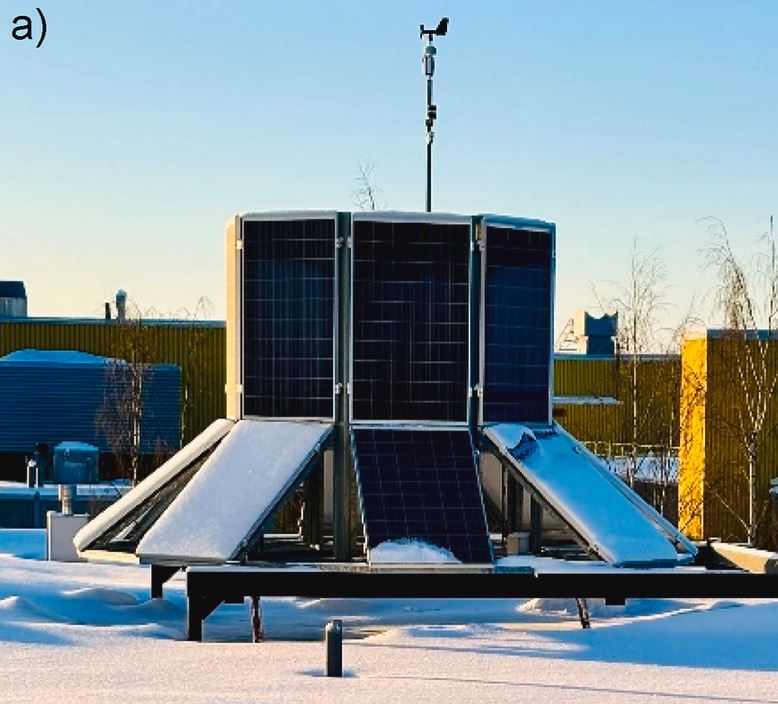
They took the measurements through a unique carousel-shaped infrastructure that records data with high resolution, Multi-Azimut data. Market statistics were also considered in the techno-economic analysis.
“This analysis not only assesses the generation potential of solar PV over different azimuts for a year, but also when that energy is generated and its value at different times of the day,” said the academics. “The results will also help policymakers make better -informed decisions with regard to the PV -Solar Energy Requirements in northern regions, making future policy directions possible.”
This infrastructure for solar carousel consists of sixteen PV panels on solar energy. Eight panels are placed in a tilt angle of 40 ° and the remaining eight are in a tilt angle of 90 °. In each tilt corner, the panels are oriented on eight compass points, namely Noord, Noordoost, East, Southeast, South, Southwest, West and Northwestern Azimuts. The panels have a nominal capacity of 270 W.
Data for energy generation were collected from September 2021 to August 2023 with intervals of 15 minutes. The value of electricity was based on the Finnish daily electricity market prices.
The infrastructure is placed on a roof in Oulu, Finland, located in the transition zone between the Arctic and Subarctic areas. The solar radiation in the region varies considerably per season, with horizontal average daily insulation ranging from 0.01 kWh/m2/day in December to 5.82 kWh/m2/day in June. The average global horizontal radiation is approximately 2.4 kWh/m2/day, with an annual maximum of 863.83 kWh/m2/day. July is the hottest month with an average temperature of 16.7 ° C, while February is the coldest month, with an average temperature of -8.7 C.
Image: University of Oulu, Renewable Energy, CC by 4.0
Panels overlooking the north, northwest and northeast appeared to generate 36-66% less energy and value of electricity than their counterparts opposite Southeast and South.
“Panels that are directed to Southeast and South consistently achieved the highest annual energy yields and value of the generated electricity, with only a variation of 1-3% in the annual output,” the researchers emphasized. “A clear seasonal and azimutal assessment was observed, with 40 ° panels that are held to the south, southeast and southwests than 90 ° panels in the summer. In the winter, however, 90 ° panels, especially those from south and southeast, up to six times more than 40 ° panels at the same Azimuth.”
The southeastern 40 ° panel and the southwest 40 ° panel yielded a higher value of electricity generation, despite the fact that their annual energy yield was lower than that of the South 40 ° panels. “This shows that, with increasing price plantness, time (tou)-conscious orientation can be more critical than maximizing the total annual output. If the strategy is to maximize the annual generation, the traditional recommendation of South and Southeast Golds,” the academician added.

Image: University of Oulu, Renewable Energy, CC by 4.0
The results were compared to those of simulations that were carried out using the Skelion plug -in, photovoltaic geographical information system (PVGIS) and the PVWATTs of the National Renewable Energy Laboratory (NREL).
All simulations showed good agreement for 40 ° panels, with an average absolute percentage error (APE) of around 3%. In the case of the 90 ° panels, however, the error percentage was approximately 11%. “Simulation models overestimate the performance for the majority of 40 ° panel azimuts and underestimate the performance for seven of the eight 90 ° panel azimuts,” the team concluded.
The platform was presented in “Optimization of photovoltaic azimut performance of solar energy in arctic conditions: an empirical techno-economic analysis“Published in Renewable energy.
This content is protected by copyright and may not be reused. If you want to work with us and reuse part of our content, please contact: editors@pv-magazine.com.
Popular content