

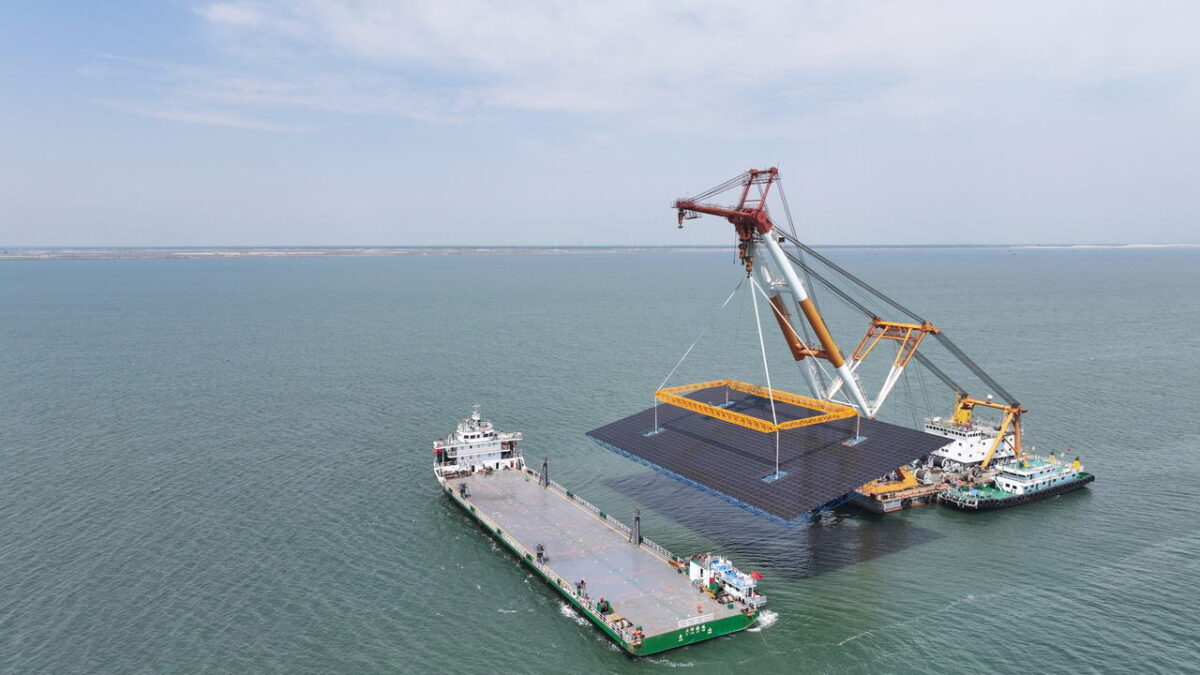
A State-led 1.8 GW Offshore PV plan in Changli, the province of Hebei in China, will become a model for large-scale marine-zonne-Zonne energy, with completion directed against mid-2026.
China promotes its Marine Solar Ambitions with a large 1.8 GW Offshore PV demonstration project in Changli County, Qinhuangdao, the province of Hebei. With a total investment of CNY 14.4 billion ($ 2.20 billion), the scheme-de first of its scale in Heei is fairly developed by four central state-owned companies: Huadian, Guodian, Guohua Investment and China Power Construction.
Stretch of approximately 17 square kilometers of sea surface and four subprojects, it is planned for complete grid connection towards the end of July 2026.
According to the government of Qinhuangdao, the top administrative of Changli, the project consists of four different subsections:
· Huadian Changli 500 MW Pilot: AC -Side capacity of 460.8 MW, with 4.68 square kilometers, estimated annual generation of 770 GWH, with investment of CNY 3.1 billion. Used structural designs with fixed mount.
· Guodian 500 MW Project: with investment of CNY 2.6 billion, expected annual generation of 690 GWH, the internal return on equity is 7.02%, to use N-Type Topcon modules and 110 kV collection rules.
· Guohua 500 MW Project: DC/AC capacity of 500/201.6 MW, 620 WP N-Type Topcon modules implement with 300 KW stringom formers, planned for completion in November 2025.
· China Power Construction 300 MW project: deep water with a fixed Stack Stichting Design, largest platform sizes and largest average water depth among the four projects, detailed technical parameters that have not yet been announced.
All four subprojects connect via submarine cables with self-built 220 kV booster stations and then feed the Qin Hai Guang 500 MW Boost station. The Huadian subproject uses 110 kV collection rules and directional drills for submarine cables, reportedly to draw up national records in cable routering distance.
Materials are selected for corrosion resistance: Special steel combined with advanced anti-corrosion coatings and polyurethane-edge component frames to suppress PID (potential induced breakdown) under high humidity and exposure to salt spray.
The construction has been running since the beginning of 2025. From August 2025, around 240 steel pipe stacks have been installed. In the coming months, the submarine will lay cable and intensify commissioning in the equipment.
When it is operational, the project is predicted that it can generate around 2.75 TWH annually – about 49% of the electricity story of Qinhuangdao – and reduce annual coal consumption each year with an estimated 840,000 tons, cutting off the CO₂ emissions by around 2.16 million tonnes every year. The local industry will benefit from more than 2,000 new jobs, and the Green Energy Supply Chain (Marine Equipment, Power Engineering) is expected to generate more than CNY 1 billion in annual economic output.
As the first large-scale offshore PV initiative of Hebei, the Changli schedule is positioned as a demonstration model for China’s wider marine strategy.
With spacious coastline sources, high solar radiation and proximity to loading centers along the east coast, Offshore PV is seen as one of the most promising paths for expansion of clean energy. Experts estimate that in 2030 Mariene Zonne -Zon could contribute more than 10% of the growth of China’s capacity, with cumulative offshore PV installations of more than 100 GW.
This content is protected by copyright and may not be reused. If you want to work with us and reuse part of our content, please contact: editors@pv-magazine.com.
