

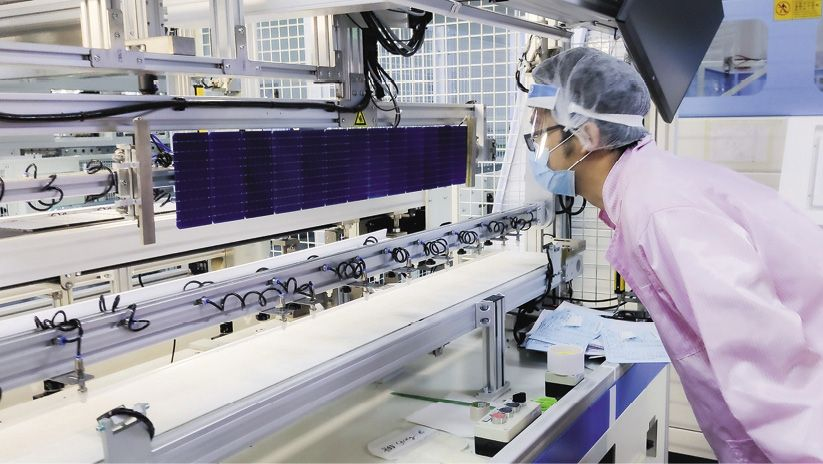
With the oversupply of solar panels set to lead to a price freefall in 2023 and no recovery in sight, market consolidation, inventory build-up, technology shifts and challenges in re-establishing PV production will impact all levels of the solar supply chain. solar energy.
The solar manufacturing industry will consolidate in 2024 after oversupply and falling material costs led to a downstream price war in the second half of 2023. Smaller, second and third tier manufacturers with module prices below cost will continue to suffer negative margins. Top Chinese manufacturers have also been hit by the crash in average selling prices and are trying to differentiate themselves from competitors with innovative products or exceptional prices.
As a result, thin or negative margins will continue to make 2024 a challenging year for manufacturers, with more than 75% of the top ten polysilicon, wafer, cell and module companies seeing market share growth.
Inventory issues
The least diversified solar distributors and installers are at risk due to price declines in their extensive inventories, especially in Europe. By the end of 2023, the total European module inventory exceeded that year’s installations. Despite excess inventories in Europe over the past two years, there are no signs of a sharp drop in shipments from mainland China in 2024.
Manufacturers and distributors are using strategies such as sales, reshipping and extended payment terms to reduce inventory and help customers cope. A recent report from S&P Global Commodity Insights predicted that a normalization of module inventory in Europe will not occur before 2025.
Technology shift
Manufacturers’ oversupply and tight margins are forcing solar companies to accelerate changes in product technology, such as from passivated emitter back cell (PERC) to tunnel oxide passivated contact panels (TOPCon). PERC technology will be phased out by 2025, with the exception of some markets.
By 2024, two out of three modules shipped will be based on negatively doped ‘n-type’ technology. The change from positively doped “p-type” shipments to n-type shipments will happen more quickly in Europe as warehouses still have many p-type imports from last year that are selling slowly. In contrast, n-type modules have a much better chance of selling at current price levels, due to their better performance.
Note the gap
This new oversupply cycle has direct implications for policy efforts to repair solar supply chains in the United States and Europe. Following a decline in raw material costs for modules, the difference in production costs between regions has only increased. In the first quarter of 2024, the average cost in mainland China was 45 – when the cost in the United States is indexed at 100 (see chart below). A year ago, Chinese costs were closer to those in Europe and the United States, at 67.
It has become increasingly difficult and expensive to build manufacturing capacity in Western countries, threatening ongoing localization efforts and the survival of existing local manufacturing bases. Incentives included in packages for local production, such as the US Inflation Reduction Act (IRA), may now prove insufficient to increase US domestic solar production capacity and the competitiveness of domestic players.
India has emerged as a country with competitive cost structures, allowing the subcontinent to lead the expansion of solar energy production beyond mainland China. In addition to manufacturers attracted by production-related incentives, new entrants are making modules, spurred by opportunities to produce in India and ship to international markets, especially the United States.
The cost difference may not be the only challenge for the reshoring policy. TOPCon is quickly becoming the dominant market technology and more than 90% of the market is based in China, where companies have invested in the approach over the past two years.
In contrast, most of the production capacity in Western countries and India consists of PERC technology, which will soon be phased out. Upgrading older production lines or building new capacity involves major investments that many Western manufacturers will find very difficult. Ultimately, in this context, moving module production back to the United States or Europe would be the easiest option if n-type cells can be imported.
These tough times will continue for Western solar manufacturers as bulging overcapacity in China shows no sign of abating, putting Western companies at risk of falling behind in technological development.
S&P Global Commodity Insights expects that the global manufacturing base will continue to grow faster than demand, with most of this expansion taking place in China. Over the next two years, manufacturers will add 300 GW of annual solar panel production capacity – the equivalent of more than 70% of total global demand in 2023.
How easily shipments from this massive new capacity reach international markets remains to be seen. In 2024, the solar industry will face a new global policy wave in key markets including the United States, Europe and India. Examples include the new foreign subsidy investigations opened by the European Union, the implementation of the restrictive approved list of models and manufacturers for government projects in India; and in the United States, the end of an anti-dumping duty and a moratorium on countervailing duties, and the Uyghur Forced Labor Prevention Act.
These steps will determine not only the fate of ongoing onshoring efforts in those regions, but also the shape of global supply chains as they adapt to continue serving core markets.
 About the Author: Edurne Zoco is Executive Director of the Clean Energy Technology group at S&P Global Commodity Insights. She leads research in solar energy, supply chains and carbon sequestration.
This content is copyrighted and may not be reused. If you would like to collaborate with us and reuse some of our content, please contact: editors@pv-magazine.com.
