

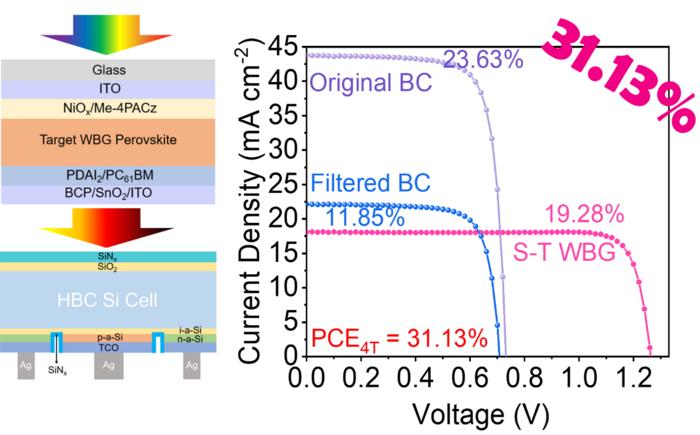
Researchers in China developed a novel two-dimensional (2D) seeding agent to control crystallization in a perovskite film with a wide band gap of 1.80 eV. A perovskite-silicon tandem device made with the resulting optimized subcell achieved an efficiency of 31.13% and outperformed a control device.
A research team from Northwestern Polytechnical University, together with Xi’an Shiyou University and Xidian University, has developed a new strategy for controlling perovskite film crystallization for tandem organic-inorganic hybrid halide perovskite solar cells with a wide band gap. It was made possible by using CsPb2Br5 as a two-dimensional (2D) graft.
“The novelty of our research lies in the use of fully inorganic 2D CsPb2Br5 flakes as a heteronucleation agent for perovskites with a wide band gap of 1.80 eV, which successfully addresses the critical problems of uncontrollable crystallization and phase separation,” co-corresponding author of the study, Chenxin Ran shared. pv magazine.
The researchers noted that both perovskite-silicon and all-perovskite tandem cells require a high-performance wide-bandgap (WBG) perovskite top cell to match the narrow-bandgap bottom cell, typically with a bandgap range of 1.68 eV to 1.80 eV, but such absorbers have problems with crystallization and phase separation that negatively affect performance.
To monitor the crystallization and phase separation in WBG perovskite film made of Cs0.2FA0.8Pb(I0.6Br0.4)3, the researchers used 2D CsPb2Br5 as a seeding agent. The synthesis of the graft was simple, according to first author Changbo Li, “using a cooling precipitation method” for the constituent CsBr and PbBr2 solutions.
“Due to its low solubility, it immediately precipitates on the top surface when the antisolvent falls and forms solid seeds, effectively directing the growth of perovskite downwards and preventing random nucleation,” said co-corresponding author Weiyin Gao. pv magazine“, explaining that the agent promotes vertical top-down crystal growth by “lowering the nucleation energy barrier and increasing the defect formation energy. “This improves charge transport and suppresses phase separation, ultimately achieving a record-high fill factor of 85.39%,” Gao said.
Furthermore, the optimized 1.80 eV WBG had a champion power conversion efficiency of 20.14% when used in a single-junction inverted solar cell, according to the researchers.
In a further demonstration, the group fabricated tandem devices with 4 terminals, one based on a silicon solar cell with heterojunction back contact (HBC) as the top subcell, and the other a narrow bandgap FA0.7MA0.3Pb0.5Sn0.5I3 top subcell. The perovskite-silicon device achieved an efficiency of 31.13%, with a stabilized output power of 30.81%, which the researchers said was “superior” to the tandem device based on the control WBG perovskite solar cells. Furthermore, an all-perovskite tandem cell built with the top cell achieved a stabilized efficiency of 28.01%.
In terms of stability, unencapsulated devices maintained 80% of initial performance under light soaking conditions, while a control device dropped to less than 80% after just 300 hours, the research team said. In addition, improved thermal stability and air stability tests also showed better performance compared to the control device.
The measurements of the demonstration devices were performed on cells with a small area of 0.05 cm2, while the scalability of the method was demonstrated by fabricating a 1 cm2 device, said co-corresponding author Weidong Zhu. pv magazine.
Reviewing the results, the researchers said the work shows that the crystallization control strategies “can effectively solve the intrinsic instability problems of wide bandgap perovskites,” with potential for use in future large-area devices.
The details of the study appear in “Heterointeraction-induced nucleation promotes vertical growth”, published in Research.
“We have successfully built perovskite-silicon tandem devices with an efficiency of more than 31%, and we are currently committed to optimizing their long-term stability to meet future application requirements,” concluded co-corresponding author Wei Huang.
This content is copyrighted and may not be reused. If you would like to collaborate with us and reuse some of our content, please contact: editors@pv-magazine.com.
