

A Chinese research team has developed a new sandwich buffer layer that improves carrier transport and efficiency in semi-transparent perovskite-silicon tandem solar cells. Mini-modules incorporating this layer achieved efficiencies of over 26% while demonstrating both scalability and long-term stability.
A research team led by the Institute of Physics of the Chinese Academy of Sciences has developed a sandwich-like buffer layer to improve the performance and scalability of semi-transparent CsPbI3-based perovskite solar cells and four-terminal (4T) tandem solar cells.
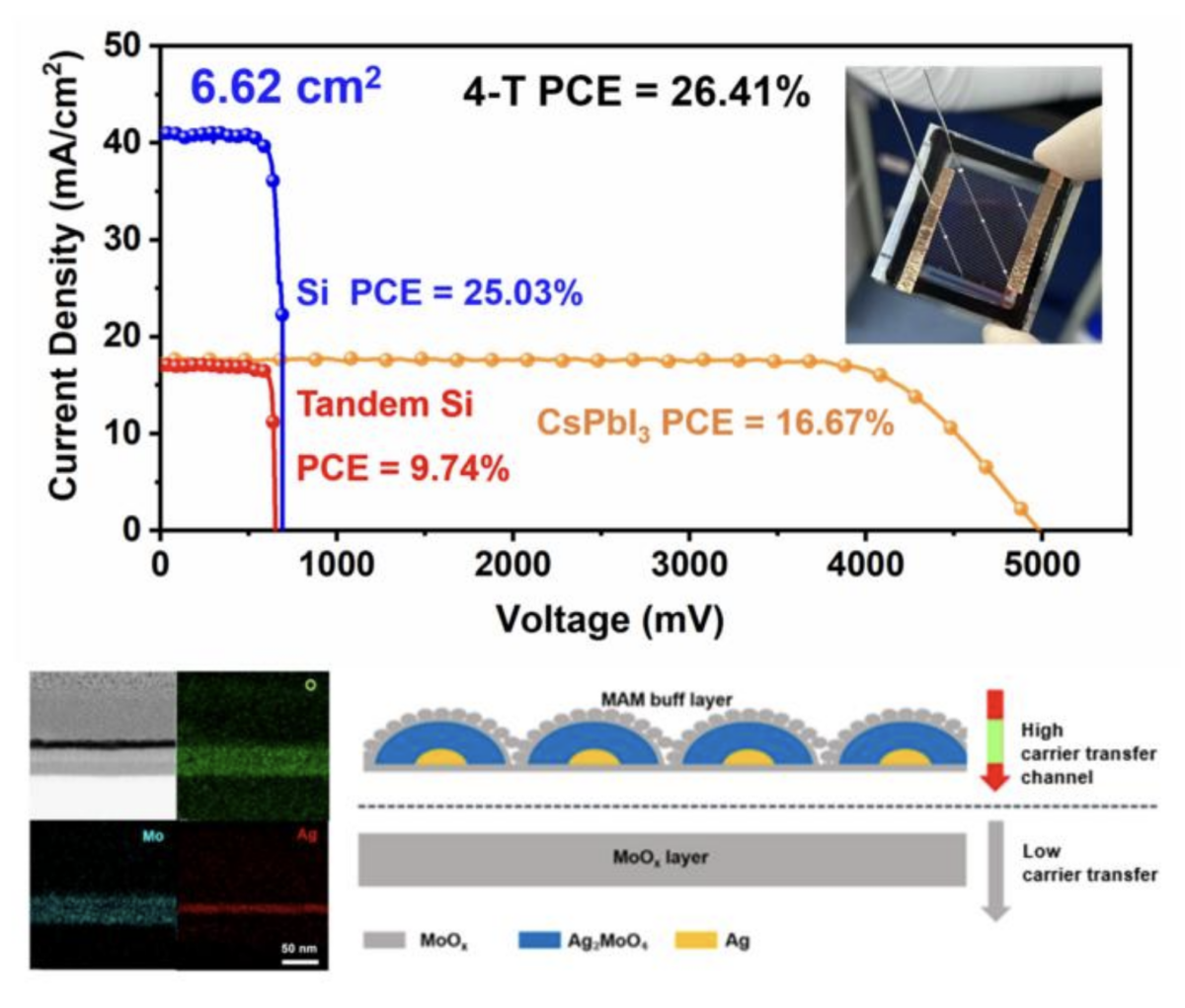
The MoOx/Ag/MoOx (MAM) buffer layer consists of a thin layer of silver (Ag) between molybdenum oxide (MoOx) layers that can act as the front cell window layer in semi-transparent CsPbI3 solar cells and 4T stacked cells.
The scientists explain that compared to conventional MoOx layers, the MAM acts as an effective buffer layer by improving the transport and collection capabilities of carriers. The team attributes this improvement to the in situ formation of Ag2MoO4 in the MAM sandwich structure.
The scientists fabricated a semi-transparent CsPbI3 device with an orifice area of 0.50 cm2 that included a MAM buffer layer and a TOPCon bottom cell with edge passivation. This device showed an energy conversion efficiency of 18.86%. A corresponding 4T CsPbI3/TOPCon tandem solar cell then achieved an efficiency of 26.55%.
The scalability of the MAM buffer layer was tested by developing CsPbI3 perovskite mini-modules with an efficiency of 16.67% and 4T CsPbI3/TOPCon tandem mini-modules with an efficiency of 26.41%, at an opening area of 6.62 cm2. The research team noted that this is the first reported mini-module demonstration for this architecture.
The stability of the device was also tested, with the transparent CsPbI3 perovskite mini-modules retaining more than 93% of initial performance after more than 1,000 hours of storage.
The researchers say this works establishes a universal strategy for MAM sandwich-structured buffer layers for semi-transparent CsPbI3 perovskite solar cells from small to large sizes, which is also suitable for tandem solar cells.
“This kind of scalable sandwich-like architecture not only increases the design flexibility of functional layers in perovskites and tandem solar cells, but also offers a promising path for further efficiency improvement,” she added.
The academics involved will now work to find suitable transparent, photostable materials to bring the two devices together in series, especially for large tandem modules, while considering practical application scenarios that control costs. This will include experimenting with alternatives to silver, as it is a relatively expensive metal.
Their findings are presented in the research paper “Designing MoOX/Ag/MoOX sandwich-structured buffer layer for four-terminal CsPbI3/TOPCon tandem mini-modules”, available in the magazine Materials Future.
This content is copyrighted and may not be reused. If you would like to collaborate with us and reuse some of our content, please contact: editors@pv-magazine.com.
