

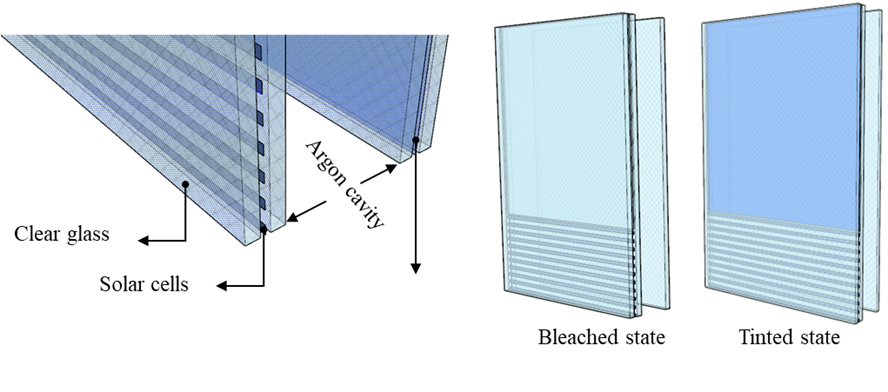
The new smart solar window combines photoelectric and electrochromic functions. It can produce electricity while regulating the amount of solar radiation entering a building.
A group of scientists from China have developed a new smart PV window (SPV) that can produce electricity while simultaneously calibrating the amount of solar radiation entering a building.
“Our study proposed an SPV window as well as the operation control strategies to improve building energy efficiency and network friendliness at the same time,” said corresponding author Yutong Tan. pv magazine. “The results showed that, compared to conventional low emissivity (Low-E) windows, the SPV window with the heat flow control strategy was able to achieve significant reductions in excess daylight illuminance, peak loads and the average daily difference between peak and off-peak and net annual energy consumption.”
The system contains both crystalline silicon cells and electrochromic film. The proposed photoelectrochromic device (PECD) combines photoelectric functions, converting sunlight into energy, with electrochromic (EC) functions, allowing a change in the transparency of the window and measuring the solar radiation hitting the building .
The window consists of a clear glass cover, a functional layer, a clear glass substrate, an argon cavity and a layer of Low-E glass. The EC film was sandwiched between the second and third surfaces of the glass and the Low-E coating was deposited on the fifth surface. The area under the effective daylight was equipped with 3 mm thin strips of 11.6% efficient crystalline silicon.
“The EC film was sandwiched between two transparent substrates and consists of five layers, two transparent electrodes, an ion storage layer, an ion conduction layer and an electrochromic layer,” the group explained. “When no voltage is applied, the EC film is in a bleached state and the visible transmission is at its maximum. When a voltage is applied to the EC film, the lithium ions rush from the ion storage layer to the electrochromic layer, and the tungsten trioxide of the electrochromic layer begins to color after meeting lithium ions. The higher the applied voltage, the darker the color of the electrochromic film, resulting in lower visible light transmission.”
This structure was built in the Window program and then exported to the building simulation software EnergyPlus. The building dimensions were 50.0 m long, 4.6 m deep and 2.7 m high, and a window-to-wall ratio of 77%. The buildings were simulated to operate during the cooling season from May to October in the Chinese cities of Fuzhou, Xiamen, Hong Kong and Haikou. The maximum monthly average solar radiation per hour was 482 W/m2, 444 W/m2, 468 W/m2 and 534 W/m2, respectively.
Two control strategies have been developed for the proposed smart window, namely solar radiation control (CtrlRad) and heat flow control (CtrlFlux). While in CtrlRad the tinted states change based on incident solar radiation thresholds, in CtrlFlux they do so based on the heat flow density through the window. In addition, a regular Low-E window was also simulated for reference.
The analysis carried out by the academics showed that, compared to the Low-E system, the SPV window with the CtrlFlux control strategy was able to achieve reductions in the ratio of excessive daylight illumination, peak loads, the average daily difference between peak and trough, and the net annual energy. consumption, ranging from 81.6% to 93.1%, 49.3% to 54.5%, 54.7% to 65.8% and 49.1% to 69.2% respectively. In the case of the CtrlRad control strategy, also compared to the Low-E system, the reduction was from 92.1% to 96.6%, 50.9% to 57.3%, 44.0% to 54, respectively .2% and 44.0% to 54.2%.
“Considering the useful daylight use, peak load, peak-off-peak difference and net energy consumption, the SPV window with the heat flow control strategy performs better with an average performance improvement rate of 55.5%,” the team concluded. “In the future, research will also be conducted on creating daylight and a thermal environment indoors through smart photovoltaic windows,” added Dr. Tan to it.
The system was presented in “Assessment of energy efficiency and network friendliness of smart photovoltaic windows with crystalline silicon cells and electrochromic film”, published in Applied energy. It was conducted by scientists from China’s Hunan University and the Key Laboratory of Building Safety and Energy Efficiency of the Chinese Ministry of Education.
This content is copyrighted and may not be reused. If you would like to collaborate with us and reuse some of our content, please contact: editors@pv-magazine.com.
