

A regional government agency in eastern China is considering whether to wind down its multi-billion-yuan joint venture with Eging PV after construction delays and financing disruptions, underscoring mounting pressure in the country’s solar supply chain.
A regional government agency in Chuzhou, China’s Anhui province, has notified Chinese module maker Eging PV of a hearing that could lead to the termination of its flagship expansion project, following lengthy closures and stalled construction plans.
In a filing dated Dec. 28, 2025, Eging PV said it had received a hearing from the Quanjiao Economic Development Zone Administrative Committee on the company and its subsidiaries Changzhou Eging and Chuzhou Eging. It said the authority is considering measures including terminating the original investment agreement and the supplementary agreement, recovering CNY140 million ($20.01 million) of already injected government capital, suspending another CNY700 million capital commitment, and pursuing claims related to the cost of construction on contract, rental and capital use fees.
Eging PV said it has requested a hearing, noting that the outcome remains uncertain.
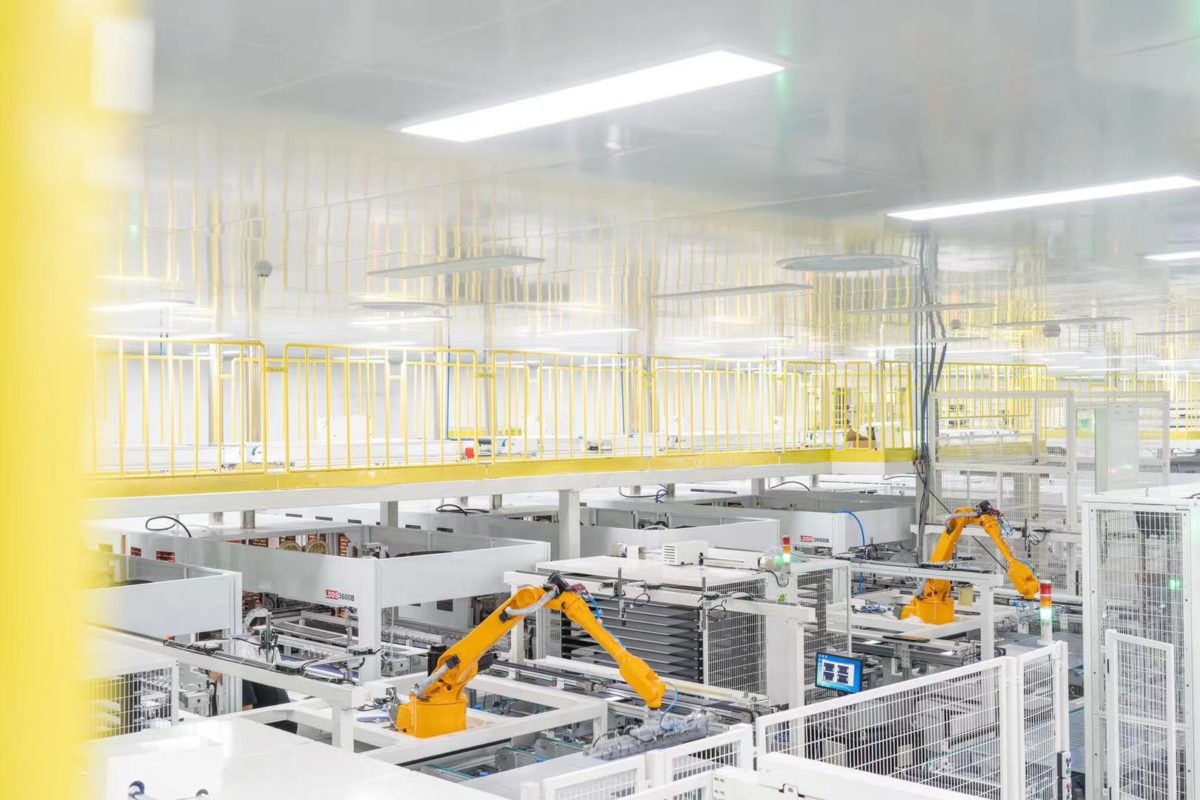
The project at the center of the dispute is a CNY10.3 billion manufacturing complex announced during the solar industry’s 2022 expansion cycle. The site is designed to support 10 GW each of wafer, solar cell and PV module capacity, with an initial phase targeting 10 GW of n-type tunnel oxide passivated contact (TOPCon) solar cells.
According to the company, construction of the complex began in November 2022 and ramp-up began in July 2023. However, only 7.5 GW of the cell capacity has been completed. In fact, production lines for wafers and modules have never been built.
Eging PV said the plant was gradually closed from October 2024, mainly due to weak market conditions and sharply reduced capacity utilization in the sector.
The impasse underlines the growing tension between local industrial policy expectations and the liquidity pressures facing China’s second-tier solar producers after two years of oversupply-induced price erosion. But Eging PV’s problems have also been exacerbated by the instability of its board. Following a judicial auction of shares held by former controlling shareholder Weizhi Energy, the company announced that it no longer has a controlling shareholder or de facto controller, leaving ownership fragmented.
Financial stress has also increased. For example, Eging PV’s 2024 annual report showed that revenue fell to CNY3.48 billion, with a net loss of CNY2.09 billion, due to sharp declines in module prices and underutilized capacity.
If the Administrative Committee of Quanjiao Economic Development Zone continues to terminate the investment agreement, the immediate financial consequences will depend on the final administrative decision and any subsequent dispute resolution. More broadly, the case would mark another high-profile wind-down of local government-backed solar manufacturing projects launched during China’s recent wave of capacity expansion, as weaker players prioritize preserving cash over scale.
Eging PV was founded in 1998 and is one of the earliest PV manufacturers in China. It was also the country’s first A-share listed solar panel company, listing on the Shanghai Stock Exchange in 2011.
This content is copyrighted and may not be reused. If you would like to collaborate with us and reuse some of our content, please contact: editors@pv-magazine.com.
