

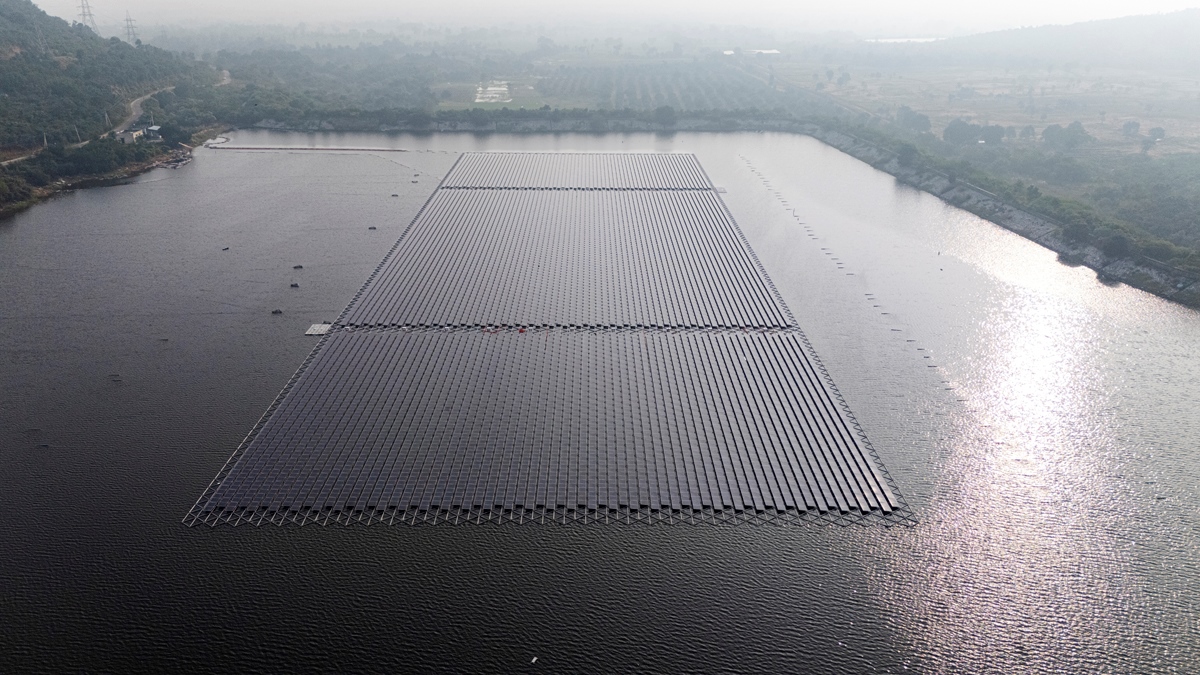
Fusio’s new floating structure has a triangular design and is said to be particularly suitable for markets such as India and South East Asia. The tilt angles can be configured at 5° or 12°.
French floating PV specialist Ciel & Terre has unveiled a new triangular float designed for floating solar power plants.
The new floating structure, called Fusio, has a honeycomb design and is said to be particularly suitable for markets such as India and South East Asia.
“The triangular shape of the Fusio structure is inspired by key principles of engineering and architecture, such as bridges, pyramids and skyscrapers,” the company said in a statement. “It is the most stable and resilient geometric shape to withstand external forces. The honeycomb design provides excellent mechanical strength and stability while ensuring optimal distribution of environmental loads across the structure.”
The Fusio platform supports all standard PV modules up to 800 W, including M10 and G12 sizes, as well as modules built with rectangular cells. The tilt angles can be configured at 5° or 12°.
According to Ciel & Terre, the system’s reduced water footprint and increased positioning of the modules improve airflow under the panels, improving cooling and increasing energy yield by up to 2% at high temperatures.
In the proposed configuration, the cabling is underwater, benefiting from additional cooling effects.
“Overall, these benefits make Fusio a highly competitive solution, designed to support projects ranging from hundreds of megawatts to gigawatt scale,” the company added. “We have also developed a unique maintenance solution: a catamaran specifically designed to glide over the PV modules. It works directly on the floating structure, providing safe, fast and easy access to every solar panel, electrical component and cable.”
Ciel & Terre said the Fusio system has already been deployed in projects totaling 4.3 MW, with a further 20 MW currently in the pipeline.
This content is copyrighted and may not be reused. If you would like to collaborate with us and reuse some of our content, please contact: editors@pv-magazine.com.
