

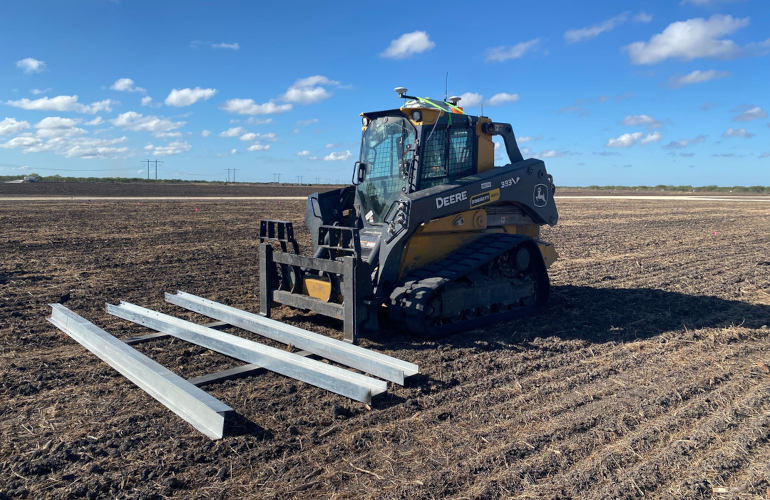
Civil robotics has launched a new AI-powered material distribution system for the solar industry. CivNav accelerates solar construction by streamlining logistics, efficient stacking and pallet placement, and advanced planning and workflow segmentation.
 “We’re seeing some really exciting technology entering the industry to solve long-standing inefficiencies,” said Tom Yeshurun, CEO and co-founder of Civ Robotics. “The most important element for us is to keep it simple and accessible, so that everyone in the workplace can benefit from new developments, regardless of their experience level. As we continue to build new robotic systems, we ensure that innovation and user experience always go hand in hand.”
To use the CivNav system, the operator mounts the sensor box on the machine of their choice and steps in with the CivNav tablet in hand. CivNav works with existing equipment; it is compatible with any skid steer or telehandler and is already installed on Bobcat, Takeuchi, Caterpillar and John Deere machines in the field. Once mounted, CivNav guides the operator where to distribute the poles, solar panels and more. The intuitive interface allows precise placement with accuracy up to 5cm, ensuring every plan is executed accurately.
When users combine this precise placement with GPS-enabled pile drivers, teams can skip the survey layout altogether. As the use of these GPS-assisted pile drivers increases and solar projects increase in size, the need to eliminate steps such as laying out structures becomes even more important. This is another important step towards automation on the construction site, which can be bridged employment gap.
 Measuring and tracking performance in the workplace can be difficult, which is why CivNav’s AI analytics automatically generates daily reports based on real-time data collected during use. By providing detailed insights into productivity, output, hours, distance traveled and more, managers can better identify bottlenecks and continuously optimize workflows as projects progress. This type of information is critical to better assess and drive decision-making about measuring the success of changes.
The CivNav works in conjunction with the company’s CivDot+ robots to provide a fully autonomous solution for EPCs with or without GPS on piling machines.
“Civ Robotics helped us map more than 300,000 point locations on three different projects with CivDots,” said Jason Field, BOLDT project manager. “When they shared with us the development of CivNav, which eliminates the need for physical point mapping for pole distribution, we knew we had to try it out. The field team was sold after a week of use and asked if it could be used for other tasks on other machines.”
CivNav is currently available for rental in beta.
