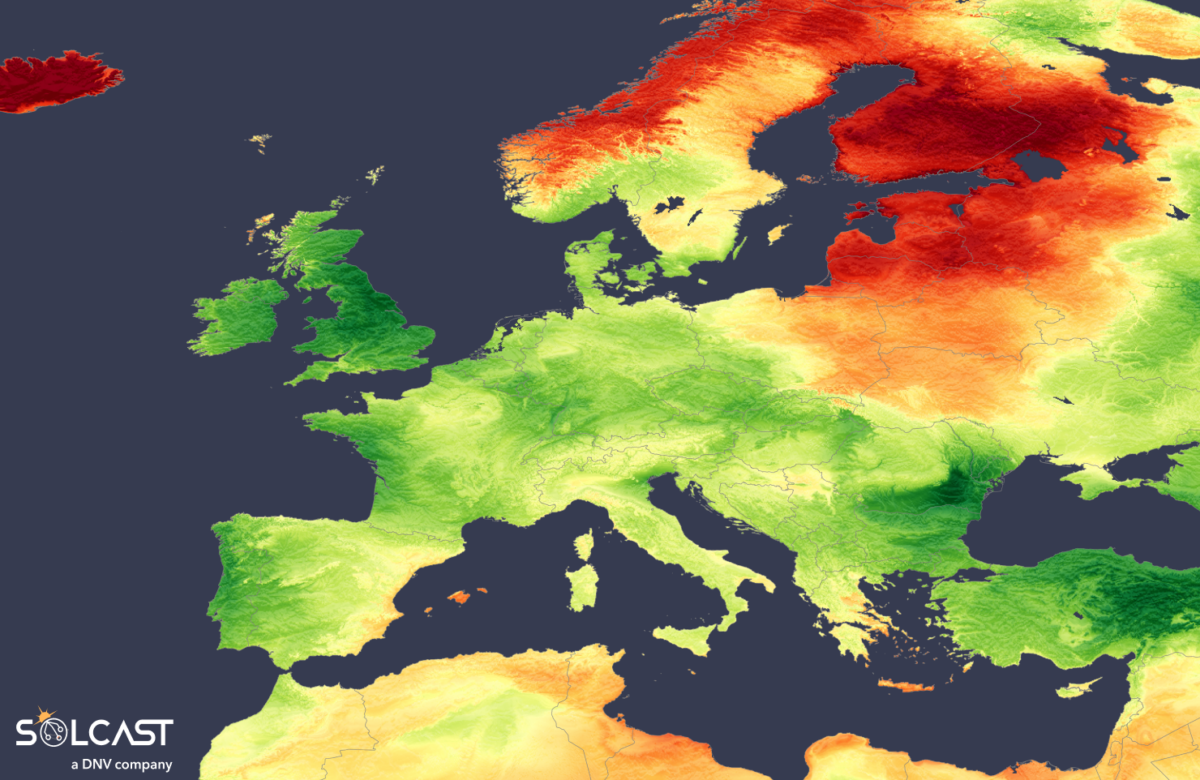
In a new weekly update for pv magazineSolcast, a DNV company, reports that there was a sharp gap in solar conditions in Europe in February. The northeastern regions experienced clear, cold weather with radiation levels 20% above average, while western and southern Europe experienced persistent storms and widespread radiation shortages.
February saw a continuation of January’s contrasting weather patterns across Europe, with stratospheric warming disrupting the polar vortex, shaping cloud cover and radiation patterns across the continent. Northeastern regions experienced colder, brighter conditions that pushed irradiance well above seasonal norms, while much of western and southern Europe experienced persistent storms, heavy rainfall and significantly reduced irradiance. According to analysis using the Solcast APIThe result was a sharply divisive month for solar conditions, with notable positive deviations in Scandinavia and the Baltics offset by widespread shortages stretching from the United Kingdom to the Eastern Mediterranean.
A major cause of this rift was a warming of the stratosphere that split the polar vortex, creating a blocking high-pressure system over northeastern Europe. This condition allowed cold, dry air to flow over the region, suppressing cloud formation and improving the clarity of the atmosphere.
While the cold conditions reflected a continuation of the exceptional winter already underway – with January bringing record cold to parts of the region – the associated dry air masses created favorable conditions for solar radiation. Iceland, Norway, Finland, Poland and the Baltic states recorded radiation levels about 20% above the long-term average. At these northern latitudes, February’s global horizontal irradiation (GHI) remains relatively low, meaning anomalies of this magnitude represent a substantial increase in available solar resources.
While northeastern Europe saw clearer skies, the displaced polar vortex also pushed the jet stream further south, sending a series of storms and atmospheric rivers towards western Europe. This shift caused persistent cloud cover and rainfall stretching from the United Kingdom and the Iberian Peninsula through France, Italy and the Balkans to Turkey. Irradiation was suppressed throughout this corridor, with the largest shortages concentrated in Britain, parts of the Black Sea coast and Turkey. The pattern continued January’s storm-dominated conditions, with systems containing Storms Leonardo, Kristin and Marta each hitting the Iberian Peninsula. These storms brought widespread flooding and landslides, while maintaining thick cloud cover that suppressed solar radiation in much of southern and western Europe.
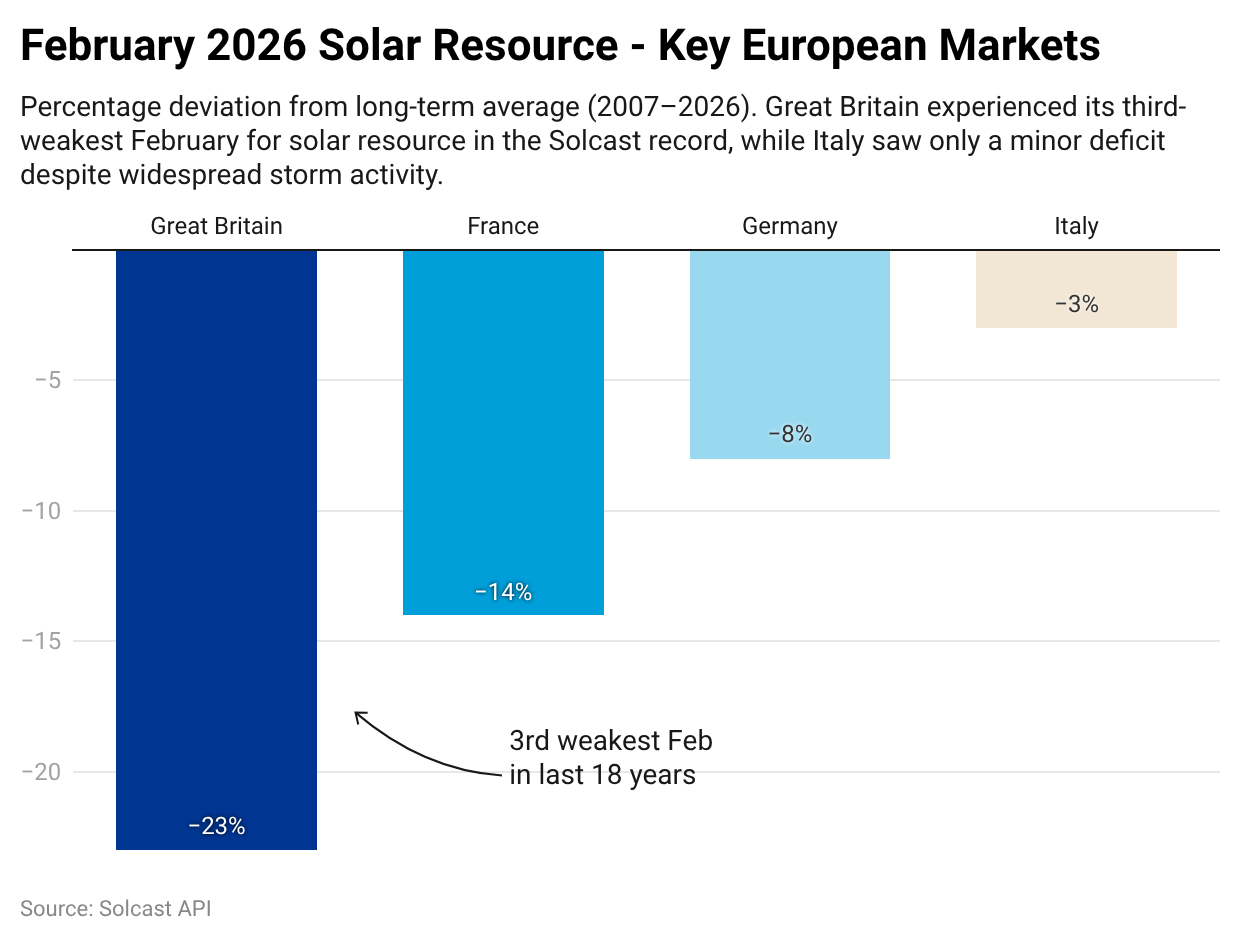
At national grid level, the impact varied significantly between the main European solar markets. Britain recorded solar power generation in February about 23% below the long-term average – the third-lowest February since 2008. France had a 14% shortfall, making it the fifth-lowest February on record. Germany experienced a more moderate decline of 8%, while Italy’s deficit was only 3%, putting the deficit in the middle of the historical range. The contrast between Britain and Italy shows how the storm track position hit west-facing markets much harder than the central Mediterranean.
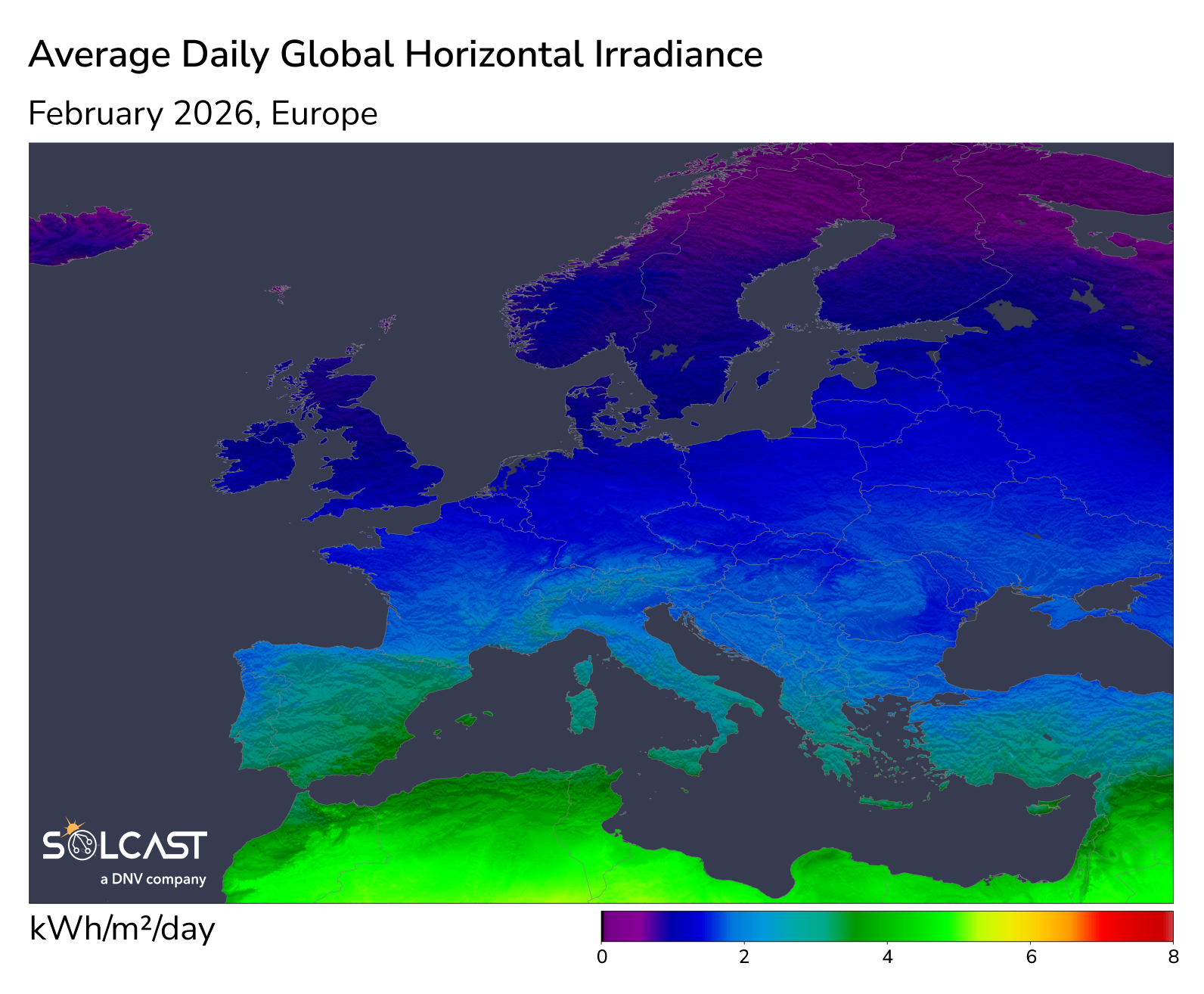
Conditions began to change somewhat towards the end of February when another blocking high developed over the Iberian Peninsula. This pattern brought a temporary break from the ongoing storm track, allowing warmer temperatures and slightly drier conditions to spread across Western Europe. Although this shift improved insolation levels at the end of the month compared to previous weeks, the overall monthly pattern remained similar to the highly distributed conditions in January. Looking ahead, conditions are expected to gradually return to seasonal norms across the continent in March, although models indicate that the UK, Benelux, northern France and northern Germany may continue to experience
slightly cloudier than normal conditions.
Solcast produces these figures by tracking clouds and aerosols worldwide at a resolution of 1-2 km, using proprietary satellite data AI/ML algorithms. This data is used to drive irradiance models, allowing Solcast to calculate high-resolution irradiance, with a typical deviation of less than 2%, as well as cloud tracking predictions. This data is used by more than 350 companies that manage more than 300 GW of solar energy worldwide.
The views and opinions expressed in this article are those of the author and do not necessarily reflect those of the author pv magazine.
This content is copyrighted and may not be reused. If you would like to collaborate with us and reuse some of our content, please contact: editors@pv-magazine.com.
Popular content