
Close Menu
  • News
  • Industry
  • Solar Panels
  • Commercial
  • Residential
  • Finance
  • Technology
  • Carbon Credit
  • More
    • Policy
    • Energy Storage
    • Utility
    • Cummunity
What's Hot

Dutch solar owners asked to switch off during peak periods to ease the distribution crisis

June 7, 2026

The hydrogen flow: Toyota demonstrates its racing prototype on liquid hydrogen

June 7, 2026

Era of electrification exposing Australia’s weakest link

June 6, 2026
Facebook X (Twitter) Instagram
Solar Energy News
Sunday, June 7
  • News
  • Industry
  • Solar Panels
  • Commercial
  • Residential
  • Finance
  • Technology
  • Carbon Credit
  • More
    • Policy
    • Energy Storage
    • Utility
    • Cummunity
Solar Energy News
Home - News - Converting seawater into freshwater using solar energy technology
News

Converting seawater into freshwater using solar energy technology

solarenergyBy solarenergySeptember 16, 2024No Comments3 Mins Read
Facebook Twitter Pinterest LinkedIn Tumblr Email
Share
Facebook Twitter LinkedIn Pinterest Email

Converting seawater into freshwater using solar energy technology


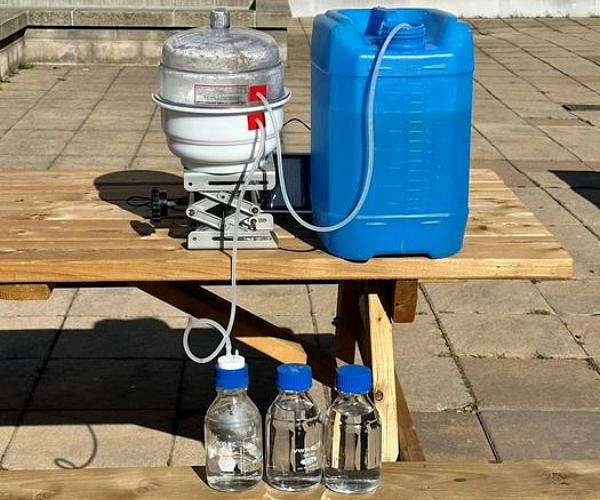
Researchers from the University of Waterloo have developed an innovative and energy-efficient desalination device that converts seawater into drinkable water using solar energy. The device uses a natural evaporation process, inspired by the way trees transport water, to provide a sustainable source of fresh water.

Desalination is becoming increasingly important for coastal and island states that face increasing concerns about water scarcity due to population growth and rising water consumption. According to the UN’s World Water Development Report 2024, approximately 2.2 billion people worldwide do not have access to clean water, underscoring the urgent need for new technologies to produce fresh water.

Traditional desalination systems rely on energy-intensive membrane filtration, which is prone to salt buildup that restricts water flow and requires regular maintenance. The newly designed system in Waterloo addresses these issues by drawing inspiration from nature and mimicking how trees move water from their roots to leaves.

“Our inspiration comes from observing how nature sustains itself and the way water evaporates and condenses in the environment,” says Dr. Michael Tam, professor in Waterloo’s Department of Chemical Engineering.

“The system we designed causes water to evaporate, transports it to the surface and condenses it in a closed cycle, effectively preventing the accumulation of salt, which reduces the efficiency of the device.”

The device is powered by solar energy and is remarkably efficient, converting approximately 93% of solar energy into usable energy – five times more efficient than current desalination technologies. The device can produce approximately 20 liters of fresh water per square meter, meeting the World Health Organization’s daily recommendations for basic drinking and hygiene needs.

See also  Australian study shows that pumped hydro and batteries can meet the needs of energy storage - PV Magazine International

The Waterloo team, including PhD students Eva Wang and Weinan Zhao, fabricated the device from nickel foam coated with a conductive polymer and thermoresponsive pollen particles. This material absorbs sunlight across the entire solar spectrum and converts it into heat. Water, distributed in a thin layer over the polymer, heats and rises through the system in a manner similar to how water moves through the capillaries of trees. As the water evaporates, the remaining salt is directed to the bottom layer, preventing clogging and maintaining efficiency.

Dr. Yuning Li, also a professor at Waterloo’s Department of Chemical Engineering, contributed to the project by measuring the light output of the device using a solar tester.

“This new device is not only efficient but also portable, making it ideal for use in remote areas where access to fresh water is limited,” said Li. “This technology provides a sustainable solution to the emerging water crisis.”

Next, the team plans to develop a prototype that can be tested at sea to evaluate the device’s performance on a larger scale.

“If the trial proves successful, the technology could sustainably deliver fresh water to coastal communities and advance the UN Sustainable Development Goals three, six, 10 and 12,” Tam said.

Research report:Thermoadaptive solar evaporation at the interface enhanced by dynamic water gating


Source link

Converting Energy freshwater seawater solar technology
Share. Facebook Twitter Pinterest LinkedIn Tumblr Email
solarenergy
  • Website

Related Posts

Dutch solar owners asked to switch off during peak periods to ease the distribution crisis

June 7, 2026

Britain’s next energy dependency is already taking shape

June 5, 2026

Letter from China’s PV Industry: Arctech wins 2.1 GW solar deal

June 5, 2026
Leave A Reply Cancel Reply

Don't Miss
Solar Industry

Shoals will invest $80 million to expand U.S. production

By solarenergyMay 4, 20240

Shoals Technologies Group, an electrical balance-of-systems (EBOS) specialist for the solar industry, says it will…

Solar energy is key to alleviating Burundi’s serious energy crisis

April 25, 2024

Aerocompact Debut based on PV solution mounted for small-scale solar energy-PV Magazine International

June 10, 2025

‘Various teams stimulate better results’ – PV Magazine International

April 6, 2025
Stay In Touch
  • Facebook
  • Twitter
  • Pinterest
  • Instagram
  • YouTube
  • Vimeo
Our Picks

Dutch solar owners asked to switch off during peak periods to ease the distribution crisis

June 7, 2026

The hydrogen flow: Toyota demonstrates its racing prototype on liquid hydrogen

June 7, 2026

Era of electrification exposing Australia’s weakest link

June 6, 2026

‘Come out from behind your screen, our industry is ultimately about people’

June 6, 2026
Our Picks

Dutch solar owners asked to switch off during peak periods to ease the distribution crisis

June 7, 2026

The hydrogen flow: Toyota demonstrates its racing prototype on liquid hydrogen

June 7, 2026

Era of electrification exposing Australia’s weakest link

June 6, 2026
About
About

Stay updated with the latest in solar energy. Discover innovations, trends, policies, and market insights driving the future of sustainable power worldwide.

Subscribe to Updates

Get the latest creative news and updates about Solar industry directly in your inbox!

Facebook X (Twitter) Instagram Pinterest
  • Contact
  • Privacy Policy
  • Terms & Conditions
© 2026 Tsolarenergynews.co - All rights reserved.

Type above and press Enter to search. Press Esc to cancel.