

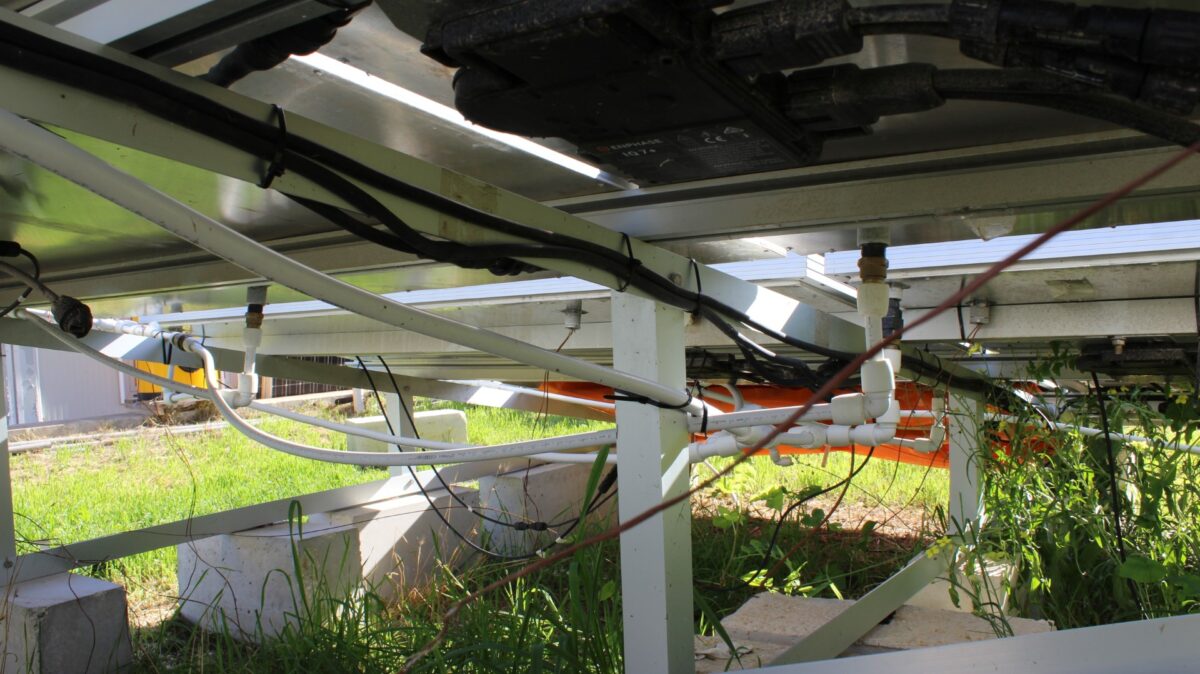
Scientists in Malta have developed an aftermarket cooling solution that can be fitted to existing standard PV modules. The system is based on a water chamber at the back of the module and can reportedly deliver a net electrical energy gain of more than 9%.
A group of scientists from the University of Malta have developed an after-market cooling system for photovoltaic modules that uses a water chamber that can be placed in an opening on the back of standard modules.
“The innovative photovoltaic cooling system (IPCoSy) has already been patented,” said the corresponding author of the study, Luciano Mulè Stagno, pv magazine. “This invention can be beneficial for offshore or floating photovoltaic installations, due to the unlimited water resources, and can also benefit both the residential and industrial sectors, which aim to install photovoltaic modules and operate them with increased efficiency. ”
The system consists of a base plate that is hermetically attached to the frame edges of a solar panel, creating a water chamber directly under the back of the panel itself. “This water chamber is defined by the backplate of the PV module, the frame wall and the bottom plate,” the scientists explained. “Examples of materials suitable for the base plate include aluminum, stainless steel, polyethylene terephthalate (PET), polypropylene and polyimide.”
The water chamber comprises a water inlet and a water outlet located at opposite locations of the frame wall. A temperature sensor is attached to the back plate of the PV module and is electrically connected to an external junction box. All these components are sealed with a waterproof material.
The system consists of a flow diffuser hydraulically coupled to the inlet on the inner surface of the frame wall. “This flow diffuser is configured to provide uniform fluid dynamics within the water chamber with the goal of pushing the hot water out with as little mixing as possible,” the group said. “The construction of the flow diffuser includes an assembly of a T-elbow joint connected at one end to the water inlet and two 45 degree elbow joints connected accordingly to two other ends of the T-elbow joint.”
The proposed solution also includes a pipe adapter that is hydraulically linked to the water outlet on the outer surface of the frame wall and is intended to allow easy installation of the panel. “The pipe adapter can be rotated so that the water in the chamber makes full contact with the backplate of the PV module, regardless of the installation angle, ensuring maximum heat transfer,” the academics said, noting that water to the cooling is pumped. system via a water pump that can use seawater or water from a tank.
According to the research group, the proposed system can deliver a net electrical energy gain of more than 9% and a thermal efficiency of up to 56%. ”
“The modified PV module in which the cooling system is integrated costs 9.7% more than the current standard PV modules,” explains Mulè Stagno. “A PV system including the aftermarket cooling design in its current state will cost double the price of current standard PV modules. However, these prices are calculated based on ‘one-off’ prototypes and therefore mass production is expected to reduce costs significantly. Even if we look at the thermal efficiency due to water heating and not just the electrical efficiency due to PV cooling, these prices already make sense.”
The new cooling technology was introduced in the study “Innovative photovoltaic cooling system,” published in Innovation disclosure. “This invention excels even more in areas where there is already a water flow for other processes, such as reverse osmosis plants,” the scientists pointed out. “In such plants, the IPCoSy modules will supply electrical energy from a renewable source, while using existing water flow to increase the operational efficiency of the PV modules.”
This content is copyrighted and may not be reused. If you would like to collaborate with us and reuse some of our content, please contact: editors@pv-magazine.com.
