A report from the International Renewable Energy Agency (IRENA) notes that while it is still uncertain whether sodium-ion batteries will become a disruptive alternative to lithium-ion technology, they could offer significant cost-saving potential in applications such as electric vehicles and large-scale energy storage.
Sodium-ion batteries (SIBs) could offer a promising cost-saving alternative to lithium-ion batteries (LIBs), according to a report from the International Renewable Energy Agency (IRENA).
The agency “Sodium-ion batteries: a technology assignmentThe report says the case for SIBs first gained traction in 2021 when lithium carbonate prices skyrocketed, but with lithium prices having fallen since then, it remains to be seen whether SIBs will become a cheaper alternative to LIBs in the long term.
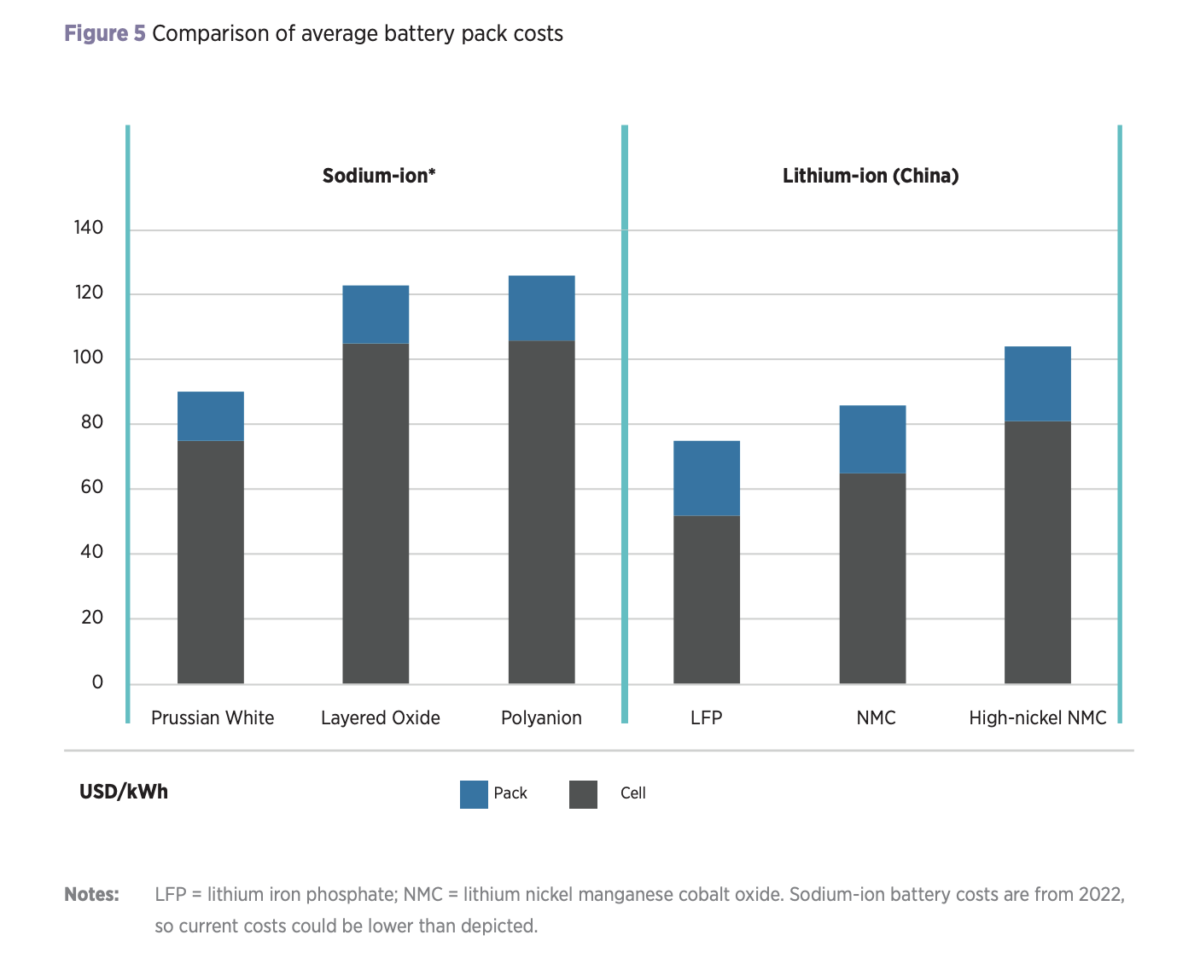
However, the report adds that SIBs can still maintain a competitive advantage over LIBs, with some manufacturers expecting the cost of SIB cells to drop to $40/kWh once production scales up.
SIBs have a potential advantage over LIBs due to the abundance and accessibility of sodium, a material that is significantly cheaper than lithium. IRENA says that between 2020 and 2024, the price of soda ash fluctuated between $100/ton and $500/ton, while the price of lithium carbonate ranged between $6,000/ton and $83,000/ton during the same period.
Sodium is also about 1,000 times more abundant than lithium in the Earth’s crust and roughly 60,000 times more abundant in the oceans. This leads IRENA to suggest that SIBs could help alleviate pressure on the supply chain and diversify the battery landscape, especially in light of the growth in the deployment of electric vehicles, which are expected to account for 90% of road transport by 2050.
The agency also suggested that SIBs could use more affordable materials in their construction, such as generally cheaper cathode materials such as manganese and iron, and the use of aluminum collectors instead of copper in LIBs.
SIBs also have the advantage of higher cost savings potential than LIBs because the technology is still in its infancy, the report adds. SIB production capacity is expected to reach 70 GWh this year, mainly concentrated in China and dominated by layered metal oxide cathode chemistry.
Although production capacity is expected to grow to 400 GWh per year by the end of the decade, IRENA points out that there is still uncertainty about the future market penetration of SIBs, with demand forecasts from various sources ranging from 50 GWh to 600 GWh per year by the end of the decade.
Beyond electric vehicles, IRENA says there is great potential for SIBs in stationary, large-scale energy storage, as they offer promising safety features, good performance at different temperatures and competitive lifetime. SIBs could also play a particularly critical role in low- and high-temperature environments for safety reasons, where they can outperform LIBs.
IRENA adds that while the potential for SIBs is substantial, future capacity deployment remains unclear, with challenges in ensuring sufficient demand and a robust supply chain. The agency also emphasizes that SIBs should not be viewed as a complete replacement for LIBs, but rather as a complementary technology that can help alleviate some of the sustainability and availability issues surrounding the battery supply chain.
“The long-term success of SIBs is likely to depend on a number of factors, including cost and availability of materials,” the report concludes. “Bottlenecks in the lithium supply chain, lithium shortages or higher lithium costs would all likely result in higher penetration for SIBs, while further cost reductions for LIBs would likely have a negative impact on SIB demand.”
This content is copyrighted and may not be reused. If you would like to collaborate with us and reuse some of our content, please contact: editors@pv-magazine.com.
Popular content