

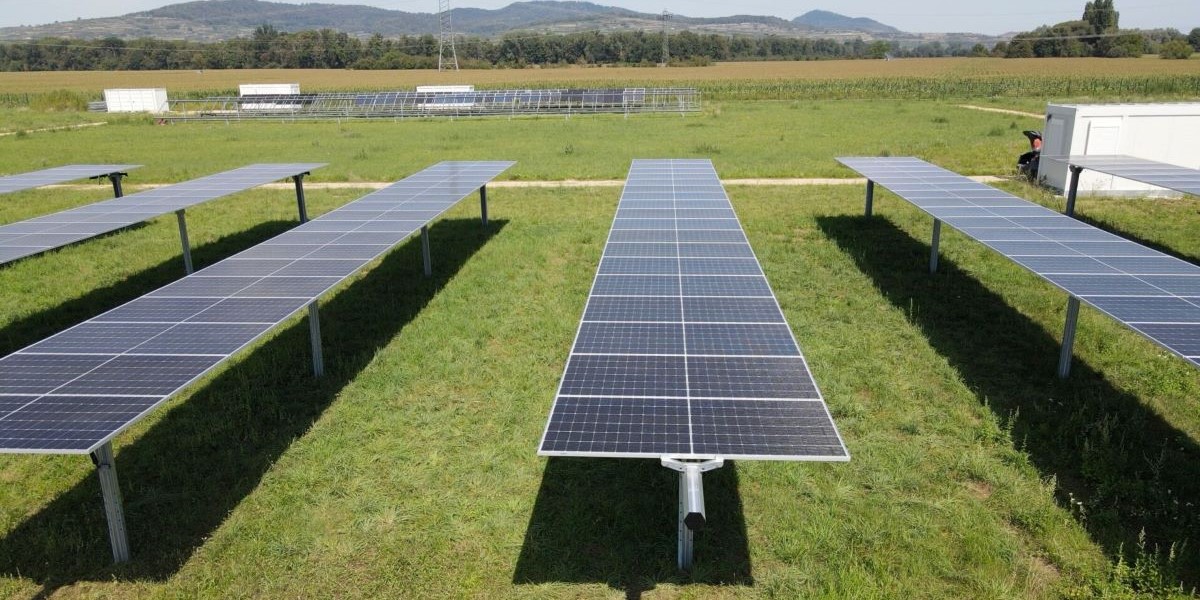
Fraunhofer ISE researchers apply deep learning and digital twin modeling tools to optimize PV tracker control systems for use in agricultural and biodiversity projects. The aim is to be able to automatically position the modules during the day to meet the needs of the plants growing underneath them, in view of the microclimatic conditions, and the need to optimize yield.
Researchers from Germany’s Fraunhofer Institute for Solar Energy Systems ISE (Fraunhofer ISE) are applying deep learning techniques and digital twin modeling tools to optimize PV tracker control systems for use in agrivoltaic and biodiversity-optimized PV systems.
The aim is to be able to automatically position the solar panels during the day to meet the needs of the plants growing beneath them in light of the microclimatic conditions and to optimize yield in light of grid conditions and tariffs. The researchers hope to develop a market-ready, computationally lightweight and cost-effective predictive control system for solar trackers.
The project, known as DeepTrack, is a collaboration between Zimmermann PV Tracker, part of the Zimmermann PV-Steel Group, and Fraunhofer ISE. This involved setting up a bifacial solar power plant at the ISE outdoor performance test site in southern Germany. It anticipates growth in the use of trackers, more powerful monitoring systems and greater adoption of agrivoltaic energy (APV) in Germany. “
As a first step, we developed control sequences aimed at the optimal electricity yield of bifacial solar panels or the best conditions for the plants under the APV system,” explains Fraunhofer ISE team leader Matthew Berwind. “The next step is to combine the two approaches so that both aspects are maximized as much as possible. Calculating this sweet spot is challenging, but possible with our AI-based approach.”
The research installation uses trackers from Zimmermann PV-Tracker and monitoring sensor systems to measure diffuse light, for example. The collected field data is used in the digital twin models, together with certain data sets, such as weather forecasts. The aim is to use deep learning techniques from artificial neural networks to enable control systems that initiate tracker actions based on both the light needs of the plant varieties below and the feed-in tariffs on the electricity grid at certain times of the day , for example.
The project website says it will be a “less compute-intensive and predictive metamodel” that can be implemented on regular computers.
The researchers anticipate a growth in the use of trackers. They point to new German regulations that are expected to enable greater adoption of agricultural solar voltaics, as well as industry forecasts that foresee a 60% tracking penetration in the next decade, citing the International Technology Roadmap for Photovoltaics. German Engineering Federation (VDMA). They also point to a Spanish market trend where trackers are reportedly used in “most newly built ground-mounted” PV systems.
“Especially for APV systems, with its wide variety of crops and systems, we see great potential for tracking PV systems with optimized tracking algorithms,” says Hannes Elsen, PV product manager at Zimmermann.
The DeepTrack research project is funded by the German Ministry of Economic Affairs, Labor and Tourism of Baden-Württemberg and is expected to run until early 2025. It is one of many agrivoltaic projects that the Fraunhofer ISE is currently working on.
This content is copyrighted and may not be reused. If you would like to collaborate with us and reuse some of our content, please contact: editors@pv-magazine.com.
