

BANDUNG CITY – The Ministry of Energy and Mineral Resources (KESDM) unveiled several new business opportunities for the ESDM sector through efforts to reduce emissions.
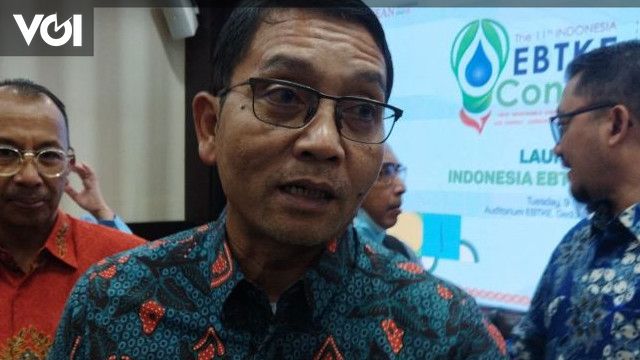
Secretary General (Sekjen) of the Ministry of Energy and Mineral Resources, Dadan Kusdiana, said one of these is through carbon trading.
“That the impetus for reducing baseline emissions is a market, the approach is a market approach. So there is supply and demand. The question is who should reduce emissions. Later, the supply will be those who can contribute to reducing emissions or known as carbon credit,” Dadan said on Saturday during a media workshop themed “Neighbors for the New Business Opportunities of ESDM Sector” in Bandung City, West Java.
The carbon exchange is a trading system where carbon emissions rights are traded with the aim of reducing greenhouse gas (GHG) emissions.
One tradeable carbon credit is equivalent to reducing one tonne of carbon dioxide emissions. When a carbon credit is used to reduce, store or avoid emissions, it becomes a substitute and can no longer be traded.
It is known that the Ministry of Energy and Mineral Resources launched carbon trading in the power generation subsector on February 22, 2023. For the first phase in 2023, there are 99 PLTU carbon trading participants with a total capacity of 33.5 gigawatts (GW).
Subsequently, Indonesia launched the Indonesian Carbon Exchange on September 26, 2023. The projects registered today, namely PT Pertamina Geothermal Energy Tbk Lahendong Project Unit 5 and Unit 6 in North Sulawesi.
“There are people selling it and someone bought it, so the market is already turning, it’s not going as fast as we thought. I think it’s good initially, you don’t have to be too fast, so there is maturity in terms of If there is a sudden fight to make the price rise, it will usually be difficult to make the price fall,” Dadan continued.
On that occasion, Dadan also mentioned the benefits and lack of CO2 emissions of the PLTU. He revealed that each PLTU emits a different volume of CO2. This depends on the technological side, the capacity and the quality of the coal itself.
“There are emissions, for example 1 kWh emits 1,100 grams of emissions. Some emit 1,000 grams of CO2 per kWh,” says Dadan.
He also provided an illustration: for example, the government has determined that the PLTU’s emissions for 2023 will be 1,050 grams of CO2.
“So with 1,100 emissions he has to reduce it to 1,050. How can he reduce that? He can actually save energy so that later the emissions can decrease, the consumption of new bricks has reduced the emissions.
“But there is a quick way: just buy carbon credits from PLTU, whose emissions are below 1,050, and buy there. This is what I call a ‘stamp and trade’,” Dadan said.
In addition, there are other new business opportunities through the development of new and renewable energy (EBT). The Ministry of Energy and Mineral Resources said EBT is increasingly important for global economic development, reducing the impacts of climate change and maintaining energy security.
Referring to the Green Electricity Supply Business Plan (RUPTL), the development of EBT will generate a total investment of approximately US$55.18 billion, open 281,566 new jobs and reduce GRK emissions by 89 million tons of CO2e.
Subsequently, Dadan also revealed that the new business opportunities for the EBY sector, ESDM, could also come from the adoption of CCS/CCUS (carbon capture/utility storage) technology.
“What CCS means is that the CO2 is captured. For example, if CO2 is captured from the power plant, the extracted CO2 is put into the stomach and stored there forever. Will we allow it later if we bring CO2 from Japan here? This is being discussed now, they will definitely pay, so it will be a new company. That’s what I said later: this will be a CCS business opportunity because we have such great potential,” he said.
Dadan said based on the latest information, Indonesia has the potential for carbon storage of 500 gigatons of CO2.
“This means there are 500 billion tons of CO2. PLN emits about the same emissions now that the figure is around 300-340 million. We spend the ESDM sector emissions nationally at 600 (million). So this is enough for about 900 years as long as it is used for the ESDM So this could be a new business area and we have now gotten into it and are now starting to implement this,” he said.
The English, Chinese, Japanese, Arabic and French versions are automatically generated by the AI. So there may still be inaccuracies when translating, always see Indonesian as our main language. (system supported by DigitalSiber.id)
