

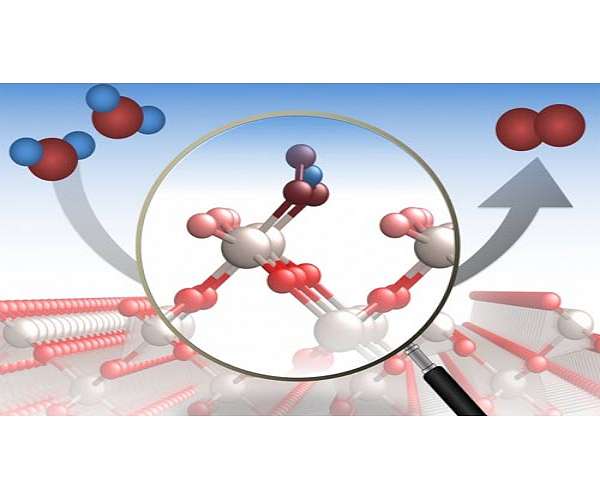
Researchers from CSIR-National Physical Laboratory and IIT Madras have fabricated MoS2-coated GaN nanorods on tungsten foil to improve the photoelectrochemical efficiency of water splitting. Gallium nitride nanorods, prized for their electron mobility and stability, face limitations due to their large band gap that limits solar energy absorption. To address this, the team integrated molybdenum disulfide – a catalytic material – onto the nanorods.
MoS2/GaN nanorods exhibited a photocurrent density of approximately 172 microamps per square centimeter, outperforming bare GaN nanorods by a factor of 2.5. This improvement was related to Type II band alignment, which improves charge separation, decreases charge transfer resistance, and increases active sites.
The heterostructures were developed using chemical vapor deposition at atmospheric pressure and molecular laser beam epitaxy. Materials analysis using Raman spectroscopy, X-ray diffraction and X-ray photoelectron spectroscopy confirmed hexagonal phases and mapped electronic states.
These findings suggest that MoS2 integration with GaN nanorods offers a way to advance solar-powered hydrogen production technology. The project received support from CSIR-FIRST and SAMMARTH. Future work will focus on scaling the approach for industrial application.
Research report:Tailoring GaN nanorods with MoS2 on tungsten foil for enhanced photoelectrochemical performance
