

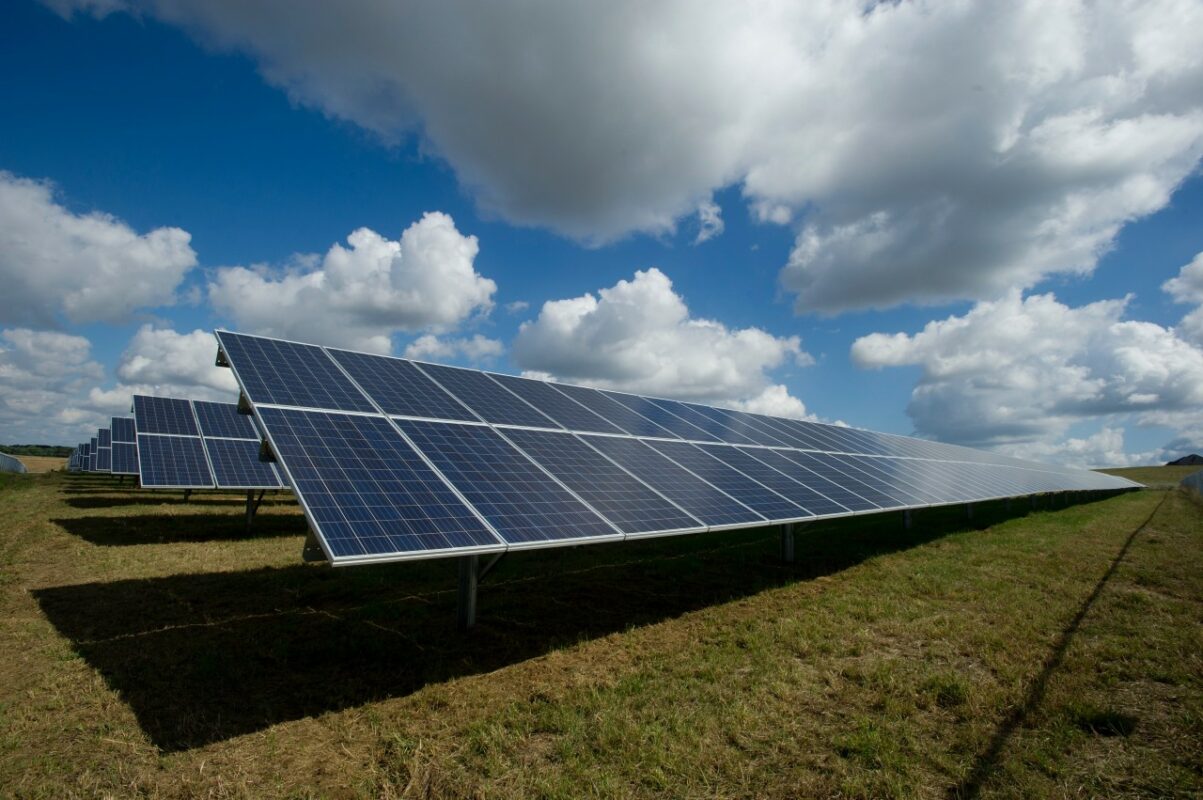
In the latest round of the UK’s renewable energy support programme, solar has acquired almost 2 GW of new capacity. Gareth Simkins examines the winning projects and looks ahead to assess how solar is likely to fare in future rounds.
A total of 56 ground-mounted solar projects have received support in the latest round of UK contracts
for Difference (CfDs) renewable energy support scheme in November.
According to government figures from September 8, the total capacity of allocation round 5 (AR5) amounts to 1,928 MW. Given that Solar Media estimates that national capacity, both ground and rooftop, will reach 17.6 GW by the end of the year, this figure represents a significant step towards achieving the government’s target of 70 GW by 2035.
This means that approximately 4 GW of capacity must be deployed every year, both on roofs and on the ground. The deployment will therefore have to be further accelerated. But this is exactly what the Department for Energy Security and Net Zero (DESNZ) is looking for: AR5 was the first round to be conducted annually, rather than every two years. It also anticipates the roadmap to be published in February by the government-industry Solar Taskforce, which will set out how the sector expects to achieve this goal and address barriers such as access to the electricity grid and the availability of skilled workers vanquish.
Of the 56 winners, 13 (with a capacity of 394 MW) are contracted to come online in 2025/26, 4 (151 MW) in 2026/27 and 39 (1,383 MW) the following financial year. The total is lower than AR4, which had 66 winning projects, and comes to just over 2.2 GW.
The agreed exercise price was £47/MWh, the same as the maximum bid price set by the government.
Since the strike prices are expressed in 2012 prices adjusted to the consumer price index, the actual value of the price is 37.4% higher and works out to approximately £64.60/MWh in today’s currencies. Although the increase is substantial, the costs are still much lower than when the CfD regime started in 2015, when £79.23/MWh was agreed for three projects due to come into service in 2015/2016 (corresponding with approximately £108.88/MWh now ).
It is also worth highlighting that £64.60/MWh is significantly less than what these projects would receive if operated on a commercial basis, assuming current wholesale electricity prices remain in place. The result is that the 56 locations are expected to pay back significant sums of money to the Treasury, in return for financial security and thus the confidence to invest.
The published capacities of the winning solar projects range from as little as 7 MW to 57 MW. But upon closer inspection, there appears to be some ambiguity about what these numbers represent.
At first glance, the largest project – an unnamed project of Enso Green Holdings – appears to be the only Nationally Important Infrastructure Project (NSIP) on the list, as it is above the 50MW threshold to be considered by the government, and not by the local authorities. The largest competitors are all 50 MW, or just below.
But the NSIPs in the pipeline are well known – and nothing can match this project. Furthermore, the additional costs of building such plants mean that building a plant so close to the capacity threshold makes little sense.
This article was first published on Solar Power Portal’s sister publication PV-Tech. You can find the full version here.
