Spanish engineering company Intergia is testing floating PV systems adapted for manure lagoons on pig farms to reduce ammonia emissions while generating solar energy on site. Two prototypes are being assessed to measure emissions reduction, sustainability and energy performance.
Engineering firm Intergia has announced that it will test floating PV systems adapted for manure lagoons on pig farms.
The initiative combines partial covering of the lagoon to limit ammonia emissions with the generation of PV electricity for on-site self-consumption. The project will run from 2024 to 2027 and is supported by funding from the EU’s NextGenerationEU programme.
The company explained that lagoons are continuously fed with manure collected from farm facilities through a pipe system. Periodically, trucks or tractors remove the manure using suction systems to empty the lagoons. In regions with intensive livestock farming, manure surpluses lead to excess nutrients, especially nitrates, which can contaminate soil and water supplies if they enter aquifers and waterways.
During storage, lagoons also release significant amounts of ammonia into the atmosphere. Satellite observations have identified elevated concentrations of the gas in areas with a high density of intensive pig farming. Covering the lagoons is therefore seen as a mitigation measure to reduce emissions and evaporation.
Intergia is currently testing two prototypes of floating PV systems with different designs.
The first was installed on a sow farm in Calzada de Tera, Zamora, using a commercial floating PV system originally designed for water applications but adapted for use on manure lagoons. It currently covers approximately 20% of the lagoon area, with plans to increase coverage to 90% using weighted hexagonal floating elements. It includes 56 solar panels with a total capacity of 33.04 kW and is expected to generate approximately 50.04 MWh annually, reducing the park’s electricity bill by as much as 22%.
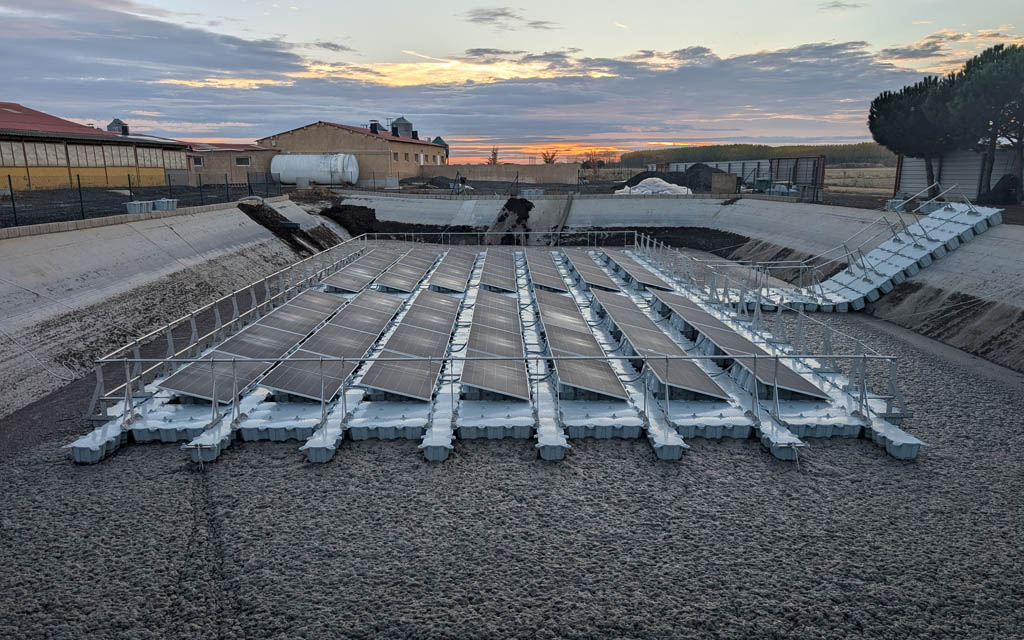
The second prototype, specially developed for this application, has been installed on a fattening farm with 6,000 animals in Tauste, Zaragoza. The facility operates off-grid and previously relied on a diesel generator supplemented by a small photovoltaic system.
Image: Intergia
The Tauste manure lagoon has a surface area of 1,100 m². To minimize air-silt interaction and reduce the risk of emissions, conventional floating photovoltaic systems were ruled out in favor of a modular floating pontoon system from Bulgaria-based Buldock, consisting of interconnected cubic elements designed to minimize open water areas.
A special superstructure was installed on this platform, consisting of a matrix of horizontal anodized aluminum beams, anchored by bolts at the float connection points. The system contains brackets that position the photovoltaic modules at an angle of 15 degrees. In total, the installation consists of 16 PV panels with a capacity of 9.44 kW, oriented slightly southeast. To prevent corrosion in the ammonia-rich environment, aluminum and stainless steel components are used throughout.
The floating platform measures 11.5 m x 9.5 m and is equipped with safety railings and a special channel for laying solar cables. It is secured by four mooring points and automatically adapts to fluctuations in the level of manure, without coming into contact with the banks of the lagoon.
The system covers approximately 10% of the lagoon’s surface area and is expected to generate approximately 15.2 MWh annually – enough to meet up to 53% of the farm’s electricity demand through self-consumption.
The project also includes an environmental monitoring campaign to assess system performance. Ammonia emissions are measured using a floating dynamic chamber in accordance with standardized protocols, while methane concentrations are monitored in real time using special sensors both above the platform and along the edge of the lagoon.
At the same time, data on PV generation and self-consumption will be analyzed. A technical and economic comparison of the two prototypes will determine which solution performs better in terms of emissions reduction, corrosion resistance, energy efficiency and economic viability, with the aim of developing a scalable commercial solution for the pig sector.
This content is copyrighted and may not be reused. If you would like to collaborate with us and reuse some of our content, please contact: editors@pv-magazine.com.
Popular content