

In a new weekly update for pv magazineSolcast, a DNV company, reports that the end of spring in the Northern Hemisphere is creating favorable conditions for solar power generation in key markets in the United States, China and Europe.
Seasonal forecasts through late spring in the Northern Hemisphere indicate favorable conditions for solar power generation in key markets in the United States, China and Europe, according to analysis using the Solcast API. Despite regional differences, especially in China, large-scale solar operators in all three regions can generally expect above-average irradiance during the critical months of the coming season. Although long-term seasonal forecasts are fickle, planning for the future is an important part of power grid and electricity distribution planning.
The southwestern United States will benefit from continued positive insolation anomalies through May. Data from Solcast shows that solar energy levels in this region could exceed climatological averages by as much as 20% in December alone. This is expected to benefit the concentration of large utility-scale PV assets from Southern California to Texas, which are expected to experience positive anomalies from December through May. The broader outlook for North America includes additional likely positive conditions in Central America, parts of the Caribbean and the eastern US, while Canada is expected to experience below-normal conditions in December. These patterns indicate a seasonal favorable period for U.S. solar operators, especially in the South.
In China, forecasts point to a continuation of the well-known east-west split in solar conditions. The eastern and southern regions are expected to experience insolation up to 20% lower than normal in December, capping an overall positive year, before picking up again in January and February. However, most of China’s utility-scale solar power generation is in the north, where GHI anomalies are expected to remain more stable. In these northern regions, insolation may be slightly below climatic conditions in January and February, but conditions are expected to improve with the arrival of spring. Solcast’s forecasts show a series of positive deviations from March through May, providing a constructive outlook for asset performance in the first part of the year, especially as conditions transition into peak solar generation in late spring and early summer.
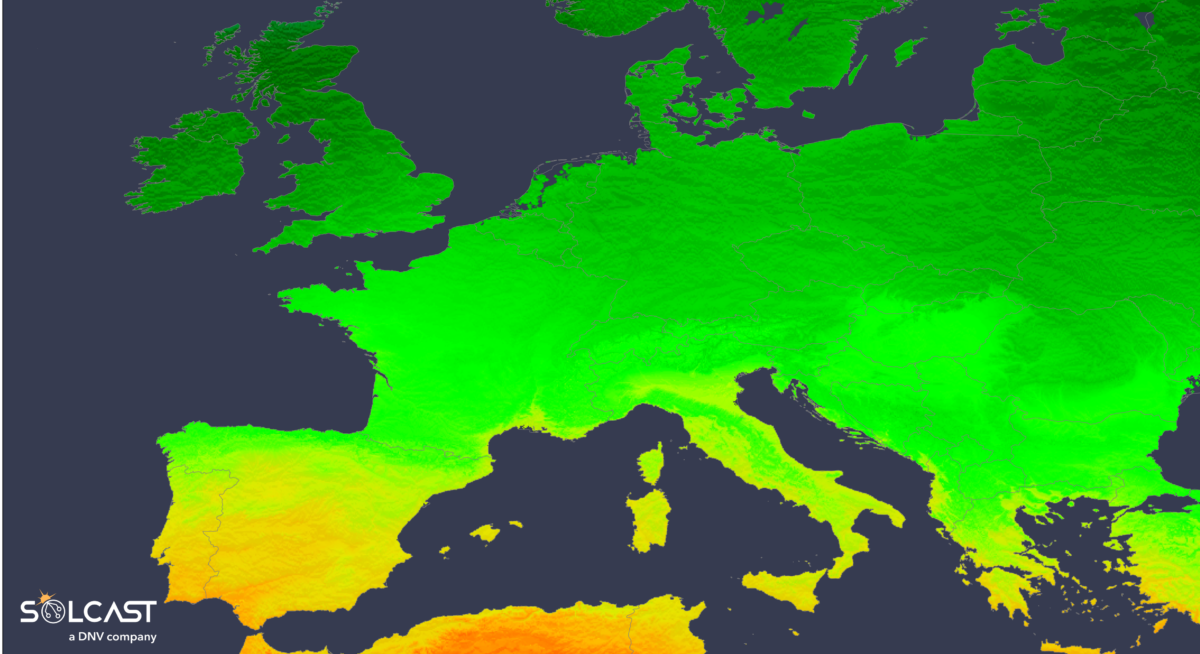
Meanwhile, Europe shows milder seasonal anomalies overall, with a clearer positive signal developing in the south. The western Mediterranean in particular is expected to benefit from stronger insolation in the spring. A general positive anomaly currently forecast for April indicates an increase in solar production as the days grow longer and skies remain clearer than normal.
As shown in the daily GHI projection from the April Solcast API analysis, the combination of ECMWF SEAS5 anomalies with Solcast’s long-term averages indicates strong positive signals in the Western and Mediterranean regions. Spain is currently forecast to see anomalies around 15% above normal in April, with the country’s main PV sites expected to exceed average irradiance by more than 5% over the same period.
Solcast produces these figures by tracking clouds and aerosols worldwide at a resolution of 1-2 km, using proprietary satellite data AI/ML algorithms. This data is used to drive irradiance models, allowing Solcast to calculate high-resolution irradiance, with a typical deviation of less than 2%, as well as cloud tracking predictions. This data is used by more than 350 companies that manage more than 300 GW of solar energy worldwide.
The views and opinions expressed in this article are those of the author and do not necessarily reflect those of the author pv magazine.
This content is copyrighted and may not be reused. If you would like to collaborate with us and reuse some of our content, please contact: editors@pv-magazine.com.
Popular content

