

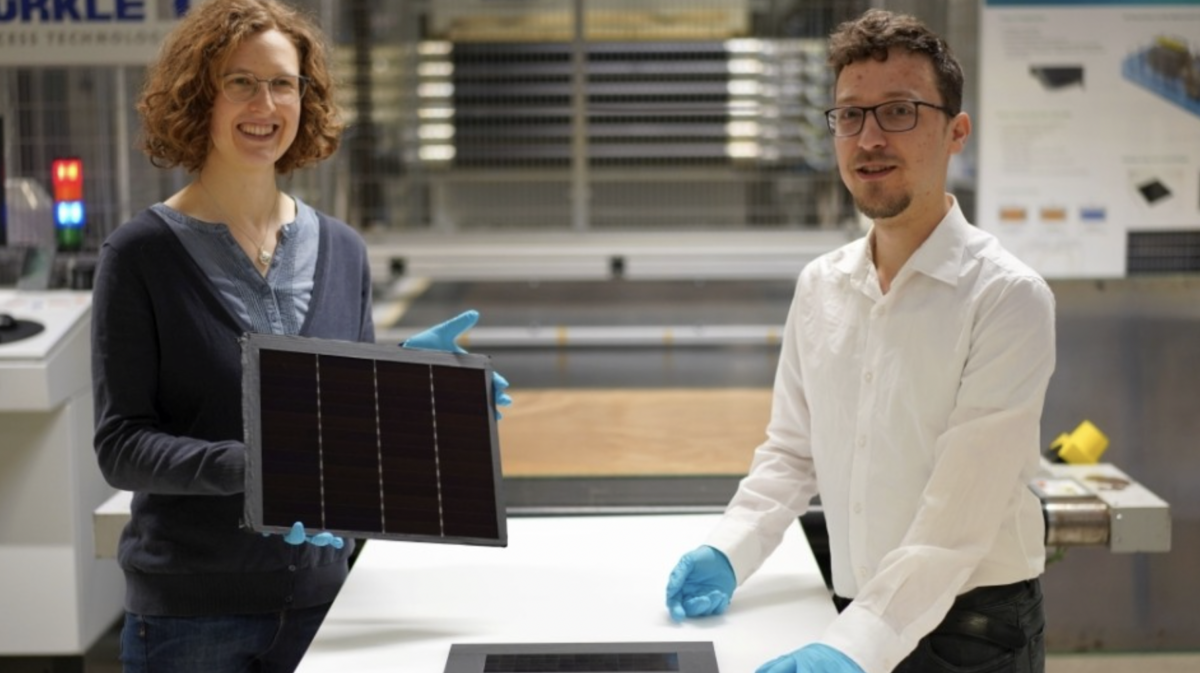
Fraunhofer scientists have announced two efficiency records for III-V tandem modules. The team says its III-V germanium PV module with an efficiency of 34.2% is the most efficient solar panel in the world, while its III-V silicon PV module with an efficiency of 31.3% is a record in its class.
Germany Fraunhofer Institute for Solar Energy Systems ISE has developed two III-V tandem PV modules with a world record energy conversion efficiency. The team’s modules each contain solar cells based on III-V semiconductor compounds, composed of elements from the third and fifth groups of the periodic table.
The first, a III-V germanium PV module, achieved an efficiency of 34.2%, making it the most efficient solar panel in the world, according to the Fraunhofer team.
The 833 cm2 tandem module was built as part of Fraunhofer’s Vorfahrt project. It consists of triple III-V germanium cells, developed by project coordinator Azur Space Solar Power, specialist in multi-junction solar cells for photovoltaic space travel. A statement from Fraunhofer explains that the manufacturer has adapted its triple solar cell technology to the terrestrial solar spectrum so that it can be produced in similar quantities and in the same wafer sizes as its space solar cells.
The module’s efficiency was further improved by nanotechnology specialists temicon GmbH, who transferred a stochastic surface structure to the glass surface using nanoimprint, minimizing reflection losses at the module interface.
Fraunhofer has also announced a record efficiency of 31.3% for a III-V silicon PV module, which it claims is a record for its class.
The module, which measures 218 cm, builds on an efficiency record for III-V silicon solar cells from Fraunhofer from 36.1%. Through the Mod30plus research project, the team has achieved small-scale production of the solar cells, adapted for interconnection with shingle technologies to produce the module.
Fraunhofer ISE scientist and Vorfahrt project leader Laura Stevens said the institute is conducting intensive research to replace individual solar cells with multiple solar cells in modules, as conventional silicon solar cells cannot exceed a physical limit of 29.4%.
“The fact that we have achieved a world record with the III-V germanium module shows the great potential of combining multiple semiconductors,” said Stevens.
Andreas Bett, director of Fraunhofer ISE, added that both tandem PV technologies have the potential to fill application gaps between conventional, cost-effective ground and roof systems on the one hand, and high-performance but more expensive space solar cells on the other.
“III-V in combination with silicon as a more affordable option, and III-V on germanium as a slightly more efficient alternative, are both interesting technology routes for integrated PV applications wherever space is limited,” says Bett.
Last July, Fraunhofer achieved this goal 40% efficiency for an indoor III-V solar cell based on an indium-gallium phosphide absorber.
This content is copyrighted and may not be reused. If you would like to collaborate with us and reuse some of our content, please contact: editors@pv-magazine.com.
