

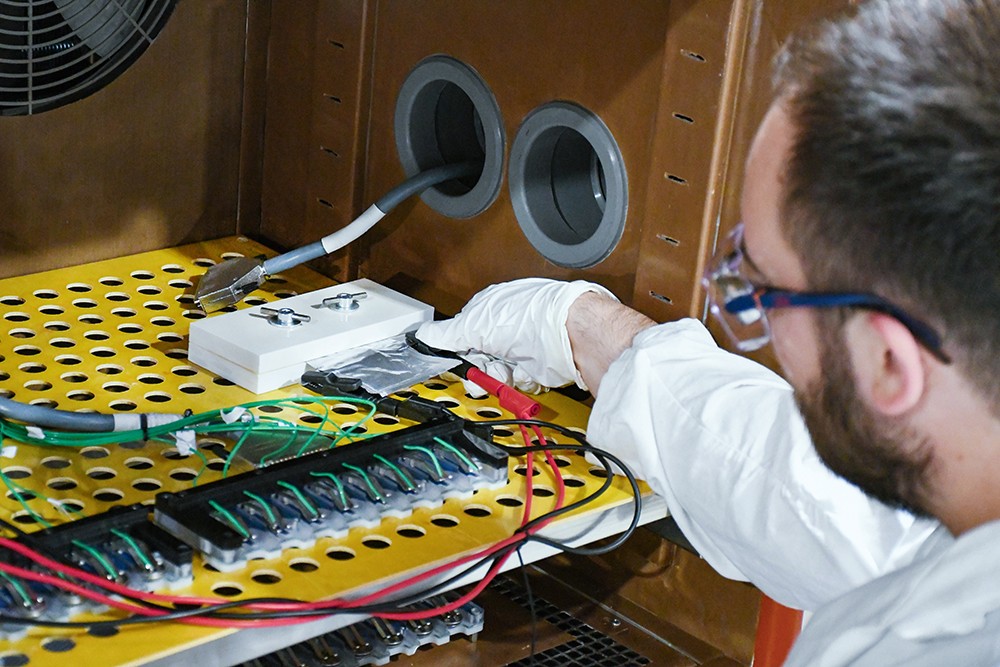
German researchers have developed a sodium-ion battery technology that uses lignin-based hard carbon as a negative electrode. The prototype 1 Ah battery cell showed no significant degradation after 100 charge and discharge cycles.
Researchers from Germany’s Fraunhofer Institute for Ceramic Technologies and Systems (IKTS) and Friedrich-Schiller-University Jena have fabricated a prototype sodium-ion battery that uses lignin, a complex organic polymer found in the cell walls of plants, as an electrode material.
Lignin is an abundant byproduct of the wood and pulp industry. After processing, it exhibits good electrical conductivity and the redox-active groups can reversibly store and release electrons. For battery applications, lignin is typically carbonized to produce hard carbon.
The research team used lignin from Mercer Rosenthal GmbH, a German company specialized in the production of cellulose, bioenergy and bio-based chemicals from wood and other renewable raw materials. The lignin was thermally converted into carbon under inert conditions and then processed into negative electrodes.
“The structure of this hard carbon is well suited for the reversible storage of sodium ions,” the academics explain. “Hard carbon has high electrochemical performance, good cycle stability and low acquisition costs, especially when obtained from sustainable raw materials.”
Image: Fraunhofer IKTS
Using this electrode material, the team assembled 1-Ah battery cells and tested them at the Fraunhofer IKTS battery test center in Arnstadt, at Fraunhofer IKTS in Hermsdorf and at the Friedrich Schiller University in Jena.
“After 100 charge and discharge cycles, the laboratory cell shows no significant degradation. The goal is to demonstrate 200 charge and discharge cycles for the 1-Ah full cell by the end of the project,” said the research coordinator, Lukas Medenbach, noting that the proposed battery technology is intended for stationary or mobile storage applications.
No further technical details about the new battery technology were provided.
“The project aims to support the increasing independence of critical raw materials while promoting the transition to cheaper, more sustainable and safer batteries,” Fraunhofer IKTS said in a statement. “It is supported by an industrial advisory board consisting mainly of regional companies, including Thuringia-based companies Mercer Rosenthal GmbH, Glatt Ingenieurtechnik GmbH, IBU-tec advanced materials AG and EAS Batteries GmbH, as well as Petrochemical Holding GmbH based in Vienna.”
This content is copyrighted and may not be reused. If you would like to collaborate with us and reuse some of our content, please contact: editors@pv-magazine.com.
Popular content

