

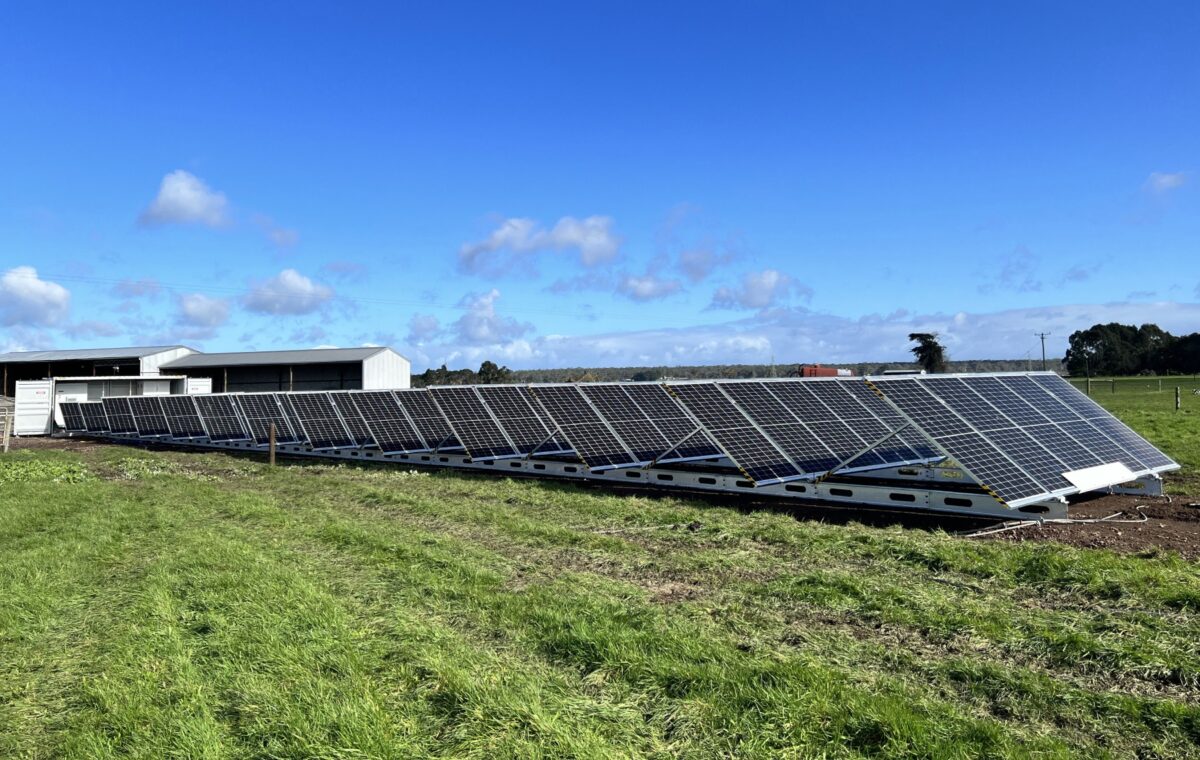
Paired Power’s modular microgrid goals are remote assembly-free industrial and agricultural applications and rural electrification for indigenous communities.
California-based Paired Power, a manufacturer of integrated solar canopy and microgrid systems and software, has partnered with Australian solar microgrid designer and manufacturer PHNXX (pronounced “phoenix”) to produce the PairPHNXX modular solar and battery storage system. Each unit deploys from a standard 20-foot shipping container and can be unpacked and operational within a day with little to no heavy equipment.
The PairPHNXX is intended for industrial, agricultural, military and emergency operations in remote locations or off the grid, or when access to the grid is negligible or disconnected.
Tom McCalmont, CEO of Paired Power, told pv magazine USA that the system is intended to be a ‘grid in a box’ that, once delivered by a flatbed truck, functions essentially unattended once the solar panels are deployed and exposed to the sun. This also makes it suitable for rural electrification efforts.
“PHNXX designed the modular hardware that forms the basis of the PairPHNXX microgrid, including the solar panels and deployment mechanism,” said McCalmont. “Paired Power has supplied the operating system – computer and software – and integrates all electronics, such as the inverter and batteries.”
The two partners bring different origin stories to the microgrid market. Paired Power integrates and installs microgrids that do not require grid interconnection, with a particular focus on EV charging applications. For example, the PairTree solar canopy system can be installed on plots without the need for soil preparation or trenching. PHNXX focuses on designing and building modular, stand-alone energy systems for rural and remote industrial communities. The company says it helps users reduce dependence on diesel generators and switch to renewable energy sources.
Both Australia and the United States are vast countries with vast “outback” areas that nevertheless support important mining, ranching, farming, and other activities that require electricity. Modular solar microgrids are a way to expand energy capacity independently of grid interconnection. At the same time, both countries also have indigenous communities in need of electricity, and Paired Power and PHNXX plan to meet this need.
Coinciding with the launch of PairPHNXX, Paired Power has been included in the Preferred Provider Program of the Alliance for Tribal Clean Energy, a Native-led 501c3 nonprofit organization that supports Native American communities’ transition to renewable energy systems. Under the terms of the agreement, Paired Power and PHNXX are now approved partners to provide clean energy solutions to Native American and Aboriginal tribes.
Citing the MacArthur Foundation, McCalmont said that 75% of unelectrified homes in the United States are found on tribal lands, and 14% of Native Americans do not have access to electricity. Native American communities were largely bypassed by rural electrification efforts, which left most of the country connected to the electric grid. The lack of reliable access to electricity networks is also affecting Aboriginal communities in Australia, where many rely on diesel generators for their electricity.
“Even for tribal communities that do have electricity, grid reliability is often a serious problem,” he said. “The Preferred Provider Program was created to help Indigenous communities achieve energy sovereignty and resilience with cost-effective, clean energy while minimizing the risk of exploitation. We are very proud to be included in this program.”
In addition to rural electrification requirements, many tribal regions support their own remote industrial and agricultural activities that could benefit from microgrids. In this sense, McCalmont says, all potential users want to effectively use and manage solar energy, stored energy and grid resources in a way that reduces costs and maximizes energy resilience and self-sufficiency.
“Paired Power is not just focused on the use of microgrids in remote and off-grid locations, although our systems are certainly useful in those circumstances,” he said. “There are also many situations where grid capacity is being constrained: the massive growth of data centers driven by AI, expanded electric vehicle charging for transportation electrification, and other new loads and rapid load growth are far exceeding the utilities’ ability to keep pace with delivering power. Microgrids are a proven, effective, and scalable solution for accelerating and supporting electrification where grid capacity is limited. is limited.”
This content is copyrighted and may not be reused. If you would like to collaborate with us and reuse some of our content, please contact: editors@pv-magazine.com.
