

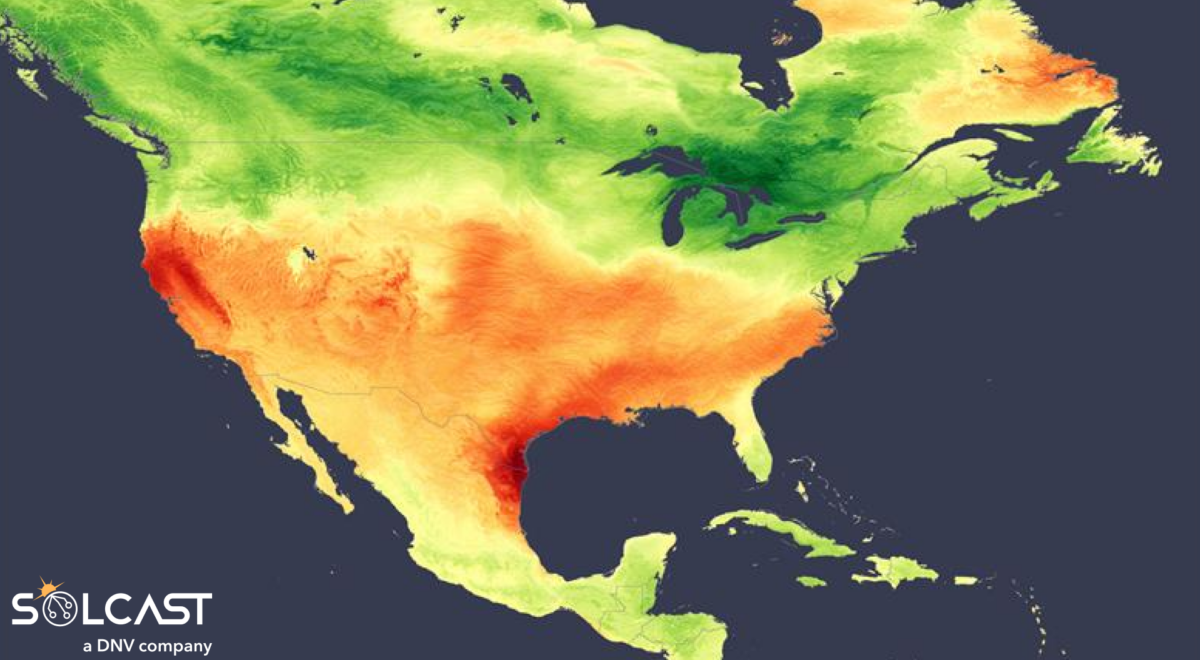
In a new weekly update for pv magazineSolcast, a DNV company, reports that North America experienced a large solar gap last month, with southern regions such as northeastern Mexico, southeastern Texas and much of California experiencing insolation 20 to 25% above average, while Canada, the Great Lakes and the northeastern US experienced persistent cloud cover and below-normal solar conditions. This contrast was caused by high-pressure systems and a southwestern heat dome to the south versus a polar vortex that brought cold air and storms to the north.
North America saw a pronounced gap in solar conditions through March, with the southern half of the continent recording widespread increases in solar energy resources, while the north saw continued cloud and storm activity, according to analysis using the Solcast API.
The strongest gains were in northeastern Mexico and southeastern Texas, where anomalies were roughly 20-25% above the March long-term average, while much of California also showed similar increases. Canada, the Great Lakes and the northeastern United States recorded lower than normal insolation as polar air and storm systems dominated conditions. This produced a month in which the usual seasonal contrast between north and south was sharpened, with clearer skies in the south and cloudier conditions in the north compared to the 2007-2025 average.
Much of the southern United States and northern Mexico benefited from a few high-pressure systems over the Pacific and Atlantic coasts of North America. These systems stabilized the atmosphere and kept the sky clearer than normal in large areas. Southern Mexico and Florida were exceptions to the southerly trend, each experiencing slightly below-average insolation where local cloud cover persisted.
A pronounced heat dome over the southwestern United States further amplified these conditions, pushing temperatures 10–19 C (18–35 F) above seasonal norms and breaking multiple records as local areas even saw large increases. These warm conditions, which more resembled summer temperatures than spring, were the result of high atmospheric stability, which also suppressed cloud formation and allowed for extended periods of clear skies. As a result, California emerged as one of the best performing regions relative to average conditions, with significantly higher insolation levels for much of the month. The magnitude of the heat anomalies was remarkable, with attribution studies indicating that these extremes would be highly unlikely without the influence of climate change.
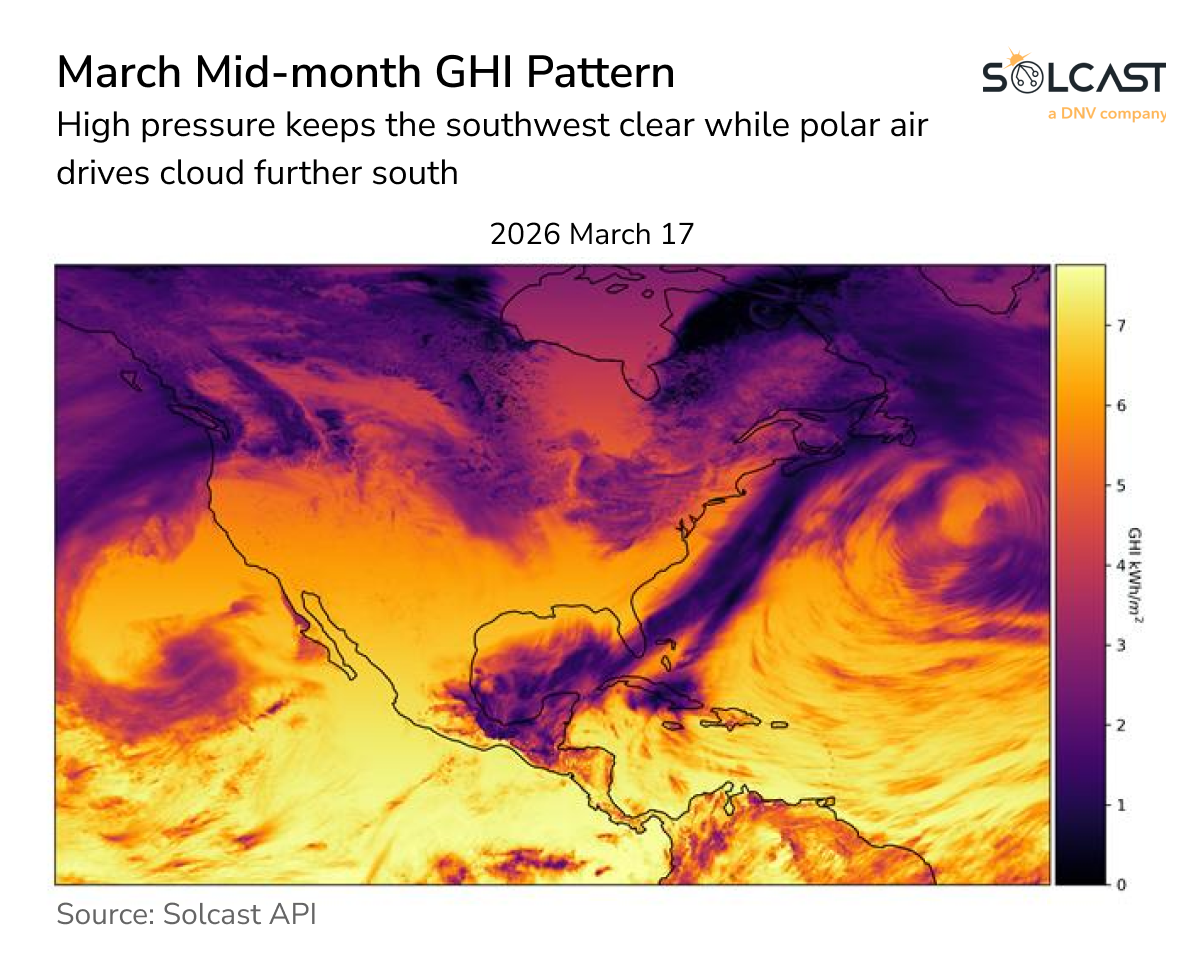
At the same time, the northern parts of the continent experienced a very different pattern as an unstable polar vortex pushed cold polar air into Canada and the northern United States. This caused blizzards and blizzards in several regions, especially around the Great Lakes and the Northeast, where insolation fell well below normal for March. These stormy conditions contributed to the largest percentage declines from average in areas north of the Great Lakes.

The Arctic air thrust extended unusually far south, reaching into Florida and contributing to the light below normal radiance, despite generally sunnier conditions over most of the southern half of North America. Collectively, these factors reinforced the stark contrast between the sunnier southern regions and the cloudier, storm-affected conditions in the north.
Solcast produces these figures by tracking clouds and aerosols worldwide at a resolution of 1-2 km, using proprietary satellite data AI/ML algorithms. This data is used to drive irradiance models, allowing Solcast to calculate high-resolution irradiance, with a typical deviation of less than 2%, as well as cloud tracking predictions. This data is used by more than 350 companies that manage more than 300 GW of solar energy worldwide.
The views and opinions expressed in this article are those of the author and do not necessarily reflect those of the author pv magazine.
This content is copyrighted and may not be reused. If you would like to collaborate with us and reuse some of our content, please contact: editors@pv-magazine.com.
Popular content

