

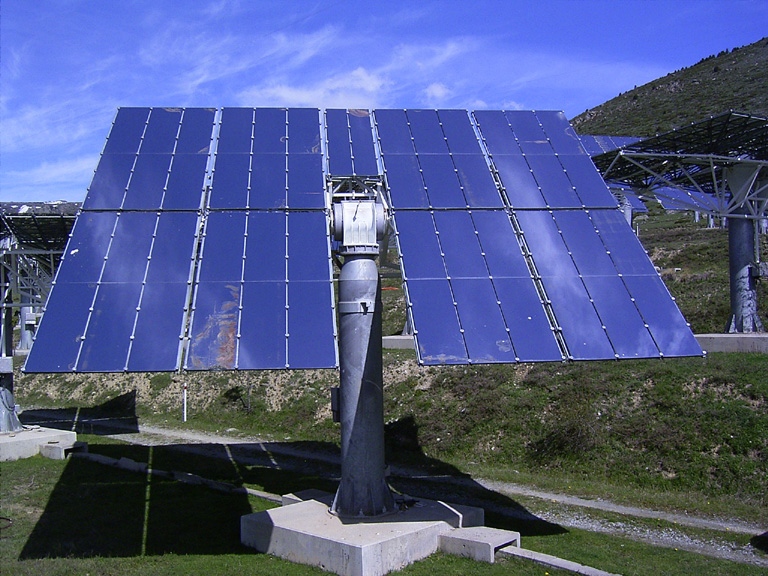
Scientists have used stearic acid and a combination of stearic acid and carbon black to increase thermal conductivity in a photovoltaic-thermal system linked to a heliostat field concentrator. From a temperature of 30 C at the inlet, they could heat the water to 59 C.
Researchers from Rajshahi University of Engineering & Technology in Bangladesh have built and tested a heliostat field-integrated photovoltaic-thermal (PVT) system supported by two different organic phase change materials (PCMs) to improve its thermal conductivity.
PCMs are can absorb, store and release large amounts of latent heat within a certain temperature range and are often used at research level for cooling PV modules.
“Organic PCMs are well suited for solar energy storage due to their narrow freezing and melting temperature range and their congruent melting point. Most organic PCMs are also readily available, relatively inexpensive, and non-toxic,” the group explains. “In the context of a solar hot water system, careful PCM selection is critical to ensure desired water temperatures and address safety concerns such as potential PCM leakage into the building’s water supply.”
The experimental setup was built on a roof in the Rajshahi district of Bangladesh, which has an average daily irradiation of 6.39 kWh/m2 and a wind speed of 2 m/s. A leak-free PVT collector was built, to which four PV panels were attached. Each panel had an output power of 5 W, an open-circuit voltage of 21.5 V and a short-circuit current of 0.32 A. A copper tube was used to direct the water through the collector from a storage tank equipped with a centrifugal pump.
“To increase the concentration ratio, the PVT system is integrated with a heliostat field concentrator,” the academics explained. “The designed heliostat field contains twenty heliostats made of plane mirrors, each with an area of 0.12637 square meters. The height of the central tower is 1.8288 meters from the ground. The heliostats are placed in three different rows.”
As for PCMs, the scientists analyzed two options. One of these was stearic acid (SA) alone, with a mass of 16.5 kg; and the other was a mixture of 16.5 kg of SA, with 165 grams of carbon black (0.01% of the entire composition). Both compositions were analyzed on different days, from 10:00 AM to 6:00 PM, each with a water flow rate of 0.0025 kg/s and 0.0035 kg/s. 0.0045 kg/s and 0.0055 kg/s.
“Using PCM with or without carbon black has little impact on electrical efficiency, which ranges from 10.50% to 13%,” the academics explained. “The maximum electrical output power was found to be 17.77 W at a water flow rate of 0.0045 kg/s for the PVT-PCM system with carbon black. The increased water flow rate lowered the cell temperature by transferring more heat from the system. Which ultimately increased the electrical output temperature of the PV cell, as well as the electrical efficiency.”
In terms of thermal efficiency, the highest level without carbon black was 45.45%, while 46.56% was achieved with the compound. The highest outlet temperatures reached a flow of 0.0035 kg/s and the water reached 59 C with the compound and 58 C without. “Compared to the other flow rates investigated, the average thermal efficiency shows a significant increase of 6.83% when integrating carbon black with PCM at a flow rate of 0.0035 kg/s,” the group points out.
The system was introduced in the study “Performance test of a heliostat field integrated PVT solar collector using organic phase change material and soot additives”, published on Energy reports.
This content is copyrighted and may not be reused. If you would like to collaborate with us and reuse some of our content, please contact: editors@pv-magazine.com.
