
Close Menu
  • News
  • Industry
  • Solar Panels
  • Commercial
  • Residential
  • Finance
  • Technology
  • Carbon Credit
  • More
    • Policy
    • Energy Storage
    • Utility
    • Cummunity
What's Hot

Dutch solar owners asked to switch off during peak periods to ease the distribution crisis

June 7, 2026

The hydrogen flow: Toyota demonstrates its racing prototype on liquid hydrogen

June 7, 2026

Era of electrification exposing Australia’s weakest link

June 6, 2026
Facebook X (Twitter) Instagram
Solar Energy News
Sunday, June 7
  • News
  • Industry
  • Solar Panels
  • Commercial
  • Residential
  • Finance
  • Technology
  • Carbon Credit
  • More
    • Policy
    • Energy Storage
    • Utility
    • Cummunity
Solar Energy News
Home - Policy - High pressure in the Pacific Ocean pushed clear skies over the American West in April – SPE
Policy

High pressure in the Pacific Ocean pushed clear skies over the American West in April – SPE

solarenergyBy solarenergyMay 5, 2024No Comments3 Mins Read
Facebook Twitter Pinterest LinkedIn Tumblr Email
Share
Facebook Twitter LinkedIn Pinterest Email

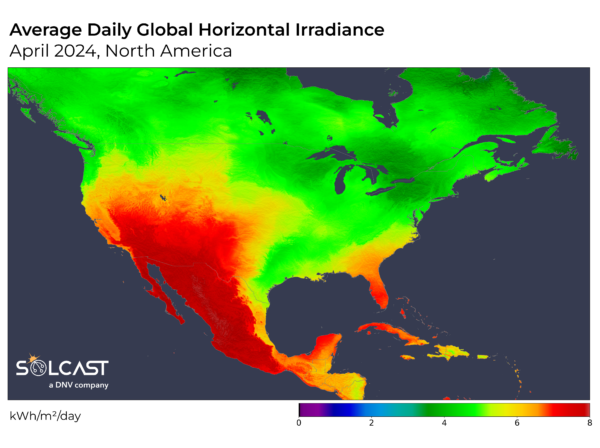
In a new weekly update for pv magazineSolcast, a DNV company, reports that a significant high-pressure anomaly in the Pacific Ocean provided more stable conditions and pushed a deep layer of drier air over the western United States, resulting in clearer skies. While coastal areas experienced average to slightly higher than normal insolation, Midwestern states including Iowa, Nebraska, Kansas and Wyoming received up to 110% normal levels.
May 3, 2024

The irradiation patterns over North America in April 2024 were shifted by a high-pressure anomaly in the Pacific Ocean and drier air over the tropics, producing favorable irradiation results for large solar areas in the Southwest. Texas solar assets performed slightly below the long-term average as low-pressure systems and a tornado outbreak affected insolation at the end of the month.

Florida and parts of Mexico witnessed above-average solar radiation in April, benefiting from unusually dry tropical air masses. Solar radiation in Florida rose to 10% above the April average, while Mexico also saw a 5% increase. These areas tend to be the brightest places in North America in April, with long-term April averages of up to 7.7 kWh/day in Mexico and 6.6 kWh/day in Florida.

The increase in solar potential was associated with a wide band of below-average relative humidity in the tropics, which significantly reduced cloud cover and boosted photovoltaic production.

A significant high-pressure anomaly in the Pacific Ocean brought more settled conditions and pushed a deep layer of drier air over the western United States, resulting in clearer skies. While coastal areas experienced average to slightly higher than normal insolation, Midwestern states including Iowa, Nebraska, Kansas and Wyoming received up to 110% normal levels.

See also  'Innovation can be deterred by cognitive biases' – SPE

In contrast, Texas, the northeastern United States and parts of Canada experienced below-average solar radiation, mainly due to persistent low-pressure systems and storms. Texas saw radiation rates about 5% below standard, while New York state and neighboring Canadian areas recorded a 10% drop.

The unfavorable conditions, including above-average rainfall and cloud cover due to the heavy thunderstorms, significantly hampered PV generation. In addition, a severe weather outbreak in Texas from April 26 to 29 brought tornadoes and large hail, posing risks not only to irradiation but also to the physical integrity of PV installations and electricity transmission infrastructure.

Solcast produces these figures by tracking clouds and aerosols worldwide at a resolution of 1-2 km, using proprietary satellite data AI/ML algorithms. This data is used to drive irradiance models, allowing Solcast to calculate high-resolution irradiance, with a typical deviation of less than 2%, as well as cloud tracking predictions. This data is used by more than 300 companies that manage more than 150 GW of solar energy worldwide.

The views and opinions expressed in this article are those of the author and do not necessarily reflect those of the author pv magazine.

This content is copyrighted and may not be reused. If you would like to collaborate with us and reuse some of our content, please contact: editors@pv-magazine.com.

Source link

American April clear High Ocean Pacific pressure pushed skies SPE West
Share. Facebook Twitter Pinterest LinkedIn Tumblr Email
solarenergy
  • Website

Related Posts

Dutch solar owners asked to switch off during peak periods to ease the distribution crisis

June 7, 2026

The hydrogen flow: Toyota demonstrates its racing prototype on liquid hydrogen

June 7, 2026

Era of electrification exposing Australia’s weakest link

June 6, 2026
Leave A Reply Cancel Reply

Don't Miss
Policy

Clean energy candidates are winning elections in Virginia and New Jersey

By solarenergyNovember 5, 20250

Newly elected Virginia Governor Abigail Spanberger. Photo: Adnan Masri In the 2025 general election, voters…

Tajikistan to build 200 MW solar and PV panel factory – SPE

May 31, 2024

CS Energy and Luminace cover the freshly capped New Jersey landfill with community solar energy

September 25, 2024

The carbon regime has yet to come into effect, but the voluntary market is already buzzing

July 13, 2024
Stay In Touch
  • Facebook
  • Twitter
  • Pinterest
  • Instagram
  • YouTube
  • Vimeo
Our Picks

Dutch solar owners asked to switch off during peak periods to ease the distribution crisis

June 7, 2026

The hydrogen flow: Toyota demonstrates its racing prototype on liquid hydrogen

June 7, 2026

Era of electrification exposing Australia’s weakest link

June 6, 2026

‘Come out from behind your screen, our industry is ultimately about people’

June 6, 2026
Our Picks

Dutch solar owners asked to switch off during peak periods to ease the distribution crisis

June 7, 2026

The hydrogen flow: Toyota demonstrates its racing prototype on liquid hydrogen

June 7, 2026

Era of electrification exposing Australia’s weakest link

June 6, 2026
About
About

Stay updated with the latest in solar energy. Discover innovations, trends, policies, and market insights driving the future of sustainable power worldwide.

Subscribe to Updates

Get the latest creative news and updates about Solar industry directly in your inbox!

Facebook X (Twitter) Instagram Pinterest
  • Contact
  • Privacy Policy
  • Terms & Conditions
© 2026 Tsolarenergynews.co - All rights reserved.

Type above and press Enter to search. Press Esc to cancel.