

A research team in India has explored the use of highly conductive transparent electrodes based on amorphous indium zinc, made using a room temperature process in perovskite solar cells. The devices can be used in tandem and building-integrated PV applications.
Scientists at the Indian Institute of Technology Bombay have demonstrated the non-destructive room temperature deposition of amorphous indium zinc oxide (a-IZO) transparent electrodes (TEs) for perovskite solar cell applications.
Compared to indium tin oxide (ITO) counterparts, a-IZO TEs reportedly avoid sputtering damage to the temperature-sensitive semiconductor material and delamination. “We found that using a-IZO as a transparent electrode offers superior performance and durability compared to traditional ITO,” said the study’s corresponding author, Ananta Paul. pv magazine.
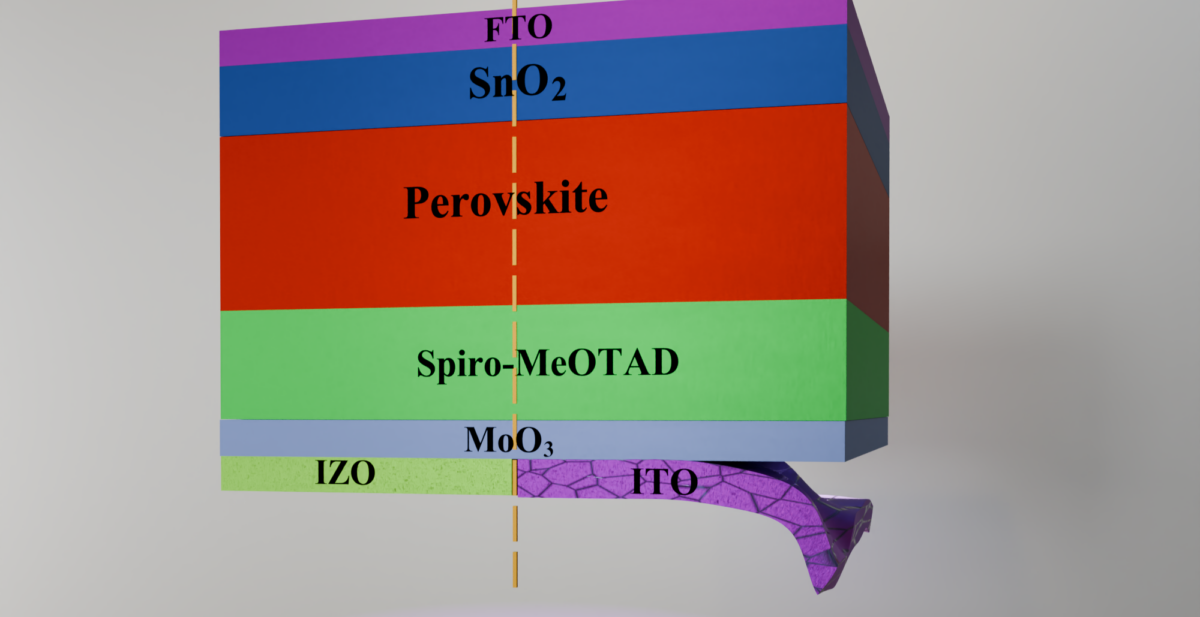
The study compared a-IZO and polycrystalline ITO films (c-ITO). It involved the use of a-IZO for transparent backside electrodes in perovskite solar cells. “Our a-IZO-based devices achieved a higher energy conversion efficiency of 18.22% and, crucially, avoided the delamination issues that plague similar devices,” said Paul.
The efficiency of the prototypes even exceeded the 15.84% energy conversion efficiency of the c-ITO-based devices.
The transparent perovskite solar cell (T-PSC) was made with a state-of-the-art ‘nip’ stack and was constructed as follows: c-ITO or a-iZO electrode, a molybdenum (VI) oxide (MoO3) buffer layer, a Spiro-MeOTAD hole transport layer, a perovskite absorber, an electron transport layer (ETL) based on tin (IV) oxide (SnO2) and with fluorine doped tin oxide (FTO) electrode.
When analyzing the test results, the researchers found that the interfacial defects were present at the MoOX/TE interface of c-ITO based devices was the “primary factor” responsible for the lower PV performance compared to a-IZO based devices. They noted that the optical characteristics showed that the enhanced mobility of the a-IZO films contributed to the higher transmission in the near-infrared region.
Referring to the superstrate architecture, they highlighted the superior performance of T-PSCs with a-IZO as a back electrode compared to c-ITO. “The main reasons behind the improvement of a-IZO based devices are the low plate resistance (22.41 Ω square meters−1), high mobility of carriers (μ = 32.12cm2V−1s−1), low roughness (RMS ∼ 1.05 nm), and high transmission in the infrared range (Attn ∼ 83.5%) compared to c-ITO,” the researchers said.
Also noted was the figure of merit (FOM) for a-IZO films, which they found to be higher than that of the c-ITO films, confirming the “superior suitability” of a-IZO for use in transparent perovskite solar cells.
The team said this work is the first detailed investigation of the delamination phenomenon in c-ITO, and provides valuable insights for the development of reliable transparent electrodes for high-efficiency transparent perovskite solar cells.
“Additionally, we bridge a significant gap in the literature by elucidating the reasons behind the transition from c-ITO to a-IZO in highly efficient transparent perovskite solar cells,” the report said, adding that the efficiency of a-IZO suggests its potential for improving the performance and cost-effectiveness of transparent perovskite solar cells in tandem solar cells and building-integrated PV (BIPV) applications.
His work is described in detail in the study “Comparative study of industry-compatible indium oxide-based sputtered transparent electrodes for transparent perovskite solar cells”, published in the Journal of Physics D: Applied Physics.
This content is copyrighted and may not be reused. If you would like to collaborate with us and reuse some of our content, please contact: editors@pv-magazine.com.
