Scientists in China have investigated how frame perforations can help reduce solar panel operating temperatures through air cooling. Their findings show that the number of perforations must be carefully calibrated, and that more is not necessarily better.
A research team led by scientists from China’s Northeast Electric Power University has investigated the impact of frame perforation on lowering the temperature of PV panels using passive air cooling.
“Compared to previous studies, the main novelty of this study is the comprehensive effect evaluation of frame perforation on the passive air cooling performance, thermal management and electrical performance of PV panels,” the group explains. “A detailed analysis of the air flow field around PV panels and the temperature field of PV panels is conducted, and the effects of different frame perforation patterns and different hole shapes on the thermal and electrical performance of PV panels are compared and discussed. The main purpose of this article is to provide a reference for research on passive air cooling technology of solar panels.”
The research team examined 17 different frame perforation designs using three-dimensional computational fluid dynamics (CFD) simulations.
The simulations were based on a monocrystalline silicon photovoltaic (PV) panel measuring 52.8 cm x 32 cm x 1.05 cm. The panel consisted of an aluminum alloy frame (2.5 mm thick), a glass layer (3.2 mm), an ethylene-vinyl acetate (EVA) layer (0.5 mm), a PV cell (0.6 mm) and a backboard (0.7 mm).
The calculation domain was a cube of 0.8 m on each side, with an installation height of 0.4 m. The inlet wind speed was determined to be 6.0 m/s. The windward and leeward sides of the panel were 52.8 cm long, while the left and right sides were 32 cm. The incident solar radiation was 900 W/m².
Image: Northeast Electric Power University, Case Studies in Thermal Engineering, CC BY 4.0
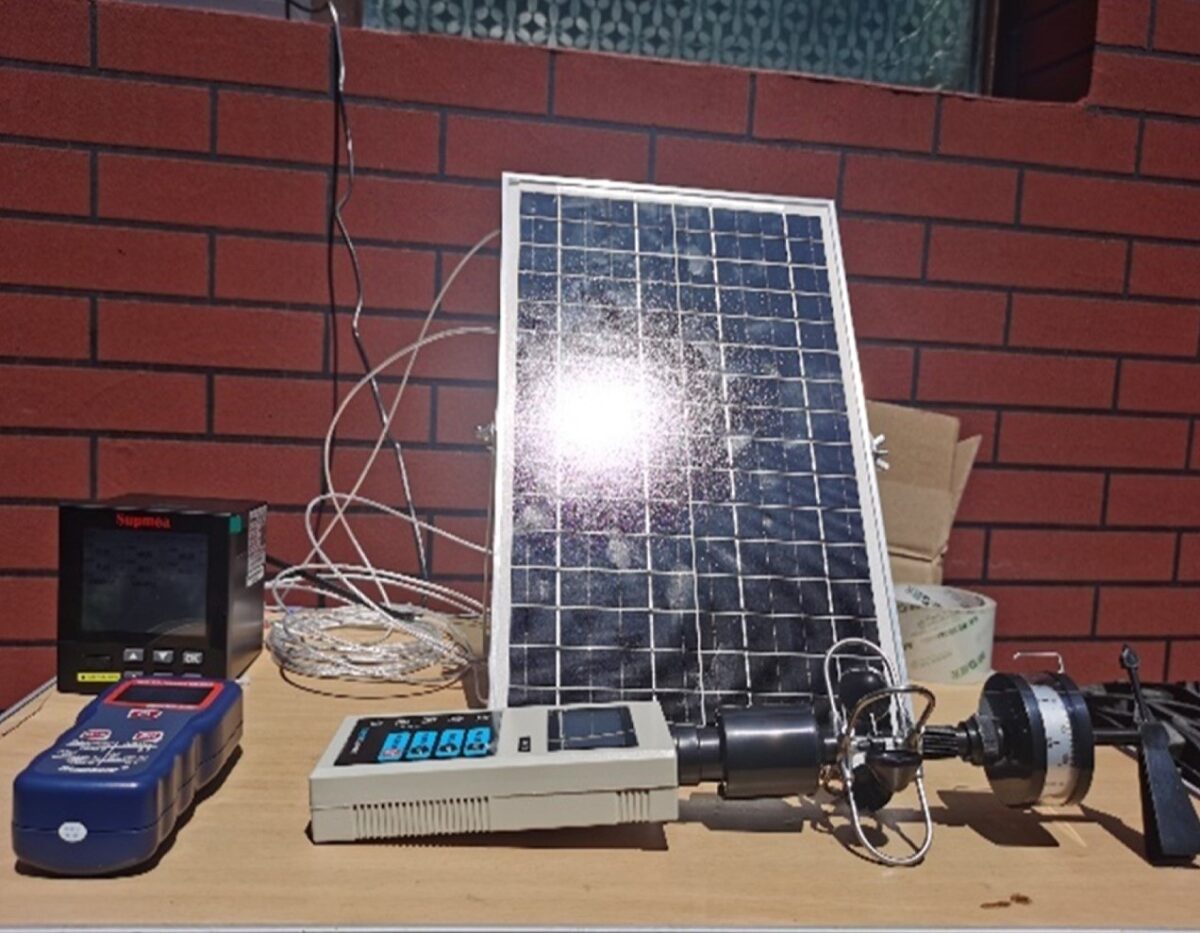
To validate their model, the researchers built an experimental setup using a smaller monocrystalline silicon PV panel with dimensions of 35 cm x 23.5 cm x 1.5 cm. The panel had a nominal power of 10 W and was installed at a tilt angle of 50°. Experiments were conducted in Jilin City, central China, and the results were compared with a separate simulation model. Analysis showed an average temperature difference between simulated and measured values of only 0.2267 °C, with a maximum single-point deviation of 0.4 °C.
Once the CFD model was validated, the team optimized the tilt angle for passive cooling, identifying 11° as the most effective. All subsequent simulations of the perforation cases were performed under this slope. The 17 perforation designs were grouped into four categories based on the number of perforated frame sides: single-sided, double-sided, three-sided and four-sided perforations.
Each box had round or rectangular perforations. For panels with windward and leeward perforations, round holes were 3 mm in radius and 58.68 mm apart; on the left and right sides the holes also had a radius of 3 mm, but were spaced 64 mm apart. Rectangular perforations measure 4mm x 100mm with 107mm spacing, and 5mm x 70mm with 60mm spacing depending on the side.
“Case 2 – with eight circular holes of 3.0 mm radius on the windward side – achieved the lowest average PV panel temperature (39.37 °C), the lowest maximum temperature (42.63 °C), the most uniform surface temperature distribution, the highest output power (24.18 W) and the greatest photoelectric conversion efficiency (15.9%),” the researchers reported.
“From the perspective of average PV panel temperature, 13 of the evaluated designs with frame perforation performed better than the non-perforated frame (case 1),” she added. Compared to the non-perforated panel, the Case 2 design reduced the panel temperature by 5.44°C. In calm conditions, the perforated frame reduced the average temperature by 37.8°C and increased the photoelectric conversion efficiency by 2.89%.
Only three perforated designs – cases 3, 7 and 8 – underperformed the non-perforated panel. Case 3 had round holes on the leeward side, Case 7 had rectangular holes on the leeward side, and Case 8 had rectangular holes on the left side. “Contrary to popular belief, drilling more holes in the frame does not necessarily improve the cooling performance of PV panels,” the team concluded.
Their work was presented in “Effect evaluation of frame perforation on reducing the temperature of photovoltaic panels with passive air cooling”, published in Case studies in thermal engineering. Researchers from China’s Northeast Electric Power University, Shengu Group and the University of Science and Technology of China participated in the study.
This content is copyrighted and may not be reused. If you would like to collaborate with us and reuse some of our content, please contact: editors@pv-magazine.com.
Popular content