

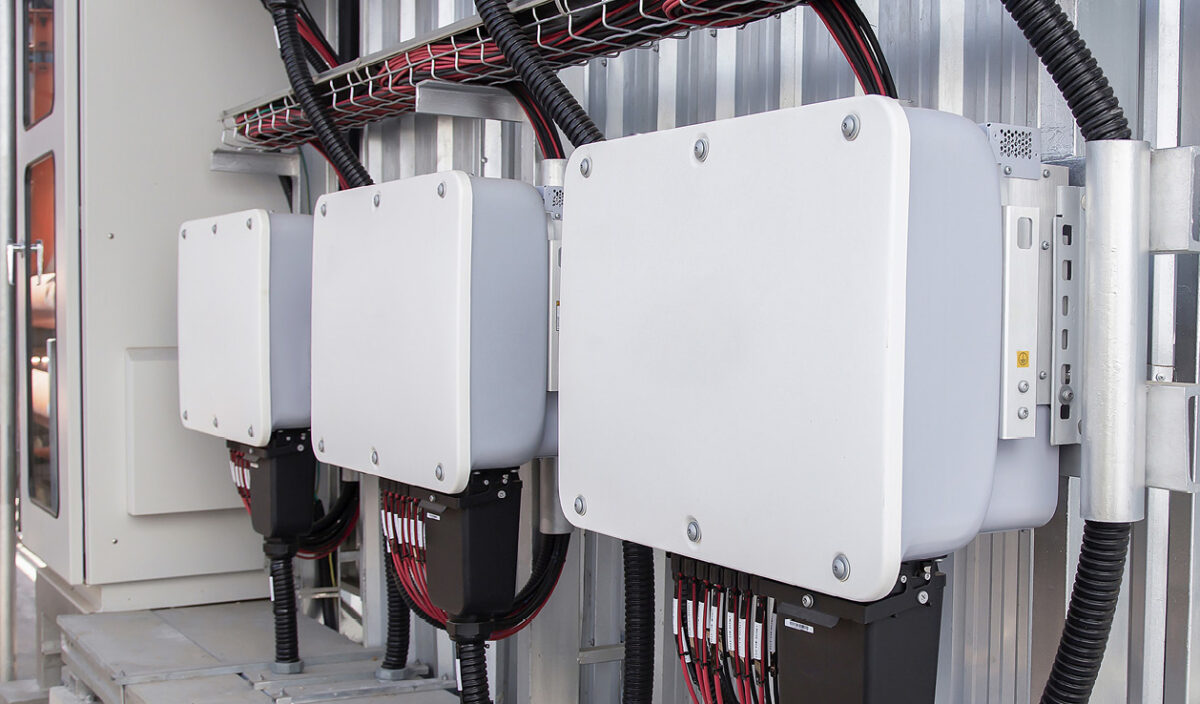
Inverters must be able to withstand the high levels of heat generated during operation, otherwise system performance and reliability can be compromised. Cody Schoener of Dow Performance Silicones states that using silicone-based materials for inverters can improve thermal management and fire protection, while providing thermal stability, environmental resistance, electrical insulation and support for operational efficiency.
From pv magazine 10/2025
In addition to their core function of converting AC to DC and optimizing the output of a PV or solar-plus-storage system, inverters must also be fire-resistant, support electrical safety and withstand outdoor conditions. Environmental resilience is critical because inverters can be installed in areas that are hot, wet, humid, or where salty air is present.
Long service life is also important because inverters must provide reliable performance for more than 20 years. Additionally, product designers want protective materials that support high-volume production and come with a host of features to address application-specific challenges.
Silicone advantage
Silicones are used as an encapsulation material and for other purposes in inverters because they can withstand higher operating temperatures than typical alternatives such as epoxy or polyurethane. As power electronics trend towards higher operating voltages, greater amounts of heat are produced. Higher voltage systems can improve energy conversion efficiency and reduce energy losses, but the inverters they use are typically more expensive and require a higher level of thermal management. Higher voltages also require greater electrical insulation.
One of their advantages is that silicones are available in formulations that meet various UL flame ratings, making them suitable for applications that require increased fire safety. This is especially relevant for systems using lithium-ion batteries, which can catch fire in rare situations.
In addition to fire resistance, silicones also provide good resistance to environmental influences, retain their mechanical properties, resist cracking caused by thermal cycles and allow electrical insulation. They are available in a range of products that support high volume production.
Thanks to their strong environmental resistance, silicones can withstand the moisture, humidity and wide temperature range associated with outdoor installations. They also resist corrosion from saltwater environments. Because they are soft and stress-relieving, they provide protection against mechanical shock and vibration. These voltages can occur during transportation or installation, due to environmental factors such as strong winds, or due to the constant operation and switching of power within a PV inverter.
Normally silicone is thermally insulating. However, the addition of thermally conductive fillers also enables efficient heat dissipation. Compared to the air that would otherwise fill the gaps between heat sources and heat sinks, silicone-based materials have higher thermal conductivity, a measure of their ability to dissipate heat. They also have low thermal resistance, a measure of a material’s ability to withstand heat flow.
Thermal management
Thermally conductive silicones for PV inverters include silicone encapsulants, thermal interface materials (TIMs), thermal greases and thermal gels. These thermal management materials are also used in battery energy storage systems (BESS), but use silicone that is thermally insulating rather than thermally conductive.
Thermally conductive silicone encapsulants flow easily to fill complex geometries in the induction module of a PV inverter. Thanks to their low viscosity, they can be easily replaced by automated equipment for high-volume production. After silicone encapsulants are applied to printed circuit boards (PCBs) and their components, curing is required. Some products can be cured at room temperature rather than in energy-intensive ovens, but ovens can still be used to speed up the process.
Silicone TIMs have higher thermal conductivity than silicone encapsulants. In inverters they are applied between PCBs and the insulated bipolar transistors (IGBTs) used for high-voltage circuits. In a solar array, silicone TIMs can support the use of 1,500 V DC/AC inverters capable of handling up to 300 kW of power. One of their advantages is that these materials can be applied as pads with automated equipment or can be screen printed or stenciled for faster assembly than can be achieved manually.
Silicone thermal greases support thinner bond lines than silicone TIMs. This is important for thermal management because there is less distance for heat to travel from a heat source to a heat sink. Silicone thermal greases are also easy to work with and have viscosities ranging from non-liquid to semi-liquid. Because they are not hardenable, they remain in a paste-like state that helps optimize surface wetting for lower thermal interfacial resistance.
Thermally conductive silicone gels support a range of bond line thicknesses to provide design flexibility. They are cheaper than manufactured thermal pads and can be used to protect IGBTs. Because they are liquid, thermal silicone gels can be applied as printable pads or dispensed as a liquid gap filler. These soft, compressible and stress-relieving materials support post-processing and are suitable for electronic designs with small shapes and complicated geometries. Although they require curing, some formulations can do so at room temperature.
Although BESS uses many of the same thermally conductive silicones found in PV inverters, they also include fire-resistant silicones that are thermally insulating. For example, silicone foams provide a lightweight alternative to encapsulants, and potting foams are used to fill the spaces between individual battery cells.
BESS designs may also contain silicone adhesives to improve mechanical stability. Available in both thermally conductive and thermally insulating formulations, these adhesives support component expansion for reduced vibration and stress on component piping.
As solar energy continues to reshape energy generation, transmission and distribution, material selection plays a crucial role in driving progress. Importantly, silicone-based materials for transducers have highly tunable properties and can meet application-specific performance and processing requirements. However, designing tomorrow’s technology is not a one-size-fits-all approach. It is therefore essential for designers to select advanced silicones that are thermally conductive, support PV performance and promote safety.Cody Schoner
About the author
 Cody A. Schoener is senior marketing manager for Dow Performance Silicones at Dow Chemical Company. His responsibilities include developing short- and long-term strategies, managing innovation portfolios and leading a global team specifically for industrial electronic strategy and global accounts. Before taking on his role in marketing, he worked for eight years as an engineering and development scientist for the Dow Chemical Company, which focused on polyurethane and cellulose chemicals. He received his PhD in chemical engineering from the University of Texas at Austin in 2012.
The views and opinions expressed in this article are those of the author and do not necessarily reflect those of the author pv magazine.
This content is copyrighted and may not be reused. If you would like to collaborate with us and reuse some of our content, please contact: editors@pv-magazine.com.
Popular content

