
Close Menu
  • News
  • Industry
  • Solar Panels
  • Commercial
  • Residential
  • Finance
  • Technology
  • Carbon Credit
  • More
    • Policy
    • Energy Storage
    • Utility
    • Cummunity
What's Hot

Why the UK solar industry needs to own its safety story

April 23, 2026

Fraunhofer ISE develops colored film technology for patterned solar panels

April 23, 2026

Thermoacoustic heat pumps are on the verge of commercial breakthrough – SPE

April 23, 2026
Facebook X (Twitter) Instagram
Solar Energy News
Thursday, April 23
  • News
  • Industry
  • Solar Panels
  • Commercial
  • Residential
  • Finance
  • Technology
  • Carbon Credit
  • More
    • Policy
    • Energy Storage
    • Utility
    • Cummunity
Solar Energy News
Home - Solar Industry - Improving the efficiency of solar cells with upconversion nanoparticles
Solar Industry

Improving the efficiency of solar cells with upconversion nanoparticles

solarenergyBy solarenergyDecember 11, 2024No Comments3 Mins Read
Facebook Twitter Pinterest LinkedIn Tumblr Email
Share
Facebook Twitter LinkedIn Pinterest Email

An international research group has developed a light upconversion system that can reportedly improve the efficiency of crystalline silicon solar cells by as much as 0.87%. The technology consists of multilayer nanoparticles that act as near-infrared absorbers over different spectral ranges.

December 10, 2024
Lior Kahana

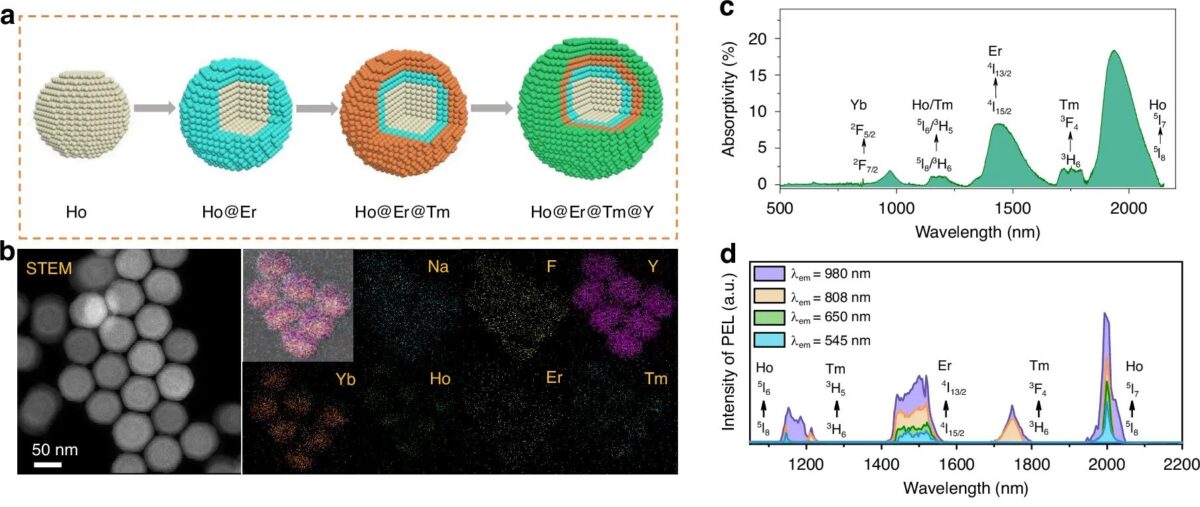
An international research team has developed a multiband near-infrared (NIR) upconversion (UC) system to improve light output in silicon solar cells (SSCs). The system is based on the idea of ​​lanthanide-doped upconversion nanoparticles (UCNPs), which convert low-energy photons in the infrared range into higher energy photons in visible light.

“We have developed an efficient approach to harvest more of the NIR energy in sunlight through SSCs by integrating multiband NIR-responsive core-shell UCNPs,” the team explained, noting that it consists of multilayer nanoparticles containing lanthanide (Lb ) and ytterbium (Yb). , which can capture NIR energy in a wide range from 1,100 to 2,200 nm.

The system also contains holmium ion (Ho³⁺), erbium ion (Er³⁺) and thulium ion (Tm³⁺), all of which are Ln activator ions. Using a solvothermal method, they were all synthesized to create core-shell-shell-shell (CSSS) nanocrystals. Yb³ was introduced into all layers of the CSSS, and the team found that it “serves as a highly efficient electron pump, in synergistic action with the long-wavelength NIR excitation light, and simultaneously acts as a two-photon UC emitter.”

After creating this CSSS UCNP, the team vertically placed 150mm x 150mm commercial solar cells into it and then placed the entire device in an oven at 30 C for four hours. The resulting CSSS films were relatively flat, with low roughness of 6.19 nm. Different film thicknesses were produced, ranging from 130 nm to 550 nm.

See also  Chinese PV industry Letter: Zhejiang Bangjie Drops 18 GW Factory Plan

“Compared to the uncoated SSCs with an absolute photon conversion efficiency of 18.5%, the efficiency of the SSCs coated with a 182 nm CSSS film was increased to 19.37% (a net increase of 0.87%) ,” said the academics. The efficiency increase for SSCs is dominated by the short-circuit currents. By further increasing the film thickness, the efficiency gradually decreases.”

Concluding their paper, the researchers added that the optimized multilayer Ln/Yb UCNPs exhibit a broad multiband NIR response distributed over the range from 1,100 to 2,200 nm, with an aggregate bandwidth of approximately 500 nm. “This design achieves a total UC photoluminescence quantum yield (PLQY) of 12% under standard solar irradiation,” they stated.

They also added that the CSSS-coated cell proved durable and retained functionality for more than 55,100 hours under standard temperature and humidity conditions. “These results make them very valuable for practical applications,” the scientists added.

Their findings were presented in “A multiband NIR upconversion core-shell design for improved light output of silicon solar cells”, published in Light: science and applications. Scientists from China’s Jilin University, Dalian Minzu University and Sweden’s KTH Royal Institute of Technology conducted the research.

This content is copyrighted and may not be reused. If you would like to collaborate with us and reuse some of our content, please contact: editors@pv-magazine.com.

Popular content

Source link

cells efficiency Improving Nanoparticles solar upconversion
Share. Facebook Twitter Pinterest LinkedIn Tumblr Email
solarenergy
  • Website

Related Posts

Why the UK solar industry needs to own its safety story

April 23, 2026

Fraunhofer ISE develops colored film technology for patterned solar panels

April 23, 2026

The federal court has halted Trump administration orders that hinder solar and wind energy development

April 23, 2026
Leave A Reply Cancel Reply

Don't Miss
Technology

Austa launches a low-voltage hybrid inverter series-PV Magazine International

By solarenergyMarch 20, 20250

The one-phase-Omwriting series can last between 4.5 kW and 12 kW PV input and convert…

Potential of floating PV, solar parking, agrivoltaics in Germany – SPE

June 18, 2024

Solar Innovations in Soil Remediation (2025)

July 23, 2025

Solar PV uses new annual record generation in Ireland

September 19, 2025
Stay In Touch
  • Facebook
  • Twitter
  • Pinterest
  • Instagram
  • YouTube
  • Vimeo
Our Picks

Why the UK solar industry needs to own its safety story

April 23, 2026

Fraunhofer ISE develops colored film technology for patterned solar panels

April 23, 2026

Thermoacoustic heat pumps are on the verge of commercial breakthrough – SPE

April 23, 2026

The federal court has halted Trump administration orders that hinder solar and wind energy development

April 23, 2026
Our Picks

Why the UK solar industry needs to own its safety story

April 23, 2026

Fraunhofer ISE develops colored film technology for patterned solar panels

April 23, 2026

Thermoacoustic heat pumps are on the verge of commercial breakthrough – SPE

April 23, 2026
About
About

Stay updated with the latest in solar energy. Discover innovations, trends, policies, and market insights driving the future of sustainable power worldwide.

Subscribe to Updates

Get the latest creative news and updates about Solar industry directly in your inbox!

Facebook X (Twitter) Instagram Pinterest
  • Contact
  • Privacy Policy
  • Terms & Conditions
© 2026 Tsolarenergynews.co - All rights reserved.

Type above and press Enter to search. Press Esc to cancel.