
Close Menu
  • News
  • Industry
  • Solar Panels
  • Commercial
  • Residential
  • Finance
  • Technology
  • Carbon Credit
  • More
    • Policy
    • Energy Storage
    • Utility
    • Cummunity
What's Hot

Zendure launches battery ranges for residential PV – SPE

April 23, 2026

The CFO’s Guide To Nature Based Solutions

April 23, 2026

Inside PV Manufacturing: Belga Solar’s module factory in Belgium

April 23, 2026
Facebook X (Twitter) Instagram
Solar Energy News
Thursday, April 23
  • News
  • Industry
  • Solar Panels
  • Commercial
  • Residential
  • Finance
  • Technology
  • Carbon Credit
  • More
    • Policy
    • Energy Storage
    • Utility
    • Cummunity
Solar Energy News
Home - Solar Industry - Improving the performance of perovskite solar cells with cadmium telluride buffer layer
Solar Industry

Improving the performance of perovskite solar cells with cadmium telluride buffer layer

solarenergyBy solarenergyAugust 8, 2024No Comments3 Mins Read
Facebook Twitter Pinterest LinkedIn Tumblr Email
Share
Facebook Twitter LinkedIn Pinterest Email

An international research team has conducted a series of simulations to investigate how a cadmium telluride buffer layer can help increase the efficiency and stability of perovskite solar cells. Their experiment showed that the cell efficiency can increase from 11.09% to 23.56%.

August 8, 2024 Emiliano Bellini

A group of scientists led by the University of Agriculture Faisalabad in Pakistan has proposed to improve the efficiency of perovskite solar cells by adding a buffer layer (BL) made of cadmium telluride (CdTe), which reportedly improves charge carrier extraction while reducing device defects . .

The researchers explained that the presence of a BL in a perovskite cell provides a porous structure that helps form the upper hole-transporting layer (HTL), while also preventing the leakage of corrosive additives from the HTL material. “The improvement in HTM layer development not only promotes efficient hole transfer and conduction, but also limits charge recombination,” they explained.

The choice of CdTe was due to the hypotheses that the hydrophobic nature of CdTe could protect the absorber against moisture and corrosion, and that its high UV resistance could minimize UV-induced degradation, thereby improving cell stability.

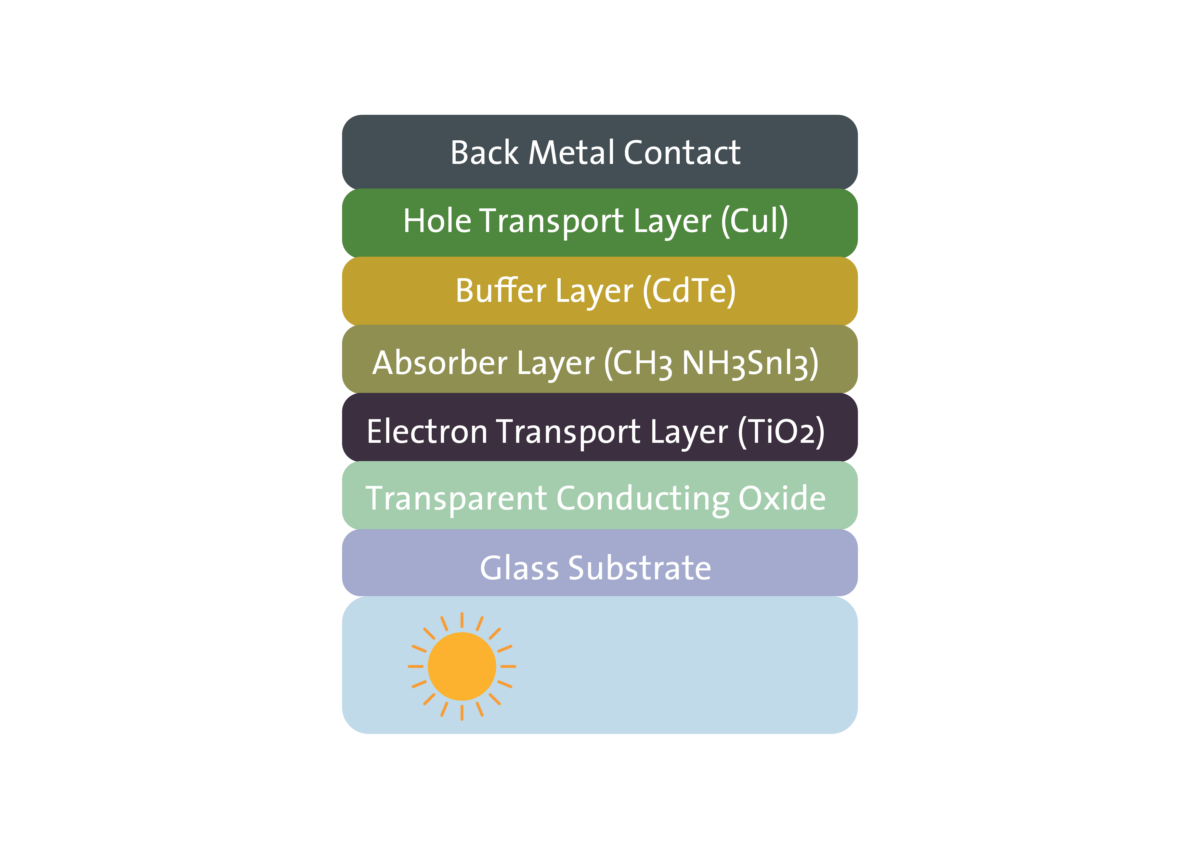
The scientists used the SCAPS-1D solar cell capacity software, developed by Ghent University, to simulate the new cell configuration. The device was based on a substrate of glass, a transparent conductive oxide (TCO), an electron transport layer (ETL) made of titanium oxide (TiO2)an absorber made from a perovskite material known as CH3NH3SnI3the CdTe buffer layer, an HTL made of copper(I) iodide (Cul) and metal contacts on the back.

The performance of this device was simulated under standard lighting conditions and compared to that of a reference device without a buffer layer. The CdTe-based cell achieved an energy conversion efficiency of 14.76%, an open-circuit voltage of 0.83 V and a short-circuit current density of 25.96 mA/cm2and a fill factor of 68.42%. The benchmark device achieved an efficiency of 11.09%, an open-circuit voltage of 0.69 V and a short-circuit current density of 26.22 mA/cm2and a fill factor of 61.46%.

See also  New solar coatings can significantly reduce the need for traditional solar farms

By further refining the thickness of the buffer layer and improving the material composition of the perovskite absorber and the ETL, the scientists were able to significantly improve cell efficiency during the simulation. “These optimized device parameters showed significant improvement in device performance with the CdTe layer on CuI/CH3NH3SnI3 interface, resulting in an efficiency of 23.56% compared to 11.09% without the BL,” they explained.

The new cell design was introduced in the study “Interface engineering for enhanced performance of perovskite solar cells using CdTe buffer layer”, which was recently published in Results in technology. “The findings demonstrate that the incorporation of CdTe significantly improves the energy conversion efficiency of the nip device,” the group concluded.

The research team also included scientists from the University College of London, United Kingdom and the National University of Malaysia.

This content is copyrighted and may not be reused. If you would like to collaborate with us and reuse some of our content, please contact: editors@pv-magazine.com.

Source link

buffer cadmium cells Improving layer performance perovskite solar telluride
Share. Facebook Twitter Pinterest LinkedIn Tumblr Email
solarenergy
  • Website

Related Posts

Inside PV Manufacturing: Belga Solar’s module factory in Belgium

April 23, 2026

Solar energy’s rebound effect could increase European electricity demand by 5% by 2050 – SPE

April 23, 2026

Repowering key for Japanese solar assets nears end of feed-in tariff – SPE

April 23, 2026
Leave A Reply Cancel Reply

Don't Miss
Commercial & Industrial

ADE announces strategic partnership with Oakes Energy

By solarenergySeptember 2, 20240

AMPYR Distributed Energy was launched early this year by Singapore-based AGP, with an initial capital…

Connecticut YMCA leases roof to Greenskies for grid-connected solar project

October 26, 2025

Sungrow works together with merit checks on cyber security software for inverter

April 7, 2025

Solar radiation in Europe increased by 4.8% between 1994 and 2023 – SPE

February 11, 2026
Stay In Touch
  • Facebook
  • Twitter
  • Pinterest
  • Instagram
  • YouTube
  • Vimeo
Our Picks

Zendure launches battery ranges for residential PV – SPE

April 23, 2026

The CFO’s Guide To Nature Based Solutions

April 23, 2026

Inside PV Manufacturing: Belga Solar’s module factory in Belgium

April 23, 2026

Solar energy’s rebound effect could increase European electricity demand by 5% by 2050 – SPE

April 23, 2026
Our Picks

Zendure launches battery ranges for residential PV – SPE

April 23, 2026

The CFO’s Guide To Nature Based Solutions

April 23, 2026

Inside PV Manufacturing: Belga Solar’s module factory in Belgium

April 23, 2026
About
About

Stay updated with the latest in solar energy. Discover innovations, trends, policies, and market insights driving the future of sustainable power worldwide.

Subscribe to Updates

Get the latest creative news and updates about Solar industry directly in your inbox!

Facebook X (Twitter) Instagram Pinterest
  • Contact
  • Privacy Policy
  • Terms & Conditions
© 2026 Tsolarenergynews.co - All rights reserved.

Type above and press Enter to search. Press Esc to cancel.