
Close Menu
  • News
  • Industry
  • Solar Panels
  • Commercial
  • Residential
  • Finance
  • Technology
  • Carbon Credit
  • More
    • Policy
    • Energy Storage
    • Utility
    • Cummunity
What's Hot

Dutch solar owners asked to switch off during peak periods to ease the distribution crisis

June 7, 2026

The hydrogen flow: Toyota demonstrates its racing prototype on liquid hydrogen

June 7, 2026

Era of electrification exposing Australia’s weakest link

June 6, 2026
Facebook X (Twitter) Instagram
Solar Energy News
Sunday, June 7
  • News
  • Industry
  • Solar Panels
  • Commercial
  • Residential
  • Finance
  • Technology
  • Carbon Credit
  • More
    • Policy
    • Energy Storage
    • Utility
    • Cummunity
Solar Energy News
Home - Solar Industry - Improving the recyclability of solar panels with lasers
Solar Industry

Improving the recyclability of solar panels with lasers

solarenergyBy solarenergyApril 29, 2024No Comments3 Mins Read
Facebook Twitter Pinterest LinkedIn Tumblr Email
Share
Facebook Twitter LinkedIn Pinterest Email

The National Renewable Energy Laboratory developed a proof of concept for a method to remove polymers from solar panel production to enable more efficient recycling.

April 26, 2024 Ryan Kennedy

By pv magazine USA

Solar panels are highly recyclable, but using thin plastic layers to encase solar cells can create challenges in effectively recycling valuable materials such as silicon or silver.

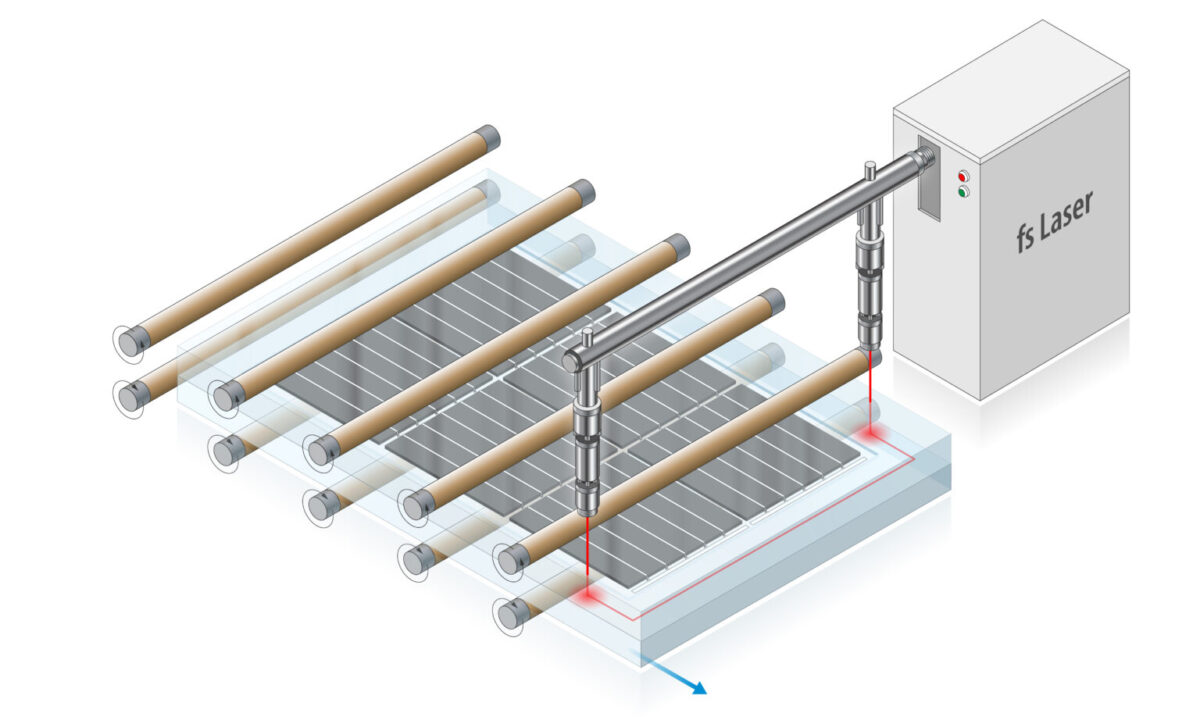
The U.S. Department of Energy’s National Renewable Energy Laboratory (NREL) has developed a proof-of-concept that helps reduce the use of polymers by creating direct glass-to-glass welds in solar cells.

The method uses femtosecond lasers, a type of infrared laser that focuses energy on a very short time scale with a single laser pulse. The laser creates hermetically sealed glass-to-glass welds. Femtosecond lasers are currently used in medical eye procedures such as cataract surgery.

The laser welding would eliminate the need for plastic laminates, which makes recycling more difficult. At the end of their life, the modules made with laser welding can be crushed, and the glass and metal wires within them can be recycled and the silicon reused.

“Most recyclers will confirm that the polymers are the main problem when it comes to inhibiting the recycling process,” said David Young, senior scientist and group manager for the High-Efficiency Crystalline Photovoltaics group in NREL’s Chemistry and Nanoscience division.

NREL published the study in the IEEE Journal of Photovoltaics. The authors said the laser is cell material agnostic and can be used with silicon, perovskites and cadmium telluride, among others, because the heat from the highly focused laser is limited to a few millimeters. The researchers said that the welds in the glass are essentially as durable as the glass itself.

See also  Saatvik Green unveils residential inverter series, C&I solar

“As long as the glass doesn’t break, the weld won’t break,” Young said. “However, because there are no polymers between the glass plates, the welded modules must be much stiffer. Our paper showed that with proper assembly and adjustment of the relief characteristics of the rolled glass, a welded module can be made stiff enough to pass static load tests.”

In the past, another type of edge sealing was tried using nanosecond lasers and a glass frit filler, but the welds proved too brittle for use in outdoor module designs. The femtosecond laser welds provide superior strength with hermetic sealing at an attractive cost, according to NREL.

The research was conducted through the Sustainable Module Materials Consortium, which aims to extend the lifespan of solar panels to 50 years or longer.

This content is copyrighted and may not be reused. If you would like to collaborate with us and reuse some of our content, please contact: editors@pv-magazine.com.

Source link

Improving lasers panels recyclability solar
Share. Facebook Twitter Pinterest LinkedIn Tumblr Email
solarenergy
  • Website

Related Posts

Dutch solar owners asked to switch off during peak periods to ease the distribution crisis

June 7, 2026

Letter from China’s PV Industry: Arctech wins 2.1 GW solar deal

June 5, 2026

ComEd starts a new energy pilot with a solar rebate on the roof of a brewery

June 5, 2026
Leave A Reply Cancel Reply

Don't Miss
Solar Industry

Holosolis signs Topcon Patent Licensing Agreement with Trina Solar

By solarenergySeptember 3, 20250

Holosolis is currently planning to open a 5 GW PV cell and panel factory in…

India’s solar capacity expansion on track by 2025, says SBICAPS – SPE

January 10, 2026

Chinese PV industry Letter: China General Nuclear concludes 10 GW mounting systems tendering

February 21, 2025

Research shows that ground reflectors with a high albedo increase the yield of bifacial solar power plants by up to 4.5% – SPE

May 9, 2024
Stay In Touch
  • Facebook
  • Twitter
  • Pinterest
  • Instagram
  • YouTube
  • Vimeo
Our Picks

Dutch solar owners asked to switch off during peak periods to ease the distribution crisis

June 7, 2026

The hydrogen flow: Toyota demonstrates its racing prototype on liquid hydrogen

June 7, 2026

Era of electrification exposing Australia’s weakest link

June 6, 2026

‘Come out from behind your screen, our industry is ultimately about people’

June 6, 2026
Our Picks

Dutch solar owners asked to switch off during peak periods to ease the distribution crisis

June 7, 2026

The hydrogen flow: Toyota demonstrates its racing prototype on liquid hydrogen

June 7, 2026

Era of electrification exposing Australia’s weakest link

June 6, 2026
About
About

Stay updated with the latest in solar energy. Discover innovations, trends, policies, and market insights driving the future of sustainable power worldwide.

Subscribe to Updates

Get the latest creative news and updates about Solar industry directly in your inbox!

Facebook X (Twitter) Instagram Pinterest
  • Contact
  • Privacy Policy
  • Terms & Conditions
© 2026 Tsolarenergynews.co - All rights reserved.

Type above and press Enter to search. Press Esc to cancel.