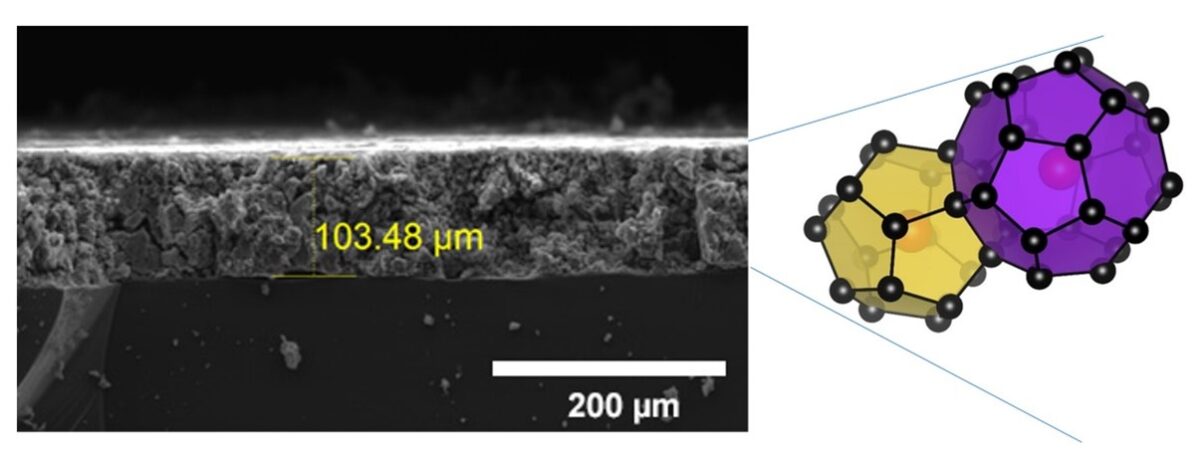
Researchers led by scientists at CNRS in France are investigating an exotic form of silicon, called silicon clathrate, as a material for energy applications, including solar photovoltaics. Mastering the synthesis and using appropriate characterizations are key elements for potential applications. Significant progress is being made in the manufacture of functional devices.
There are many different forms of silicon used in the PV industry: amorphous, polycrystalline and monocrystalline. Although the photovoltaic market is dominated by crystalline silicon solar cells, alternative materials are being explored.
The requirements for these materials are the abundance of their chemical elements, as well as stability, low toxicity, ease of fabrication and potential for high conversion efficiency. Silicon, on the other hand, is the second most abundant element on Earth.
While the band gap of diamond silicon has been set at around 1.1 eV, exotic forms of silicon could provide an alternative. For example, silicon clathrates are based on silicon cages containing a guest atom, often sodium (Na), which can be almost completely removed from the cages. The band gap of Type II silicon clathrate is direct and its energy is about 1.8 eV, making it quite ideal for silicon tandem solar cells.
Although the manufacturing routes of silicon clathrate in the form of powders were discovered in the 1960s, their development was hampered by the lack of a film manufacturing process. This has been made possible in recent years by at least three groups, Gifu University in Japan, the Colorado School of Mines and the National Renewable Energy Laboratory (NREL) in the United States, as well as the CNRS research laboratories ICube/IPCMS and INL.
A recent development by CNRS within a national research project has enabled a dramatic improvement in film quality, thanks to a thermal press annealing process. This breakthrough has enabled an Atomic Force Microscopy image to be captured on silicon clathrate films for the first time.
Image: French National Center for Scientific Research
Another development of CNRS-ICube consists of the surface photovoltage (SPV) measurements of silicon clathrate films with different Na occupancy in the cages. This occupancy can be monitored using Energy Dispersive X-ray Spectroscopy and analyzed via X-ray diffraction patterns.
Other researchers discovered this as-grown samples have a composition of approximately Na4Si136a Na0.1Si136 film with much less Na can be obtained by chemical treatment with iodine. Other research has shown that semiconductor and photovoltaic properties are significantly improved at very low Na occupancy.
More recently, prototype p-n heterojunction devices with metal oxides based on silicon clathrate films were fabricated and tested. The paving routes for possible applications were demonstrated with a rectification.

Image: French National Center for Scientific Research
Indeed, in addition to the possible use of silicon clathrates as solar cell devices, there is significant potential for cross-fertilization of the discoveries in other areas, such as anodes for batteries, hydrogen storage and thermoelectrics.
Authors: Fix, C. Tamin, A. Bharwal, C. Chevalier, S. Roques, R. Vollondat, A. Dinia, A. Slaoui
This article is part of a series contributed by RD20a global initiative of leading research institutes of the G20 countries with the aim of strengthening international cooperation in R&D and promoting innovation towards a carbon-neutral society. Articles under this column are contributed by individual RD20 member institutions and are the sole property of the designated author(s).
For more information: https://rd20.aist.go.jp/
The views and opinions expressed in this article are those of the author and do not necessarily reflect those of the author pv magazine.
This content is copyrighted and may not be reused. If you would like to collaborate with us and reuse some of our content, please contact: editors@pv-magazine.com.
Popular content