

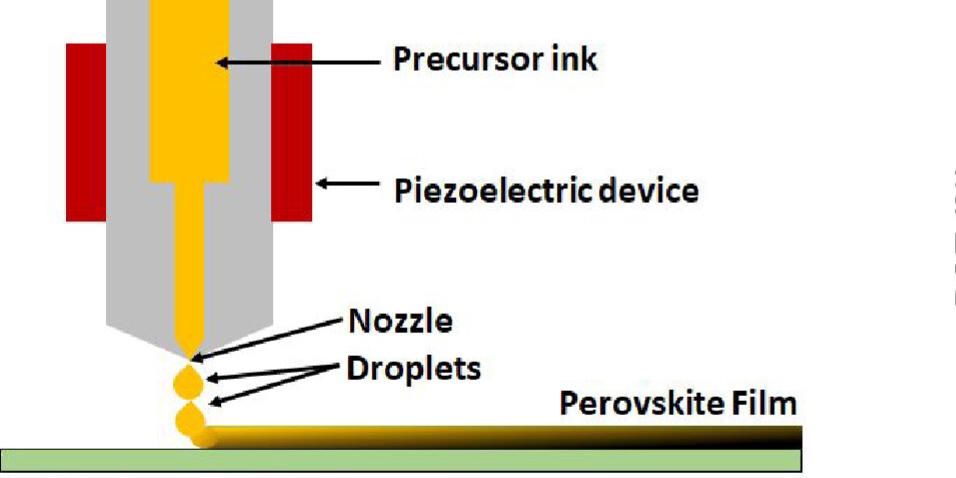
Researchers from Germany and India have demonstrated an inkjet printing method to fabricate formamidinium-tin-lead-perovskite solar cells, achieving an energy conversion efficiency of 10.26% and an energy bandgap of 1.25 eV.
An international research team has used an inkjet printing process to fabricate formamidinium tin-lead (Sn-Pb) perovskite thin films for applications in perovskite solar cell manufacturing.
“This work represents a significant advance in the development of low-lead, environmentally friendly perovskite solar cells using inkjet printing technology. Our team led by Prof. Eva Unger focused on optimizing the inkjet printing process to ensure accurate film deposition and improve device performance,” shared first author Ayush Tara. pv magazine. “The study opens new avenues for environmentally conscious, scalable and efficient solar energy solutions.”
The team chose inkjet printing for the combinatorial mixed formamidinium tin-lead (Sn-Pb) film because of its “flexibility in design” and ability to “precisely tailor the crystallization properties of organohalogen perovskite layers,” in addition to a high degree of control. It is also considered a high-throughput manufacturing method, unlike spin coating, which has enabled high-performance laboratory-sized devices but lacks the potential for scale.
The researchers prepared a filtered perovskite ink solution before filling the Pixdro LP50 inkjet printhead in a tool from Germany-based Süss Microtec. It was a Spectra SE128 printhead with a droplet size of 30 pL. They explained that the ink is kept at an inkhead temperature of 60 C and that printing is done with a printhead voltage of 80 V and a beam frequency of 100 Hz, which is applied to a mobile substrate. “Best results are obtained with a print resolution of 500 dpi, quality factor 4, print speed of 100 mm/s and drop speed of 4 m/s,” they say.
After printing, the substrates were treated with gas flow-assisted vacuum drying, followed by thermal annealing at 100 C for 10 min. Test results showed that “incorporating Pb up to 50% into FASnI3 films improves lattice stability.” The best performing composition was a solar cell with an active area of 0.16 cm2, an energy conversion efficiency of 10.26% and an energy band gap of 1.25 eV band gap.
The team added that based on their knowledge, the performance represents the highest reported efficiency for mixed Sn-Pb-based perovskite solar cells produced to date via inkjet printing. “In addition, these cells showed an absorption spectrum extending beyond 1000 nm, corresponding to a band gap of 1.25 eV,” the scientists noted, highlighting its suitability as a candidate for the narrow band gap subcell of all-perovskite tandem solar cells . “The results suggest that inkjet printing can effectively improve the efficiency of tin-lead based PSCs, supporting scalability in device manufacturing,” they concluded.
The research provides a basis for further research. “The next goal is to develop large-area inkjet-printed tin-lead-perovskite solar cells and ultimately integrate them as bottom cells in all-perovskite tandem solar cells,” says Tara.
Details of the research work are published in “Inkjet-printed FASn₁–ₓPbₓI₃-based perovskite solar cells”, in the news ACS applied materials and interfaces. The team included researchers from the German Helmholtz-Berlin Research Institute, the Indian Institute of Technology Bombay and the University of Jammu India.
This content is copyrighted and may not be reused. If you would like to collaborate with us and reuse some of our content, please contact: editors@pv-magazine.com.
